
How CBR Puncture Strength Protects Geomembranes from Sharp Subgrade Damage
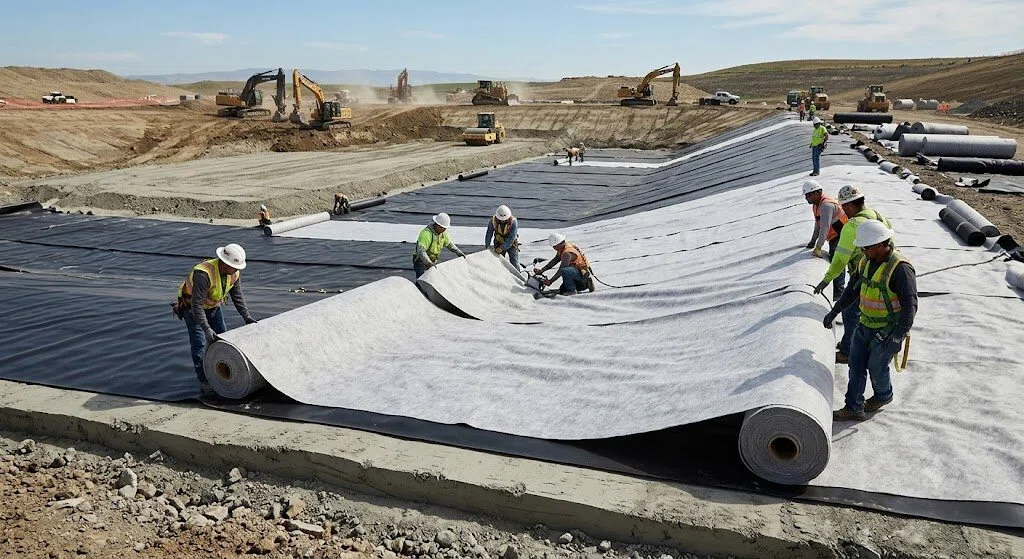
If a geomembrane fails shortly after installation, the liner is not always the problem. In many projects, damage starts underneath the membrane, where sharp stones, crushed aggregate, or uneven subgrade create concentrated pressure points. Once construction equipment or overlying materials apply additional load, small punctures can quickly develop into leaks.
Table of Contents
Why do geomembranes fail on rocky or uneven subgrades?
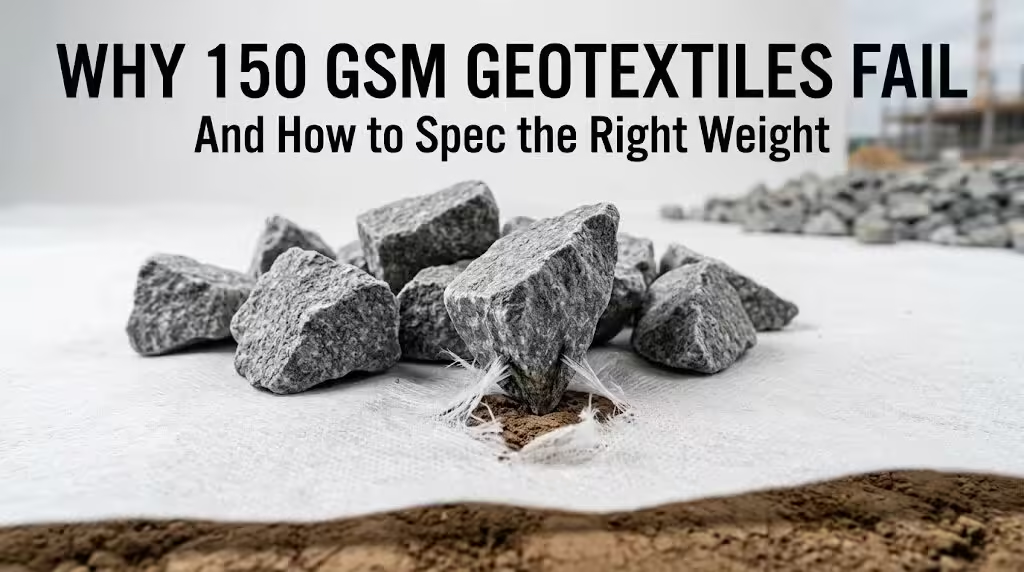
Most geomembranes are designed to provide containment, not absorb concentrated impact from sharp aggregate. Even a thick HDPE liner can be punctured if the load is transferred through angular stones beneath it.
Failure usually results from several conditions acting together:
- Poor subgrade preparation
- Sharp crushed rock
- Heavy construction traffic
- Thin or unsuitable protection geotextiles
- Localized stress concentrations
This is why many landfill and mining specifications require a geotextile protection layer between the geomembrane and the subgrade.
What does CBR Puncture Strength actually measure?
Many buyers assume puncture resistance simply means “strong fabric.” The CBR puncture test measures something much more specific.
CBR Puncture Strength evaluates the force required for a steel plunger to penetrate a geotextile under controlled laboratory conditions. Unlike tensile testing, it simulates localized loading caused by stones pressing against the protection layer.
The test is standardized under ASTM D6241, which describes the puncture strength of geotextiles and related products using a CBR loading device.
The result helps engineers compare geotextile puncture resistance under concentrated loads instead of distributed loads.
This distinction is important because many field failures occur from point loading rather than overall tension.
CBR Puncture Strength vs Tensile Strength
These two properties are often confused during product selection.
| Property | What it Measures | Typical Application |
|---|---|---|
| Tensile Strength | Resistance to pulling forces | Reinforcement and load distribution |
| CBR Puncture Strength | Resistance to localized penetration | Geomembrane protection over sharp subgrades |
A geotextile with excellent tensile strength may still perform poorly when exposed to sharp aggregate if its puncture resistance is insufficient.
The Wikipedia article on Geotextiles also explains that different mechanical properties serve different engineering functions rather than replacing one another.
How much CBR Puncture Strength is enough for a protection layer?
There is no universal value that works for every project.
The required CBR puncture strength depends on:
- Aggregate size
- Aggregate shape
- Overburden pressure
- Geomembrane thickness
- Construction equipment
- Long-term loading conditions
| Project Type | Typical Risk Level | Recommended Focus |
|---|---|---|
| Decorative pond | Low | Moderate puncture resistance |
| Irrigation reservoir | Medium | Balance puncture resistance and cushioning |
| Landfill liner | High | High CBR puncture strength and thicker nonwoven geotextile |
| Mining heap leach pad | Very High | High puncture resistance with engineered protection design |
Rather than selecting the heaviest geotextile available, engineers evaluate the interaction between the geotextile, the geomembrane, and the subgrade.
The United States Environmental Protection Agency (EPA) discusses liner systems and protective layers in landfill engineering guidance, emphasizing that system design should consider expected loading conditions instead of relying on a single material property.
Can a thicker geotextile always provide better puncture protection?
Not necessarily.
Increasing geotextile mass can improve puncture resistant geotextile performance, but thickness alone does not guarantee better protection.
Experienced engineers also evaluate:
- Fiber structure
- Manufacturing process
- Compression behavior
- Load distribution capability
- Installation conditions
In some projects, a well-designed nonwoven geotextile with optimized mechanical properties performs better than a heavier product with lower structural stability.
This is why many specifications evaluate geotextile mechanical properties as a complete package instead of comparing only GSM or thickness.
According to the Federal Highway Administration (FHWA) Geosynthetics Engineering Manual, selecting geotextiles should consider puncture resistance together with installation conditions, survivability, and expected service loads.
How do engineers choose geotextiles for geomembrane protection?
Selecting a geotextile protection layer is not simply about choosing the highest weight or the largest thickness. The correct choice depends on how the geotextile will interact with the geomembrane, subgrade, and external loading conditions.
For projects where sharp aggregate is present, engineers usually evaluate:
- CBR Puncture Strength
- Material weight (GSM)
- Thickness under pressure
- Elongation capacity
- Fiber structure
- Installation survivability
A protection geotextile must absorb localized pressure and distribute stress before it reaches the geomembrane.
For example, a landfill liner installed over crushed rock faces a different risk compared with a pond liner placed on prepared soil. The same geotextile specification may not work for both applications.
What mistakes reduce geomembrane puncture protection?
Many liner failures are not caused by incorrect geomembrane selection. They often happen because the protection layer is underestimated during design or installation.
Common mistakes include:
Choosing tensile strength instead of puncture resistance
Tensile strength shows how a material handles pulling forces. It does not directly indicate how well it resists a sharp object pressing through the surface.
For geomembrane protection, geotextile puncture resistance is usually the more relevant property.
Installing over insufficiently prepared subgrade
Even a strong geotextile may not fully protect a liner if the subgrade contains:
- Large angular stones
- Construction debris
- Sharp metal fragments
- Uneven protrusions
Proper ground preparation reduces concentrated stress before it reaches the protection layer.
Ignoring construction conditions
The installation stage can create unexpected loading.
Examples include:
- Heavy machinery driving over the liner system
- Aggregate placement from height
- Workers moving equipment across exposed materials
The geotextile must provide enough protection during both installation and long-term operation.
Where are CBR puncture strength geotextiles commonly used?
A high puncture resistance geotextile is commonly specified in applications where a geomembrane needs protection from mechanical damage.
Landfill liner systems
Landfills are one of the most demanding applications.
Protection layers must withstand:
- Waste placement pressure
- Construction equipment movement
- Irregular subgrade conditions
A failure in the liner system may lead to leakage concerns, which is why landfill designs often include protective geotextiles above and below geomembranes.
Mining heap leach pads
Mining applications create unique challenges because the liner system supports large material loads.
Important factors include:
- Sharp ore particles
- Heavy equipment operation
- Long-term compression
In these conditions, selecting the correct puncture resistant geotextile can help reduce damage during installation and operation.
Water containment projects
Reservoirs, canals, and irrigation ponds also use geotextile protection layers.
Typical applications include:
- HDPE geomembrane liners
- Canal lining systems
- Artificial lakes
The protection layer helps prevent damage from stones and uneven ground movement.
How does CBR Puncture Strength improve geomembrane service life?
The purpose of CBR Puncture Strength is not to make a geotextile act as the primary barrier. The geomembrane still provides the containment function.
The geotextile works as a mechanical buffer.
It helps by:
- Reducing direct contact between sharp particles and the liner
- Spreading concentrated loads over a wider area
- Absorbing installation-related stresses
- Improving the survivability of the liner system
For engineers, the key question is not:
“Which material has the highest strength?”
The better question is:
“Which protection layer matches the actual damage risk of this project?”
Final Thoughts
Geomembrane damage often begins beneath the liner, where sharp aggregate creates concentrated stress points. Selecting the correct protection layer before installation can prevent costly repairs and extend the service life of containment systems.
By understanding CBR Puncture Strength, engineers can better evaluate geotextile puncture resistance, match materials to site conditions, and reduce the risk of sharp subgrade damage.
For landfill, mining, water containment, and infrastructure projects, CBR Puncture Strength remains an important indicator when choosing geotextiles designed to protect geomembranes from mechanical damage.
FAQ
What is CBR puncture strength?
CBR puncture strength measures the force required to puncture a geotextile using a standard plunger test. It indicates resistance against concentrated penetration loads.
Why is CBR puncture strength important for geomembranes?
Because sharp stones and uneven subgrades can damage geomembranes. A geotextile with suitable puncture resistance reduces this risk.
Is higher GSM always better for geomembrane protection?
No. GSM is only one factor. Fiber structure, puncture resistance, and project conditions also affect performance.
What is the difference between tensile strength and puncture strength?
Tensile strength measures resistance to pulling forces, while puncture strength measures resistance against localized penetration.
Which industries use puncture resistant geotextiles?
Common applications include landfill liners, mining containment systems, reservoirs, canals, and other geomembrane protection projects.