
Geotextile for Road Construction: How to Choose the Right Fabric Before Your Project Fails
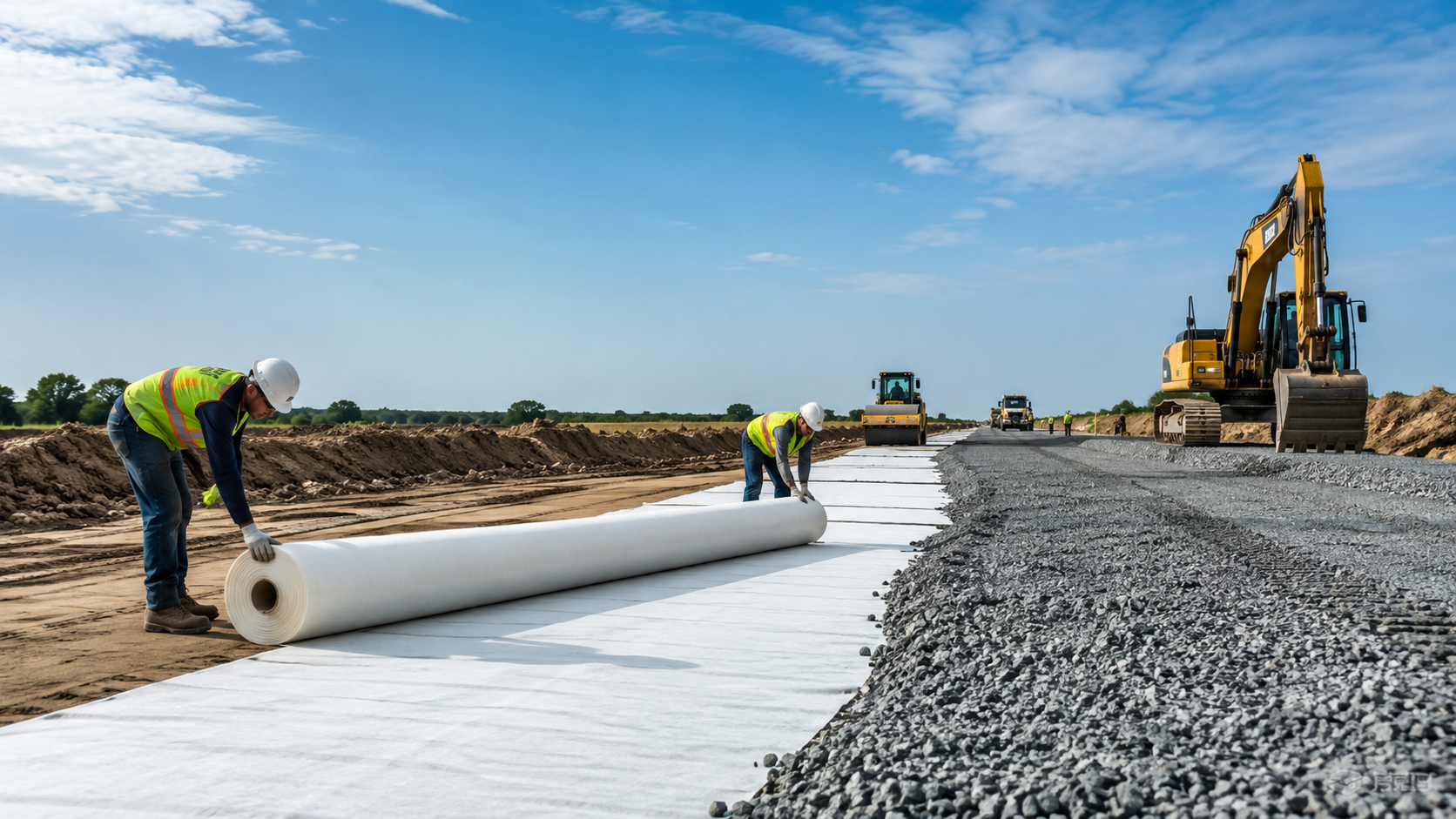
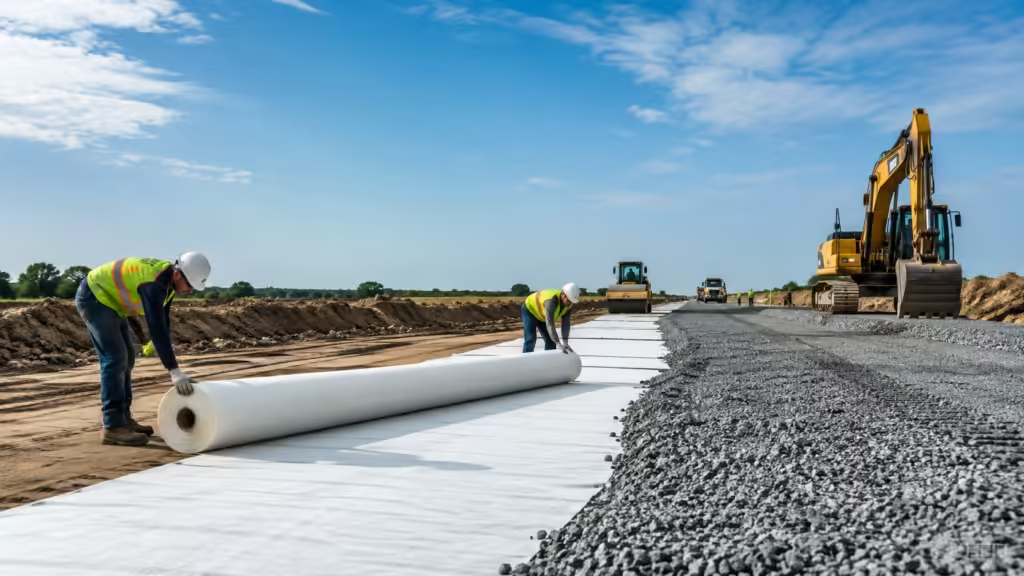
Geotextile for road construction should not be selected by GSM weight alone. The correct fabric depends on what problem the road project needs to solve: separating soil layers, improving drainage, stabilizing weak subgrade, or surviving heavy construction loads.
Many road failures start below the surface. When fine soil mixes with aggregate, water cannot move properly, or the subgrade cannot support construction equipment, the pavement structure may deteriorate much earlier than expected.
Table of Contents
What problem is the geotextile solving under the road?
Before comparing woven and nonwoven geotextiles, start with the failure risk.
A road foundation usually fails because of one or more of these issues:
Soil contamination
Fine particles from the subgrade migrate into the aggregate layer.
The result:
- reduced drainage
- weaker base layer
- uneven settlement
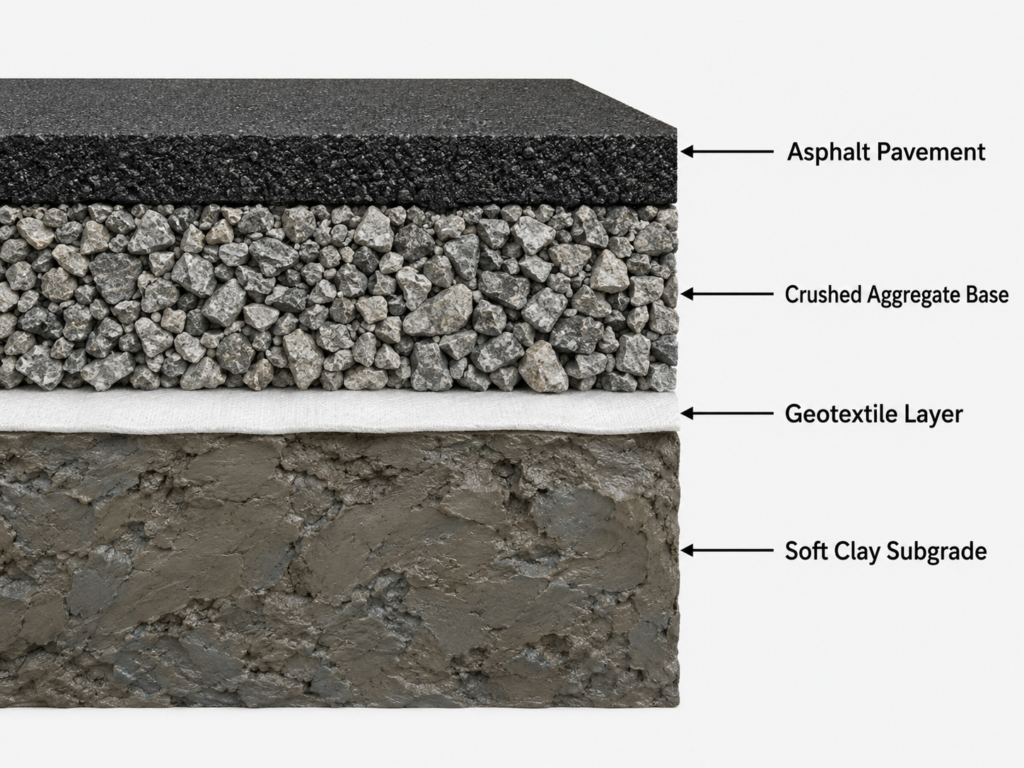
In this case, the geotextile works as a separation layer.
The Federal Highway Administration (FHWA) Geotextile Design & Construction Guidelines explain that geotextiles in transportation applications are commonly used to separate soil layers, provide filtration, and improve roadway performance.
Weak and wet subgrade
Clay, silty soil, and saturated ground create another challenge.
Typical symptoms:
- wheel rutting
- pumping of fine soil
- construction equipment getting stuck
Here, the requirement changes.
The fabric needs stronger resistance against installation damage and may need reinforcement capability.
The Washington State Department of Transportation (WSDOT) Geosynthetics Design Manual explains that roadway geotextile selection depends on whether the application requires separation, stabilization, filtration, or drainage.
Poor drainage conditions
Water trapped inside the road structure can accelerate failure.
For drainage-related applications, permeability and filtration become more important than simply choosing a heavier fabric.
A common mistake is selecting a geotextile because it has a higher GSM while ignoring whether water can pass through correctly.
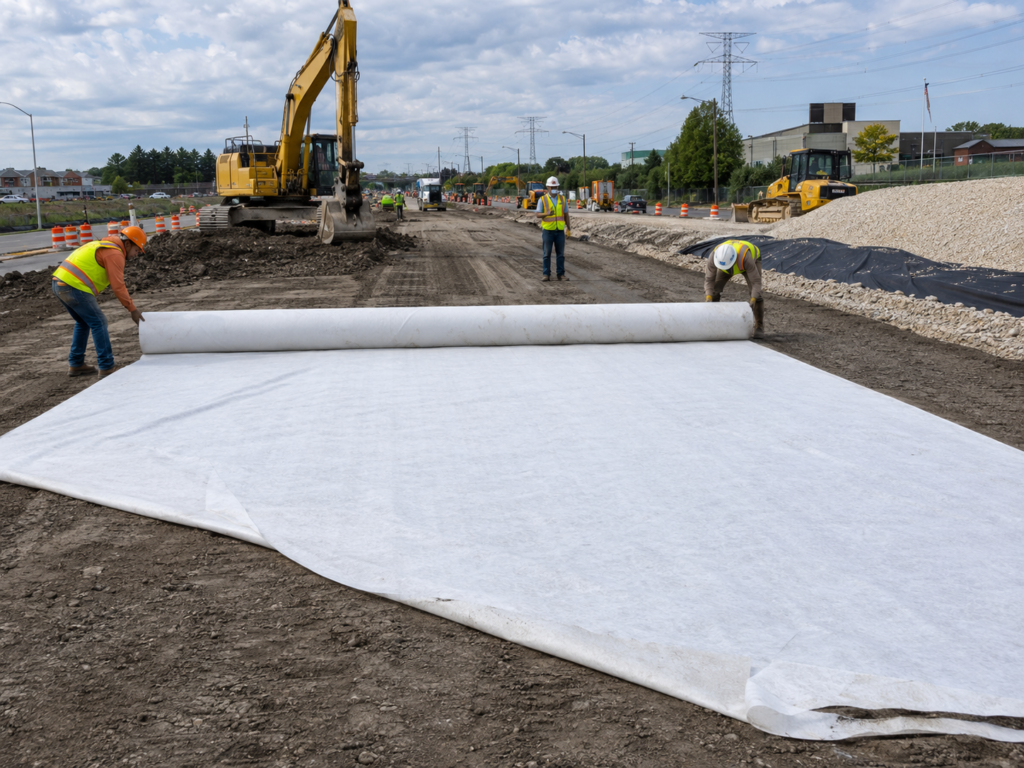
Which type of geotextile is used for road construction?
There is no universal answer.
The correct choice depends on whether the project needs:
- reinforcement
- separation
- filtration
- drainage
This is why engineers usually evaluate woven vs nonwoven geotextile for road construction based on function rather than appearance.
When should you choose woven geotextile for roads?
A woven geotextile is commonly considered when the project requires higher tensile strength and reinforcement.
Typical applications:
- heavy traffic roads
- access roads
- weak subgrade stabilization
- aggregate reinforcement
Woven fabrics are manufactured by interlacing yarns, creating a structure that can provide higher tensile performance.
The University of Texas Center for Transportation Research roadway geotextile guide discusses how high-strength woven geotextiles are commonly used in roadway reinforcement and stabilization applications.
A woven geotextile may be suitable when the main question is:
How can we improve the load distribution over weak soil?
When should you choose nonwoven geotextile for roads?
Nonwoven geotextiles are commonly selected when filtration and drainage are the main requirements.
Typical applications:
- drainage layers
- soil filtration
- erosion control
- separation applications
Their needle-punched structure allows water movement while limiting soil migration.
For drainage-focused projects, engineers usually review:
- permeability
- apparent opening size (AOS)
- soil compatibility
The Geosynthetic Research Institute specification resources emphasize that geotextile selection should consider filtration behavior, soil retention, and durability rather than only material weight.
If you need to compare different woven and nonwoven options for a specific project, you can review EcoGeo’s geotextile product range and match the fabric type with your engineering requirement.
Do you need geotextile under a gravel road?
For many gravel road projects, the answer is yes — especially when the soil underneath is weak or moisture-sensitive.
A gravel road without geotextile may experience:
- aggregate sinking into soft soil
- rut formation
- loss of gravel thickness
- repeated maintenance costs
However, not every gravel road requires geotextile.
A dense granular subgrade with good drainage may not need the same solution as:
- clay soil
- organic soil
- wet silty soil
The University of Minnesota transportation research report on geotextiles for unpaved roads notes that geotextiles have been successfully used for reinforcement and separation in unpaved road applications, but material selection and installation conditions are critical.
A practical decision:
| Road condition | Recommended consideration |
|---|---|
| Dense granular soil | May not require geotextile |
| Wet clay subgrade | Separation and stabilization |
| Soft soil with heavy vehicles | Higher-strength geotextile |
| Gravel road with pumping issues | Separation fabric |
How do you choose geotextile based on soil conditions?
Soil is one of the most important factors in geotextile selection.
Clay or silty soil
Challenges:
- low drainage
- poor bearing capacity
- soil migration
Common requirements:
- filtration
- separation
- installation resistance
Sandy soil
Main concern:
preventing aggregate and soil mixing while maintaining water flow.
Important properties:
- AOS
- permeability
Very soft subgrade
Examples:
- peat
- saturated clay
- marsh areas
The project may require stronger reinforcement consideration rather than a simple separation layer.
This is why the question:
What is the best geotextile for road base stabilization?
cannot be answered without knowing soil conditions.
Should you select geotextile by GSM or engineering performance?
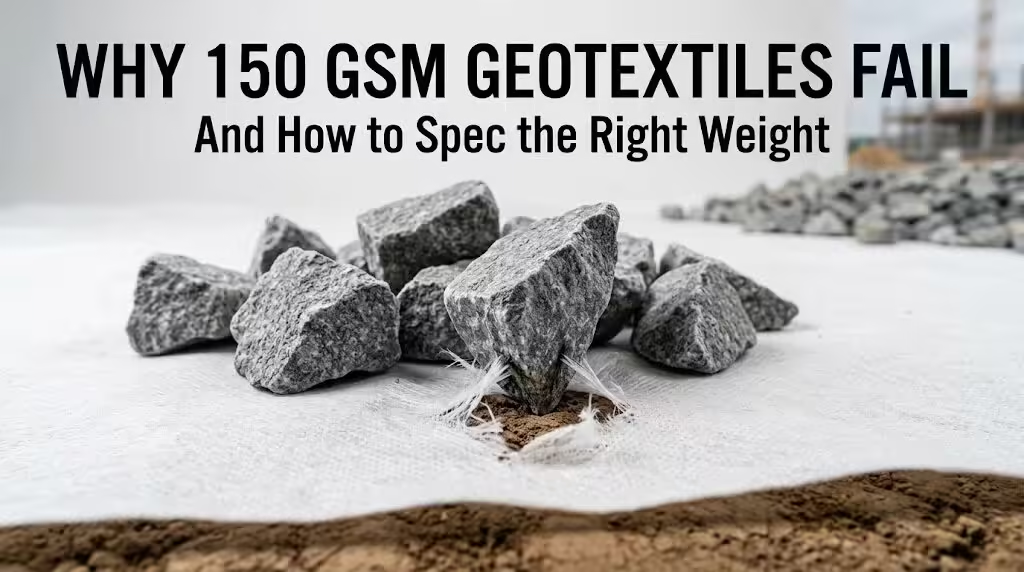
GSM is useful, but it should not be the first selection factor.
A heavier geotextile is not automatically better.
Engineers usually check:
Tensile strength
Important for reinforcement and load distribution.
Puncture resistance
Important when construction involves:
- sharp aggregate
- rough subgrade
- heavy equipment
Apparent Opening Size (AOS)
Controls soil retention.
Permittivity
Shows how easily water passes through the fabric.
The FHWA guidelines and ASTM-related geotextile testing methods emphasize that properties such as tensile strength, filtration characteristics, and survivability should match the intended application.
The ASTM D4751 standard information explains the test method used for determining apparent opening size of geotextiles.
So when a supplier provides specifications, do not only ask:
“Is it 300gsm or 400gsm?”
Ask:
- What is the tensile strength?
- What is the puncture resistance?
- What is the AOS?
- Is it suitable for my soil condition?
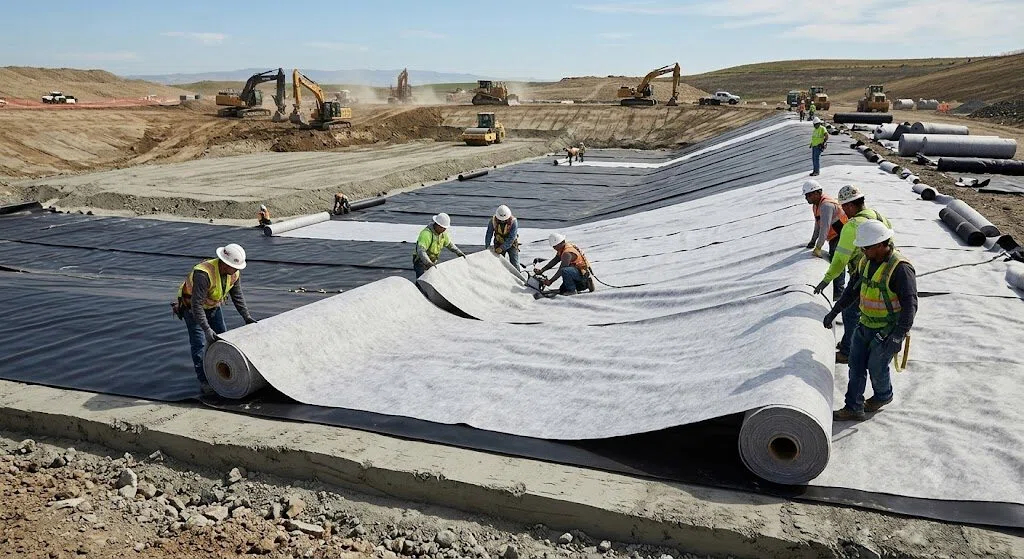
What installation mistakes cause geotextile failure?
Even the correct fabric can fail if installation is poor.
Common problems include:
Incorrect overlap
Insufficient overlap can create weak points between rolls.
Wrinkles and folds
The fabric should be placed flat against the prepared surface.
Damage during aggregate placement
Sharp stones or careless equipment movement can reduce performance.
The FHWA guidelines highlight that installation survivability is an important part of geotextile design.
What Should You Check Before Ordering Geotextile for Road Construction?
A common mistake in geotextile purchasing is sending a supplier only one requirement:
“We need 300gsm geotextile for a road project.”
That information is not enough.
A 300gsm fabric may perform well in one application and fail in another because road conditions are determined by:
- subgrade soil
- traffic loading
- drainage conditions
- aggregate size
- installation method
Before ordering geotextile for road construction, contractors should prepare the engineering requirements first and then match the fabric.
What information should you provide when buying road geotextile?
A professional quotation should be based on project conditions, not only fabric weight.
Before contacting a supplier, prepare the following information.
1. Road type and expected loading
A temporary access road for construction equipment and a permanent highway foundation have completely different requirements.
Important questions:
- Is it a temporary or permanent road?
- Will trucks or heavy equipment pass regularly?
- What is the expected traffic volume?
- Is the road paved or unpaved?
For example:
A gravel access road with heavy trucks may require stronger separation and stabilization performance compared with a low-traffic farm road.
2. Subgrade soil condition
Soil is one of the biggest factors affecting geotextile selection.
Provide:
- soil type
- moisture condition
- compaction level
- bearing capacity if available
Typical situations:
| Soil Condition | Main Concern |
|---|---|
| Clay soil | Poor drainage and pumping |
| Silty soil | Fine particle migration |
| Sandy soil | Filtration and separation |
| Soft wet soil | Stabilization and reinforcement |
A geotextile for weak subgrade should be selected based on the actual soil problem.
3. Required geotextile function
Do not choose fabric before deciding what it needs to do.
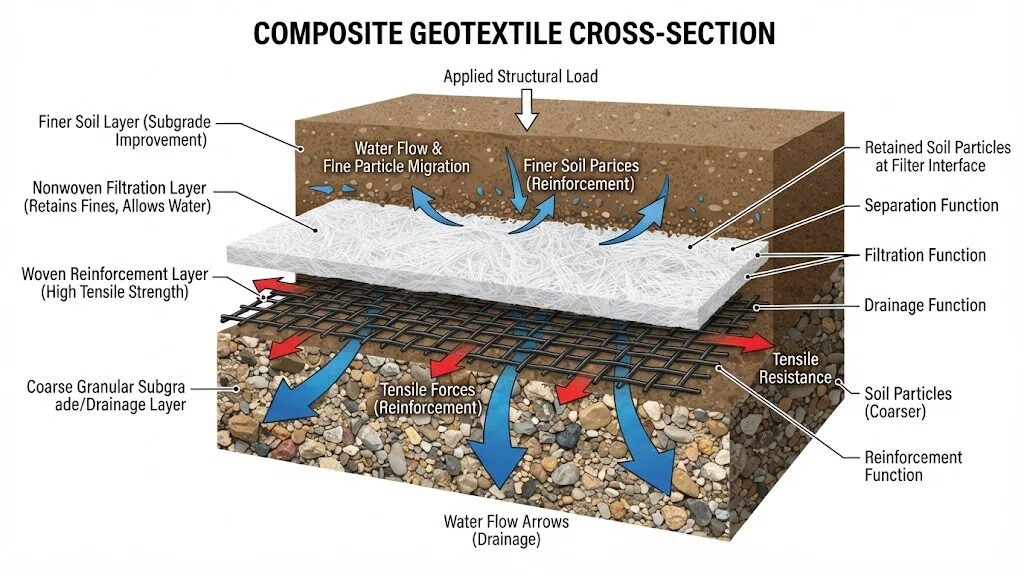
A road geotextile normally performs one or more functions:
Separation
Prevents mixing between:
- subgrade soil
- aggregate base
Filtration
Allows water movement while retaining soil particles.
Drainage
Helps maintain water flow through the structure.
Reinforcement
Improves load distribution over weak soil.
The International Geosynthetics Society (IGS) specification guide explains that geotextile specifications should consider application requirements such as tensile strength, puncture resistance, and durability rather than relying on a single property.
How can contractors compare geotextile supplier specifications?
When comparing suppliers, many buyers focus only on:
- price per square meter
- GSM
- roll size
These are important, but they do not tell the complete story.
A proper technical comparison should include:
Tensile strength
Important for:
- reinforcement applications
- heavy traffic roads
- weak soil stabilization
Higher tensile strength does not automatically mean better.
The question is:
Does the fabric have enough strength for the expected load?
Puncture resistance
During installation, geotextile may contact:
- sharp aggregate
- rocks
- construction equipment
A fabric with insufficient puncture resistance can be damaged before the road is even completed.
Apparent Opening Size (AOS)
AOS determines whether the geotextile can retain soil while allowing water movement.
It is especially important for:
- drainage systems
- filtration applications
ASTM D4751 provides the test method for measuring apparent opening size of geotextiles.
Permittivity
Permittivity measures how easily water passes through the geotextile.
For drainage-related projects, a strong fabric with poor hydraulic performance may not be the right choice.
Should you buy woven or nonwoven geotextile for road construction?
This is one of the most common questions from contractors.
The answer depends on the role of the fabric.
Choose woven geotextile when reinforcement is important
Typical applications:
- heavy-duty roads
- haul roads
- weak subgrade stabilization
- high load areas
Woven geotextiles generally provide higher tensile strength and better reinforcement behavior.
Choose nonwoven geotextile when filtration is the priority
Typical applications:
- drainage layers
- soil filtration
- erosion control
- separation applications
Nonwoven geotextiles allow water movement through their needle-punched structure.
A simple decision:
| Project Requirement | More Suitable Option |
|---|---|
| Load distribution | Woven geotextile |
| Weak soil stabilization | High-strength woven |
| Drainage | Nonwoven geotextile |
| Filtration | Nonwoven geotextile |
| General separation | Depends on soil and design |
If you need to compare different material structures, EcoGeo’s geotextile product range includes different woven and nonwoven options for civil engineering applications.
What mistakes should you avoid when selecting road geotextile?
Choosing only by GSM
A heavier fabric is not always the correct fabric.
A 500gsm nonwoven and a 500gsm woven product may serve completely different purposes.
Ignoring installation conditions
A geotextile may meet laboratory requirements but fail during construction if:
- aggregate is too sharp
- equipment damages the fabric
- overlap is insufficient
Using the wrong fabric function
Example:
A drainage-focused nonwoven geotextile may not replace a reinforcement woven geotextile under heavy traffic.
The fabric must match the engineering problem.
Not testing with actual soil conditions
For large projects, laboratory testing or field trials can prevent expensive mistakes.
Road Geotextile Buying Checklist for Contractors
Before requesting a quotation, prepare:
✓ Road application
✓ Soil type
✓ Traffic load
✓ Required function
✓ Woven or nonwoven preference
✓ Tensile strength requirement
✓ Puncture resistance requirement
✓ AOS requirement
✓ Permeability requirement
✓ Roll width and installation method
This information allows suppliers to recommend a suitable fabric instead of simply offering the lowest-cost option.
Selecting the Right Fabric Before Construction Starts
he best geotextile for road construction is not the heaviest fabric or the cheapest quotation.
It is the material that matches:
- the soil beneath the road,
- the expected traffic load,
- the required engineering function,
- and the installation environment.
A good selection process starts with understanding the failure risk first.
Once you know whether the project needs separation, drainage, filtration, or stabilization, choosing the right geotextile becomes much more straightforward.
FAQ
What type of geotextile is best for road construction?
It depends on the purpose. Woven geotextiles are commonly used for reinforcement, while nonwoven geotextiles are often selected for filtration and drainage.
Do I need geotextile under a gravel road?
If the soil is weak, wet, or contains fine particles that can mix with gravel, geotextile is often beneficial. Stable granular soil may not require it.
Is higher GSM geotextile always better?
No. Engineering properties such as tensile strength, AOS, permeability, and puncture resistance are more important than GSM alone.
How long does geotextile last under roads?
Service life depends on polymer type, soil conditions, installation quality, and environmental exposure.
Can woven and nonwoven geotextile be used together?
Yes. Some projects combine different geosynthetics when both reinforcement and filtration functions are required.