
Composite Geotextile Tensile Strength: How to Choose the Right Reinforcement Performance for Geotechnical Projects
Choosing a composite geotextile is not only about checking weight, thickness, or appearance. For reinforcement projects, composite geotextile tensile strength is one of the key values that determines whether the material can resist pulling forces, maintain soil stability, and perform under construction loads.
Many project failures are not caused by the geotextile itself, but by selecting a product with unsuitable tensile properties for the actual site conditions. A road base, landfill liner, slope stabilization system, or drainage layer may require very different strength levels.
This guide explains how tensile strength is measured, which factors influence composite geotextile strength, how engineers interpret test data, and how to choose the right specification for different applications.
Table of Contents
What Does Composite Geotextile Tensile Strength Actually Measure?
Composite geotextile tensile strength refers to the maximum pulling force a geotextile composite material can withstand before breaking. It is usually expressed in kN/m (kilonewtons per meter) and indicates the reinforcement capacity of the material when subjected to tension.
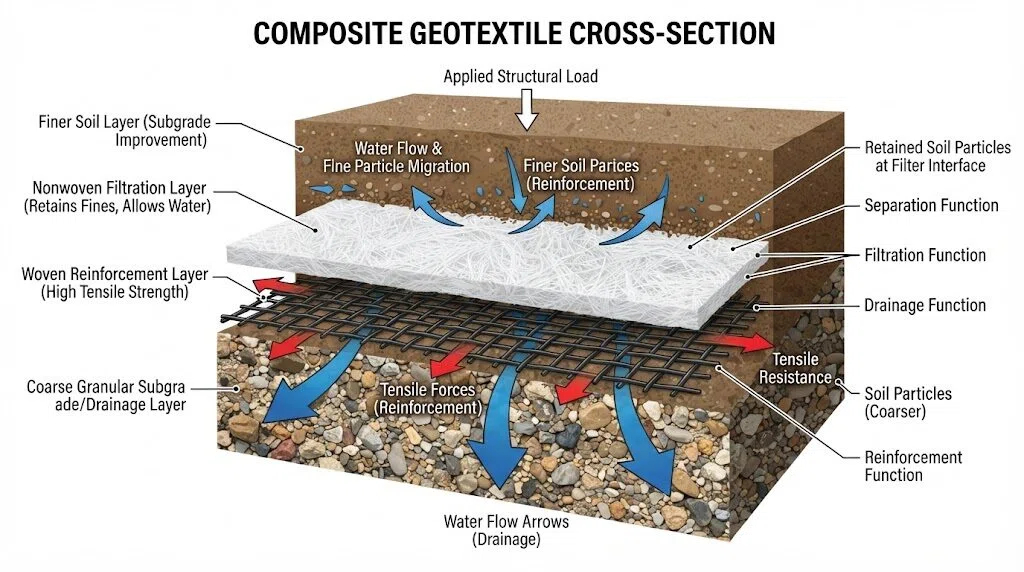
Unlike simple filtration fabrics, composite geotextiles usually combine multiple layers, such as:
- woven geotextile reinforcement layers
- nonwoven geotextile filtration layers
- geomembrane or drainage components
The combination allows the material to handle both mechanical stress and hydraulic functions.
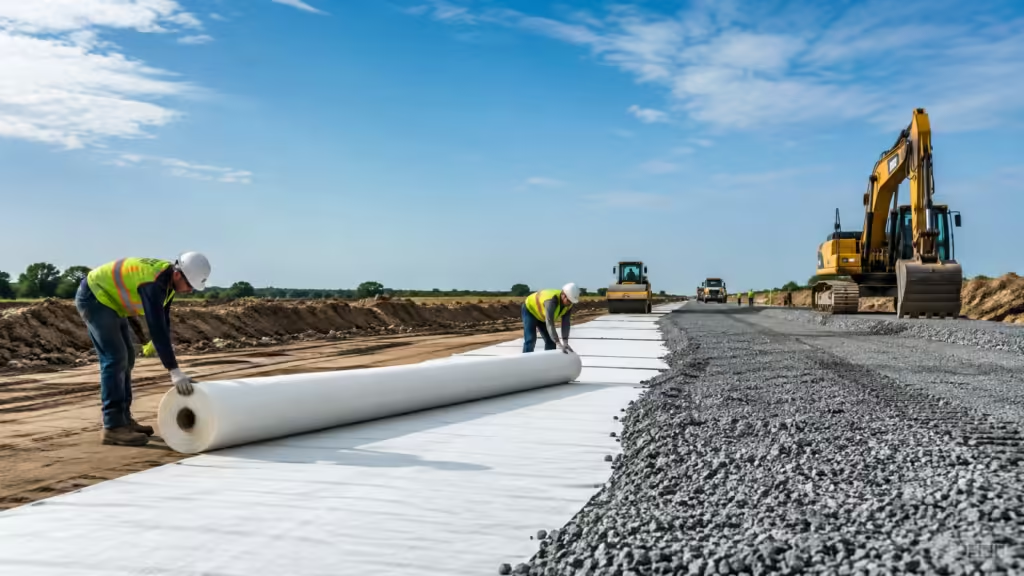
For example, in a road construction project, heavy vehicle loads create pressure that transfers into the soil structure. A composite geotextile with suitable tensile strength helps distribute these stresses and reduces excessive deformation.
According to the Federal Highway Administration (FHWA) geosynthetics engineering guidance, geosynthetic materials are commonly used in transportation projects for reinforcement, separation, drainage, and erosion control because their mechanical properties directly affect structural performance.
Why Does Tensile Strength Matter in Road and Soil Reinforcement Projects?
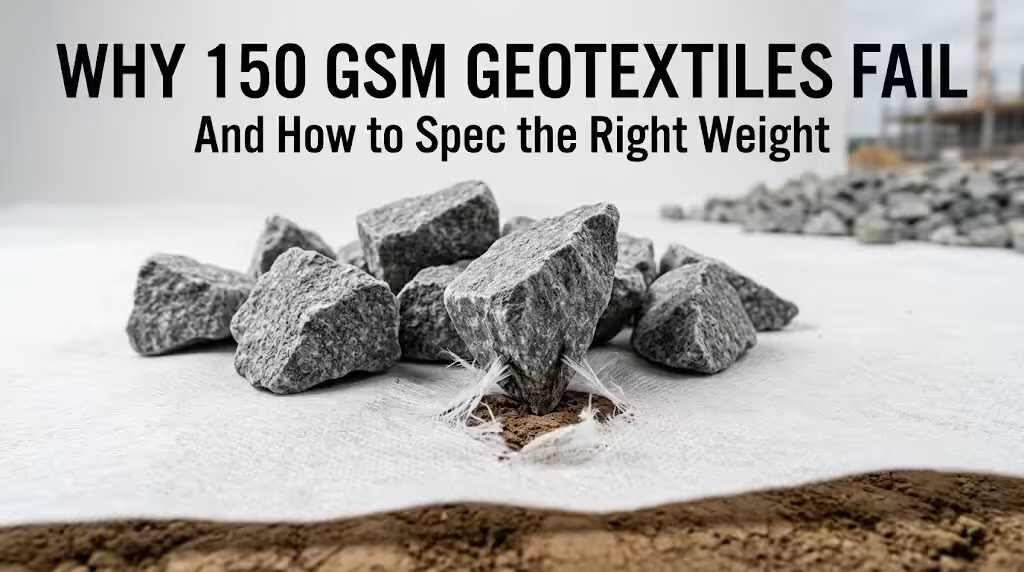
A common misunderstanding is that a heavier geotextile automatically provides better reinforcement. Weight and thickness can provide basic information, but they do not directly show how the material performs under tension.
The geotextile tensile strength test provides engineers with measurable data to evaluate whether a material can handle expected forces.
1.Reducing soil movement under repeated loads
In road construction, repeated traffic loads can cause:
- soil displacement
- rutting
- uneven settlement
A composite geotextile placed between soil layers creates a reinforcement effect. The tensile capacity helps limit lateral movement and improves load distribution.
For example:
A highway built on weak subgrade soil may require a stronger reinforcement geotextile than a pedestrian pathway because vehicle loads create significantly higher stress.
2.Improving stability in slopes and embankments
Slope failures often occur when soil particles move along weak planes.
Composite geotextiles used in slope stabilization need enough tensile resistance to:
- hold soil structures together
- esist shear movement
- maintain stability during rainfall or changing groundwater conditions
The required strength depends on:
- slope angle
- soil type
- expected loading
- project lifespan
Engineers normally evaluate these factors through geotechnical calculations rather than selecting materials only by thickness.
3.Protecting landfill and containment systems
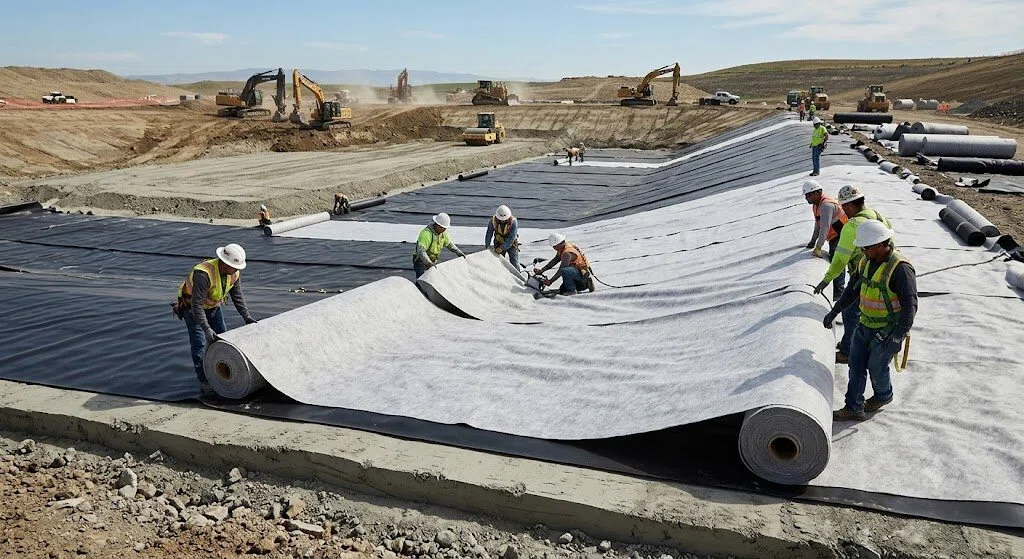
Landfill projects require materials that can withstand installation stress and long-term soil pressure.
During installation, sharp stones or construction equipment can create tension and puncture risks.
A composite geotextile specification for landfill applications usually considers:
- tensile strength
- puncture resistance
- chemical exposure
- long-term creep behavior
The United States Environmental Protection Agency (EPA) landfill liner technical resources provide information about landfill containment systems and the importance of engineered barrier components.
How Is Geotextile Tensile Strength Tested According to ASTM Standards?
The reported strength value on a specification sheet is only meaningful when the testing method is clear.
Different test methods measure different types of tensile behavior.
ASTM D4595 wide width tensile test
The ASTM D4595 geotextile tensile strength test is one of the most widely referenced methods for evaluating tensile properties.
This test measures the force required to break a wide specimen under controlled pulling conditions.
It provides information about:
- maximum tensile strength
- elongation at break
- stress-strain behavior
The ASTM D4595 standard overview explains the testing method used for determining wide-width tensile properties of geotextiles.
For large-scale reinforcement projects, wide width tensile testing is often preferred because it better represents the behavior of geotextiles installed in the field.
Grab tensile strength testing
Another commonly used method is the grab tensile test.
The difference between:
Grab tensile strength vs wide width tensile strength
is mainly related to how the force is applied.
| Test Method | Main Purpose | Typical Use |
|---|---|---|
| Grab tensile test | Measures localized tensile resistance | Quality control and product comparison |
| Wide width tensile test | Measures full-width tensile behavior | Engineering design and reinforcement evaluation |
What Tensile Strength Values Should Engineers Look For?
There is no single tensile strength number that fits every project.
A common mistake is asking:
“Which composite geotextile has the highest tensile strength?”
The better question is:
“What tensile strength is required for this application?”
Typical considerations include:
| Application | Main Tensile Requirement |
|---|---|
| Road base reinforcement | Resistance against traffic loading and soil deformation |
| Slope stabilization | Resistance against soil movement |
| Landfill systems | Long-term strength retention and installation resistance |
| Drainage applications | Balance between strength and permeability |
| Mining projects | Resistance against heavy loading and harsh conditions |
The material selection should match the engineering requirement, not simply choose the highest specification available.
What Factors Change the Strength of a Composite Geotextile?
The tensile performance of a composite geotextile depends on more than the final product weight. The structure, raw materials, manufacturing process, and installation environment all influence how the material behaves after being placed underground.
Understanding these factors helps buyers avoid selecting a geotextile based only on a specification sheet number.
Material type: polypropylene, polyester, and composite structures
he raw material directly affects tensile behavior.
Polypropylene (PP)
Polypropylene geotextiles are widely used because they provide:
- good chemical resistance
- low moisture absorption
- suitable mechanical strength for many civil applications
They are commonly used in:
- road reinforcement
- drainage systems
- erosion control projects
Polyester (PET)
Polyester generally has a higher tensile modulus compared with polypropylene, which makes it suitable for applications requiring stronger reinforcement performance.
Typical applications include:
- steep slope stabilization
- retaining structures
- heavy-load soil reinforcement
Composite structures
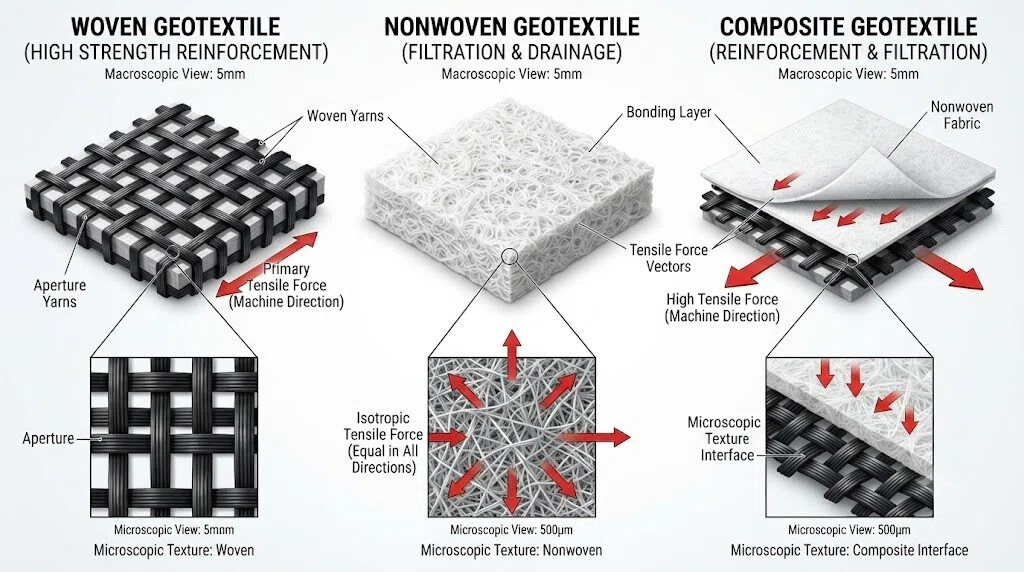
A composite geotextile combines different functions in one material.
For example:
- woven layer → provides tensile reinforcement
- nonwoven layer → improves filtration and protection
This combination allows engineers to address multiple site requirements without installing separate materials.
Manufacturing structure affects reinforcement performance
Two geotextiles with similar weight can perform differently because their internal structures are not the same.
Important structural factors include:
Fiber orientation
Woven geotextiles usually have stronger directional tensile properties because the yarns are arranged in controlled directions.
This is important when the expected load direction is known.
For example:
- road reinforcement → resistance against horizontal movement
- retaining wall applications → resistance against soil pressure
Bonding method
Composite geotextiles may use different bonding methods between layers.
The bonding strength affects whether the layers work together when exposed to stress.
Poor layer bonding can reduce the actual reinforcement effect even if individual layers have acceptable tensile values.
Elongation behavior
Tensile strength should not be considered alone.
Engineers also evaluate:
- elongation at break
- creep resistance
- stress-strain behavior
A material that stretches excessively may not provide the required reinforcement effect in applications where deformation must be controlled.
How Should Buyers Read a Composite Geotextile Specification Sheet?
A specification sheet contains several values, but not every number has equal importance.
When evaluating a composite geotextile specification, buyers should check the following items.
| Parameter | Why It Matters |
|---|---|
| Tensile strength (kN/m) | Shows maximum resistance to pulling force |
| Elongation (%) | Indicates deformation before failure |
| Tear resistance | Helps evaluate installation damage risk |
| Puncture resistance | Important when sharp aggregate exists |
| Permeability | Determines drainage performance |
| UV resistance | Important for exposed installation periods |
A common purchasing mistake is comparing only tensile strength while ignoring elongation or puncture resistance.
For example:
A landfill project may require a balance between tensile strength and puncture resistance because installation damage can affect the entire containment system.
How Do Engineers Select the Right Composite Geotextile for Different Projects?
The correct material selection starts with site conditions rather than product availability.
A practical selection process includes five steps.
1.Identify the expected loading condition
First determine what force the geotextile will experience.
Examples:
Road construction
Main concerns:
- traffic loading
- subgrade weakness
- repeated deformation
A higher tensile reinforcement capability may be required when the soil has low bearing capacity.
Slope stabilization
Main concerns:
- soil sliding force
- rainfall impact
- long-term stability
The geotextile must provide reinforcement in the direction where soil movement is expected.
Drainage and filtration systems
Main concerns:
- water flow
- soil particle retention
- clogging resistance
In these projects, tensile strength is important, but hydraulic performance cannot be ignored.
2.Check engineering standards and project specifications
International projects often refer to recognized testing standards.
Common references include:
- ASTM testing methods
- ISO geosynthetic standards
- project-specific engineering requirements
The International Geosynthetics Society (IGS) technical resources provide industry information related to geosynthetic applications, testing, and design practices.
3.Consider installation conditions
The laboratory tensile value does not represent every field condition.
During installation, materials may experience:
- construction vehicle movement
- aggregate impact
- uneven soil surfaces
- accidental damage
A geotextile used under heavy crushed stone requires different protection characteristics compared with one installed in a controlled drainage layer.
Composite Geotextile vs Traditional Geotextile: Which One Fits Better?
The choice between composite and traditional geotextiles depends on project requirements.
| Feature | Composite Geotextile | Woven Geotextile | Nonwoven Geotextile |
|---|---|---|---|
| Tensile reinforcement | High | High | Moderate |
| Filtration ability | Good | Limited | Excellent |
| Separation function | Excellent | Good | Good |
| Drainage performance | Balanced | Moderate | Excellent |
| Multi-function applications | Strong advantage | Limited | Limited |
Composite materials are often selected when a project requires both reinforcement and filtration functions.
However, if only one function is needed, a traditional geotextile may be more suitable.
Common Mistakes When Choosing Composite Geotextile Tensile Strength
Mistake 1: Choosing the strongest product available
Higher tensile strength does not always mean better performance.
An oversized specification may increase material costs without improving project results.
Mistake 2: Ignoring installation damage
Mistake 2: Ignoring installation damage
A laboratory-tested product may lose performance if it is damaged during placement.
Always consider:
- aggregate size
- construction method
- site conditions
Mistake 3: Comparing products without checking test methods
A tensile value without the testing standard is difficult to compare.
Always confirm:
- ASTM method
- specimen size
- testing direction
- elongation value
Final Thoughts
Selecting the correct material requires more than comparing a single strength number. Engineers need to evaluate tensile performance together with elongation, installation conditions, soil behavior, and project requirements.
For reinforcement applications where soil movement and external loads are critical, understanding composite geotextile tensile strength helps buyers choose materials that match real construction conditions instead of relying only on product labels.
FAQ
What is composite geotextile tensile strength?
It is the maximum pulling force a composite geotextile can withstand before failure, usually measured in kN/m.
How is geotextile tensile strength tested?
Common methods include ASTM D4595 wide width tensile testing and grab tensile testing.
Is higher tensile strength always better?
No. The required strength depends on soil conditions, loading requirements, and project design.
What tensile strength is needed for road construction?
It depends on traffic loads, soil conditions, and engineering design. Road reinforcement projects usually require higher tensile performance than light-duty applications.
Can composite geotextile replace separate reinforcement and filtration layers?
In many projects, yes. Composite geotextiles combine reinforcement and filtration functions, reducing the need for multiple materials.