
Why 150 GSM Geotextiles Fail Under Heavy Aggregate (And How to Spec the Right Weight)
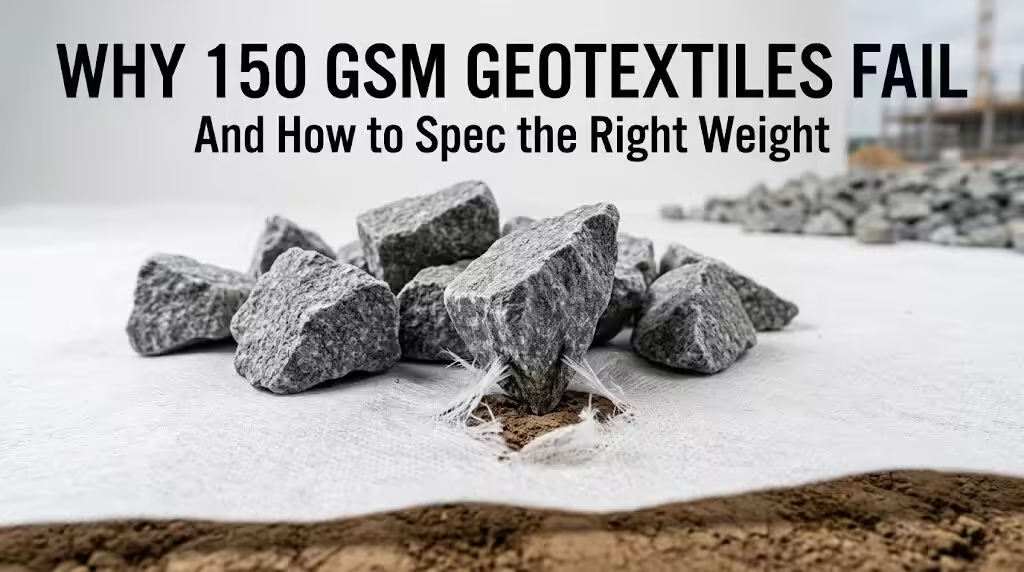
Dumping 75mm blasted quarry stone directly onto a thin filtration fabric instantly ruins your subgrade separation layer before compaction equipment even rolls out. If you under-spec your fabric weight, the aggregate punctures the matrix; if you over-spec, you waste thousands of dollars in unnecessary material overhead across large project acreages.
Table of Contents
What Causes a 150 GSM Fabric to Puncture During Aggregate Dumping?
A 150 gsm (grams per square meter) fabric is primarily engineered for civil drainage filtration and light trenches, not heavy-duty subgrade stabilization. When heavy haul trucks drop sharp, angular aggregate from a height of over one meter, the localized impact stress far exceeds the bursting threshold of low-density polymer structures.
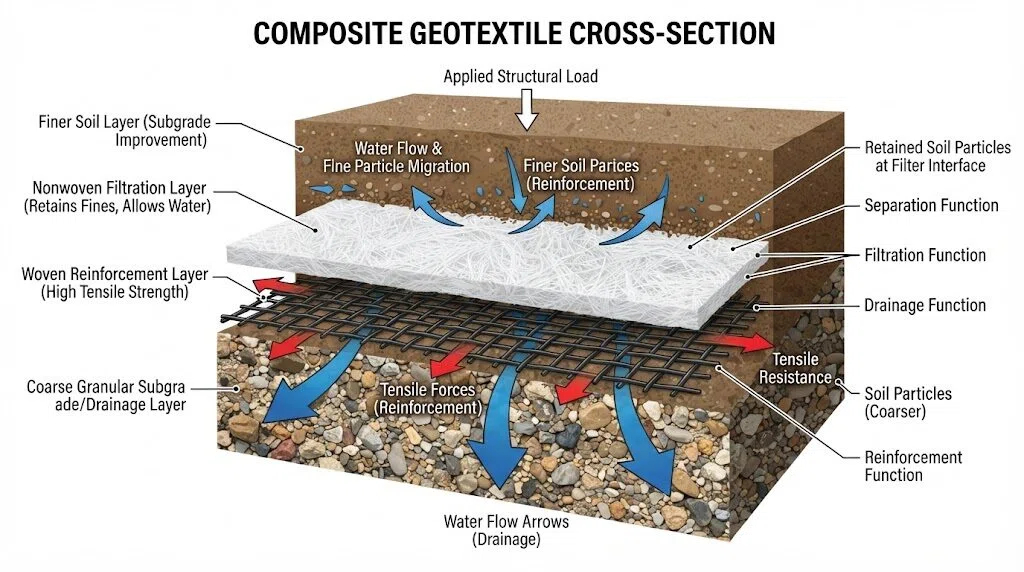
According to the mechanical principles outlined in Wikipedia’s technical breakdown of geotextile separation functions, structural failure occurs when aggregate points pierce the sheet, allowing soft clay silt to pump upward into the clean base stone. This contamination permanently reduces the bearing capacity of your road base, leading to early surface ruts.
How Do You Calculate the Exact Geotextile Weight Per Square Meter Based on CBR Soil Ratings?
Civil procurement teams cannot safely evaluate fabric strength by touch or visual thickness. True mechanical performance depends directly on precise mass-per-unit-area verification. To guarantee consistency across high-volume production batches, manufacturers must test materials using the strict guidelines found in the ASTM D5261 standard test method for measuring mass per unit area of geotextiles.
To match your site’s physical load requirements with the correct fabric weight, use this field-tested allocation framework:
- Subgrades with CBR > 3 (Firm Soil): 150 gsm to 200 gsm works efficiently for separation, provided aggregate sizes remain under 40mm and drop heights are minimized.
- Subgrades with CBR 1 to 3 (Soft, Silty Soils): A minimum of 250 gsm to 300 gsm is mandatory to prevent tearing during the initial lift compaction.
- Subgrades with CBR < 1 (Saturated Mud/Peat): A heavy-duty 400 gsm layer is required to absorb extreme multi-directional stresses and prevent deep mud pumping under heavy tracked machinery.
150 GSM vs. 400 GSM: Which Technical Specifications Drive the Engineering Decision?
Choosing the wrong weight often stems from looking solely at thickness rather than fiber density. The interlocking matrix of short synthetic filaments creates varying friction and filtration profiles depending on the needle-punch density during production. As explored in the technical data hosted on ScienceDirect’s engineering archive regarding staple fiber matrix performance, higher mass weights heavily alter hydraulic parameters.
The following engineering matrix compares the critical mechanical trade-offs you must evaluate before finalizing your purchase order:
| Mechanical Property | 150 GSM (Lightweight Class)150 GSM | 400 GSM (Heavy-Duty Class)400 GSM | Engineering Decision Point |
| Grab Tensile Strength | ~550 N | ~1500 N | Use 400 GSM for high-stress rail or heavy haul roads. |
| CBR Puncture Resistance | ~1500 N | ~4200 N | 150 GSM will tear if aggregates exceed 40mm with angular edges. |
| Water Flow Rate (Permeability) | ~120 $L/m^2/s$ | ~45 $L/m^2/s$ | Select 150 GSM if rapid pore-water pressure dissipation is top priority. |
| Apparent Opening Size (AOS) | 0.08 mm – 0.20 mm | 0.05 mm – 0.12 mm | 400 GSM retains finer silts but chokes faster in high-viscosity muds. |
The data reveals a critical engineering paradox: scaling up to a 400 gsm fabric dramatically boosts puncture resistance, but cuts the water flow rate by more than half. If your primary goal is rapid groundwater dissipation in a retaining wall or trench drain, an over-specified heavy fabric will choke the system, while a 150 gsm fabric provides the ideal flow dynamics.
What Installation Damage Variables Dictate a Heavier Staple Fiber Geotextile Specification?
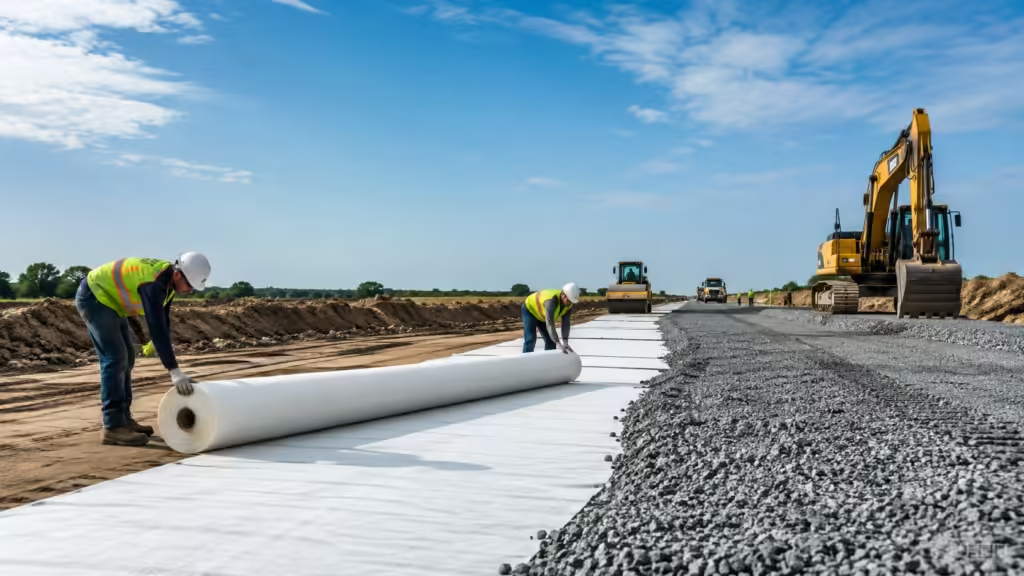
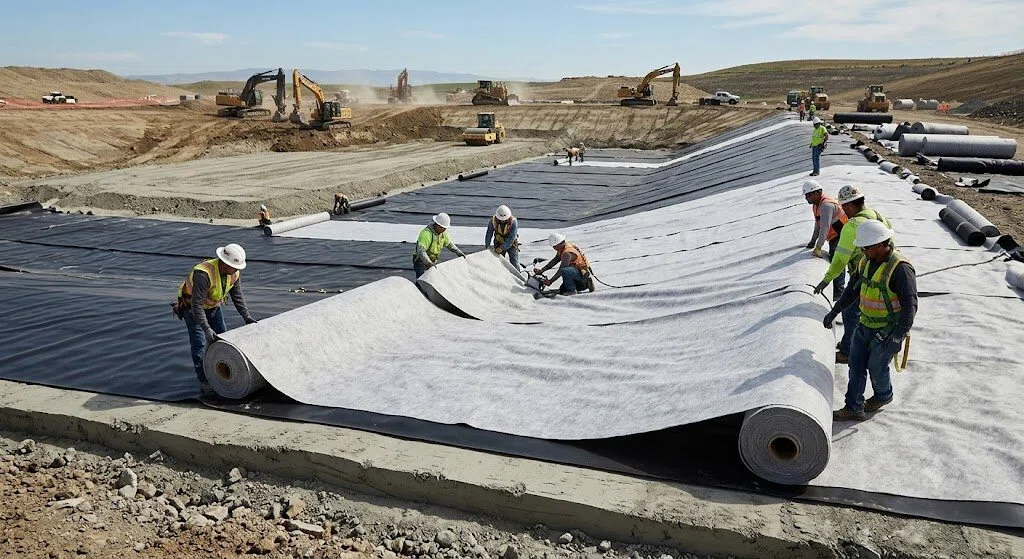
In heavy road construction, the most severe stress occurs during installation, long before the finished pavement experiences vehicle traffic. The weight of heavy tracked bulldozers spreading coarse gravel creates intense localized shear forces along the unrolled sheets.
To account for these dynamic forces, engineers apply severe reduction factors based on field variables. The core calculation methodology found in the ScienceDirect geosynthetics installation damage mitigation reference dictates that if you are using recycled concrete or sharp blasted quarry stone, the installation damage factor triples compared to using rounded river gravel. When these aggressive aggregates are mandatory, down-specifying to save material cost guarantees a ruptured boundary layer.
Selecting the correct material class requires aligning your subgrade soil properties with realistic installation stresses. Under-specifying leads to immediate structural contamination, while over-specifying drains vital project capital. Matching your exact site parameters to a verified staple fiber geotextile ensures your civil infrastructure stands up to cyclic compaction loads without inflating your underlying material costs.
You can access comprehensive technical datasheets and stress-strain curves directly on our staple fiber geotextile product specifications page to find the precise mass allocation for your next deployment.
FAQ
Does fabric thickness indicate true puncture resistance?
No. Thickness can be inflated by loosely rolling the fibers. Always verify the actual weight per square meter (GSM) and the CBR puncture rating in Newtons (N) on the manufacturer’s certified datasheet.
Can staple fiber variants be welded or must they be overlapped?
They can be both hot-air welded or overlapped. For typical road projects, an overlap of 300mm to 500mm is standard, but soft subgrades below CBR 1 require up to 1 meter of unjointed overlap to prevent splitting under load.
Why do edges pull apart during the initial aggregate lift?
This happens when machinery drives directly onto the bare polymer or turns too sharply on the freshly dumped stone layer. This common site failure is a frequent topic of troubleshooting on Reddit’s civil engineering community boards regarding geotextile installation tracking errors, where field superintendents warn that directional spreading errors ruin even the highest-spec fabrics.