
Can Staple Fiber Geotextile Fix Your Soft Subgrade and Stop Differential Settlement?
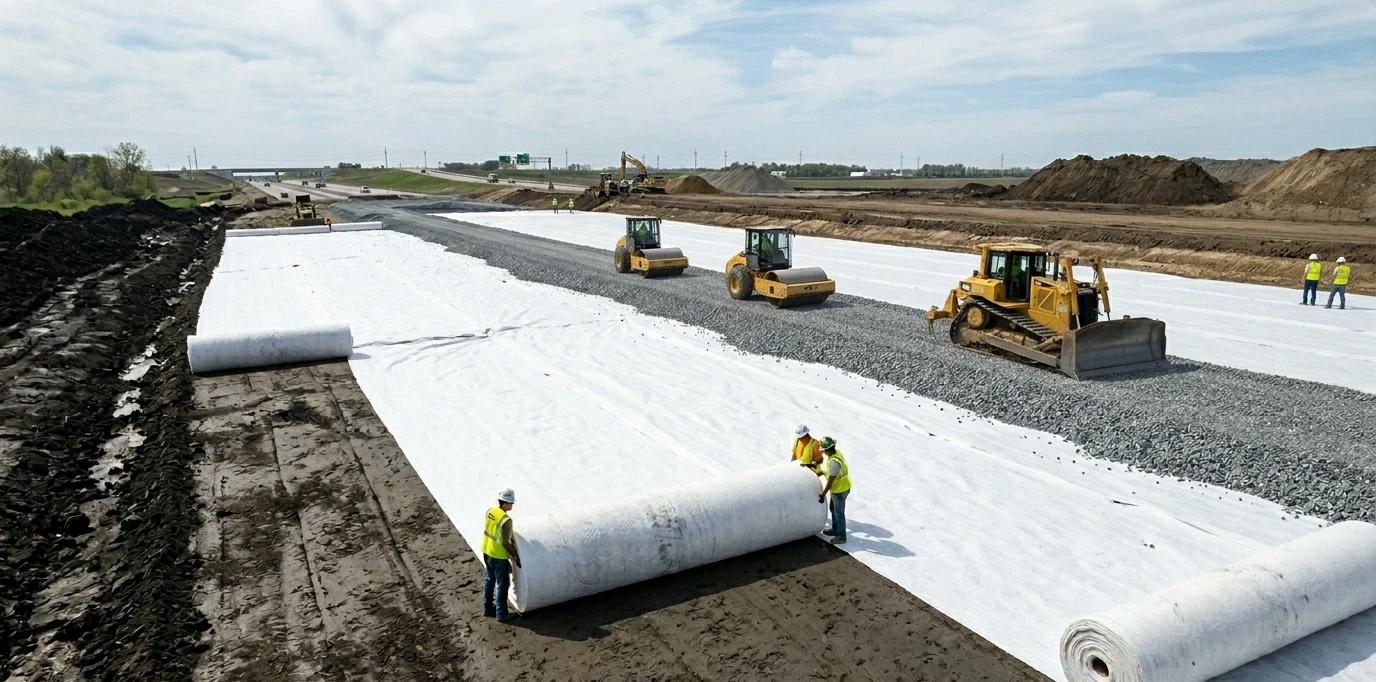
Passing a heavy proof-roll on soft, saturated clay subgrades is a persistent headache for civil contractors and site engineers. When heavy dump trucks and compactors drive over unreinforced weak soil, the expensive base gravel sinks directly into the mud, leading to severe deep ruts and massive material overruns. Integrating an engineered Staple Fiber Geotextile into your civil design resolves this structural failure mode entirely.
By reading this field guide, you will master the exact load-distribution mechanics that prevent base failure, understand how to interpret critical tensile and puncture testing metrics to pass inspection, and learn the practical steps to deploy these materials efficiently under tight deadlines. Utilizing a high-quality Staple Fiber Geotextile allows road crews to minimize aggregate thickness, cut labor costs, and build high-performance pavements that stay flat under the heaviest axle loads.
Table of Contents
Why Weak Soils Fail and How Staple Fiber Geotextile Prevents Rutting
When heavy wheel loads repeatedly stress a weak, unconfined subgrade, the dynamic pore water pressure forces fine clay particles upward into the crushed stone base. This destructive phenomenon, commonly known as mud pumping, rapidly destroys the structural capacity of the road base. Without a reliable mechanical barrier, the uneven bearing capacity of the soil results in localized structural failures, making Preventing differential settlement in road embankments nearly impossible.
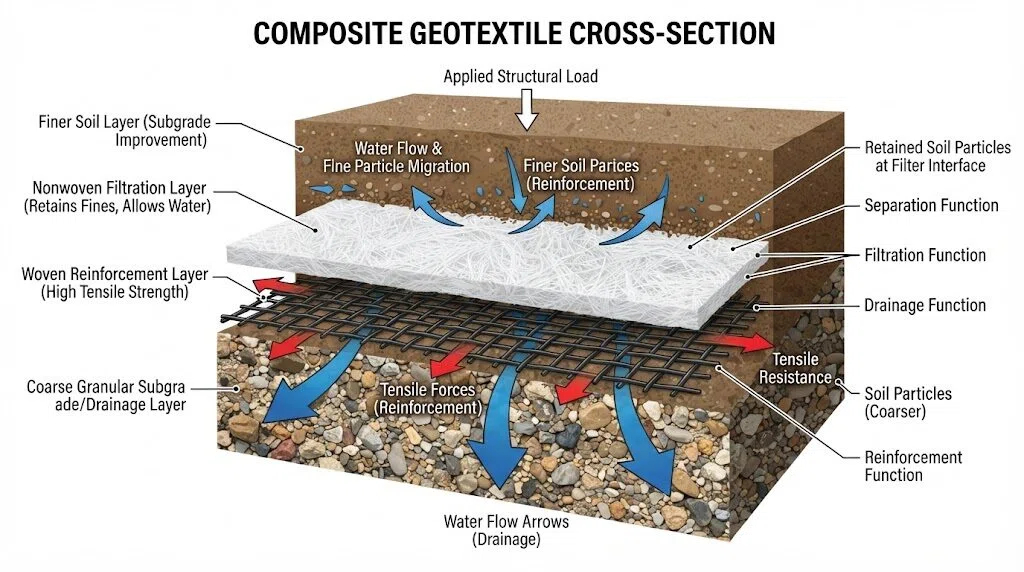
The primary method to counteract this degradation chain is installing a dedicated Geotextile separation layer for soft soils. By placing a synthetic barrier between the soft subgrade mud and the stone base, you prevent the two distinct layers from intermixing under stress.
From a physics standpoint, the fabric acts as a tensioned membrane. When a heavy vehicle tire passes overhead, the downward vertical force is converted into horizontal tensile stress within the synthetic plane. This specific mechanical action distributes the concentrated wheel load across a significantly wider surface area, reducing the localized pressure on the weak clay underneath. For detailed mathematical modeling of soil-fabric boundary shear stresses and confinement physics under cyclic heavy loading, civil engineers can reference the empirical field study available via the National Center for Biotechnology Information (NCBI) Database.
To achieve this level of performance, contractors cannot rely on cheap, thin fabrics that tear easily during aggregate dumping. Sourcing an industrial-grade Staple Fiber Geotextile ensures that the filtration and confinement properties remain active for the entire design life of the pavement structure, safeguarding the roadbed from progressive internal shifting.
Critical Quality Benchmarks for Subgrade Stabilization Using Nonwoven Geotextiles
Achieving successful Subgrade stabilization using nonwoven geotextiles depends entirely on matching your material specification to the physical realities of the job site. The industry standard choice for managing soft foundation soils is a Short fiber needle punched nonwoven geotextile. This manufacturing style utilizes thousands of small, entangled synthetic fibers tangled together via precision needle punching, creating a tortuous three-dimensional pore structure that allows water to pass through freely while capturing fine soil particles.
When selecting materials to satisfy rigorous municipal or commercial project specifications, site engineers must pay close attention to two critical mechanical metrics:
- Geotextile fabric tensile strength requirements: The material must possess high multi-directional tensile strength to resist the intense tearing forces generated when heavy track-driven bulldozers and multi-axle tippers spread the first lift of crushed rock.
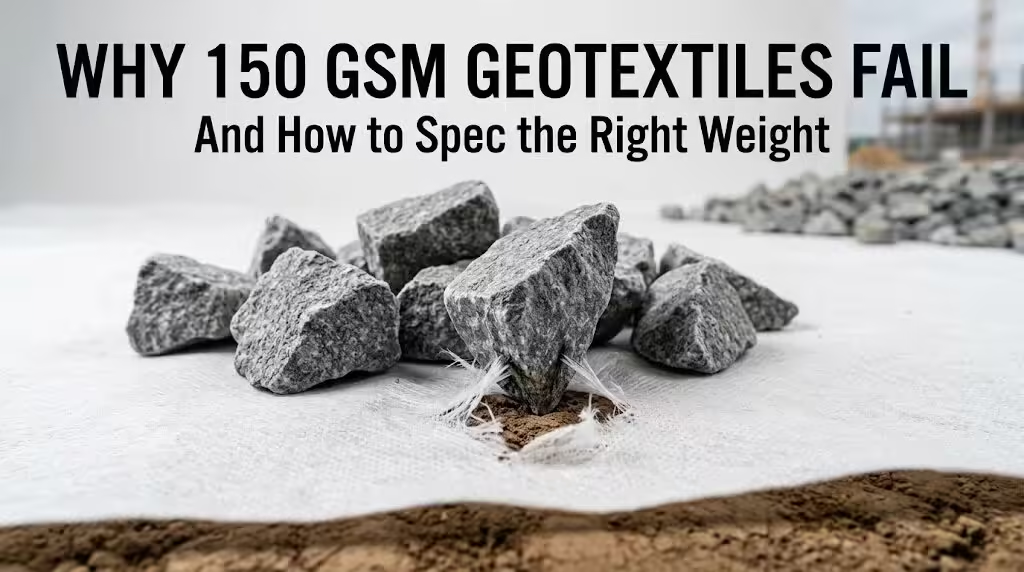
- CBR puncture resistance for road underlayment: As large, angular stones (often 3 to 4 inches in diameter) are dropped from dump truck beds directly onto the fabric, the material faces extreme localized impact forces. High CBR puncture resistance prevents jagged rock edges from piercing the sheet, ensuring the separation barrier remains 100% continuous.To review empirical stress-strain curves and micro-structural fiber reorientation under localized puncture loads, engineers can access the full laboratory evaluation hosted on the National Center for Biotechnology Information (NCBI) Database.
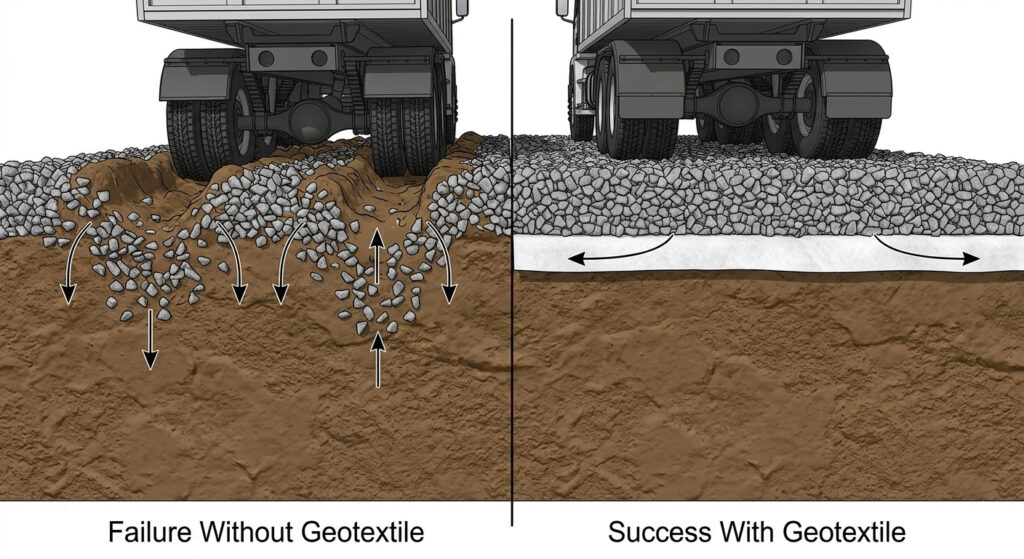
If the material breaks or punctures during installation, the entire mud-pumping cycle will re-start at that exact breach point. By verifying that your supplier’s Staple Fiber Geotextile meets or exceeds these structural parameters, you eliminate the risk of hidden foundation failures that lead to premature asphalt raveling. Deploying a robust Staple Fiber Geotextile significantly reduces the total volume of imported gravel required to stabilize the roadbed, directly protecting your project’s financial bottom line.
How to Lay Geotextile Fabric on Soft Subgrade
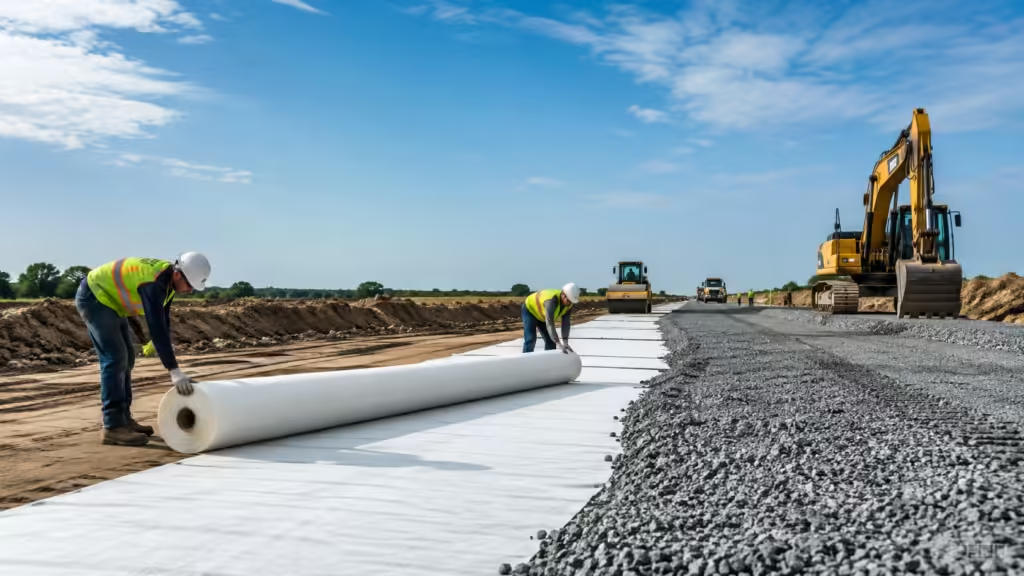
Even the highest-grade synthetic material will fail if the crew installs it incorrectly on the job site. Knowing How to lay geotextile fabric on soft subgrade conditions is a fundamental skill that prevents costly rework and project delays. The installation process must be executed systematically to preserve the structural integrity of the fabric layer.
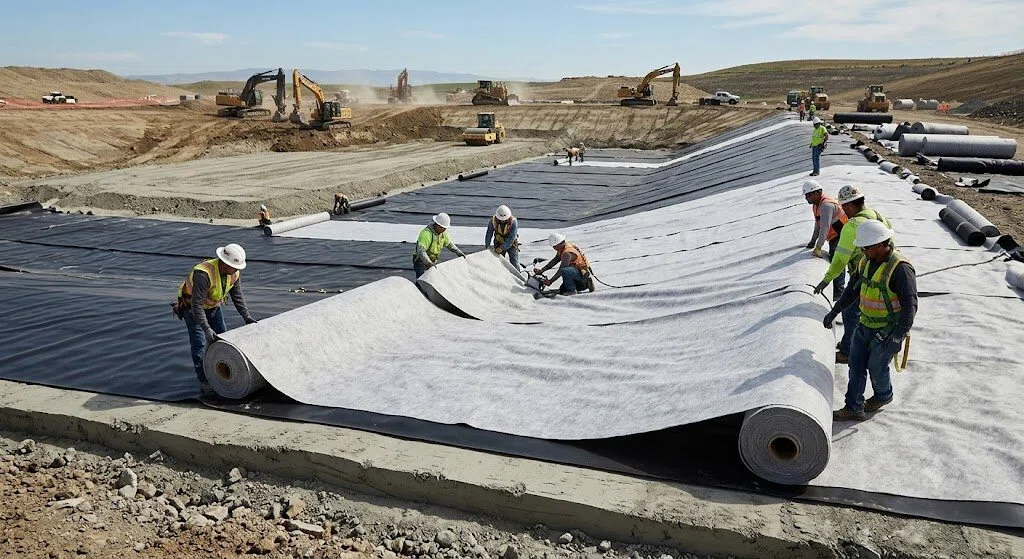
First, the native subgrade must be cleared of large, sharp debris, heavy tree roots, and standing water. Minor ruts should be leveled out to prevent hollow air pockets from forming beneath the sheet. Next, the rolls should be unrolled manually or with a basic excavator attachment, tracking parallel to the centerline of the roadway.
| Subgrade CBR Value | Recommended Overlap Width | Pinning/Securing Requirement |
| CBR > 3.0 | 300 mm (12 inches) | Standard steel pins or landscape staples |
| CBR 1.0 – 3.0 | 500 mm to 750 mm | Sandbags or strategic aggregate piles |
| CBR < 1.0 | 1000 mm (36+ inches) or sewn seams | Strict aggregate back-dumping method only |
A critical variable that site inspectors watch closely is the Geotextile overlap width for road construction. On stable ground, a standard 300mm overlap is usually sufficient. However, when working on soft, saturated soils with a California Bearing Ratio (CBR) of less than 2.0, the minimum overlap width must be increased to 500mm or even 1000mm. This extra width prevents the parallel sheets from sliding apart under the weight of the advancing aggregate pile, which would expose the bare mud underneath.
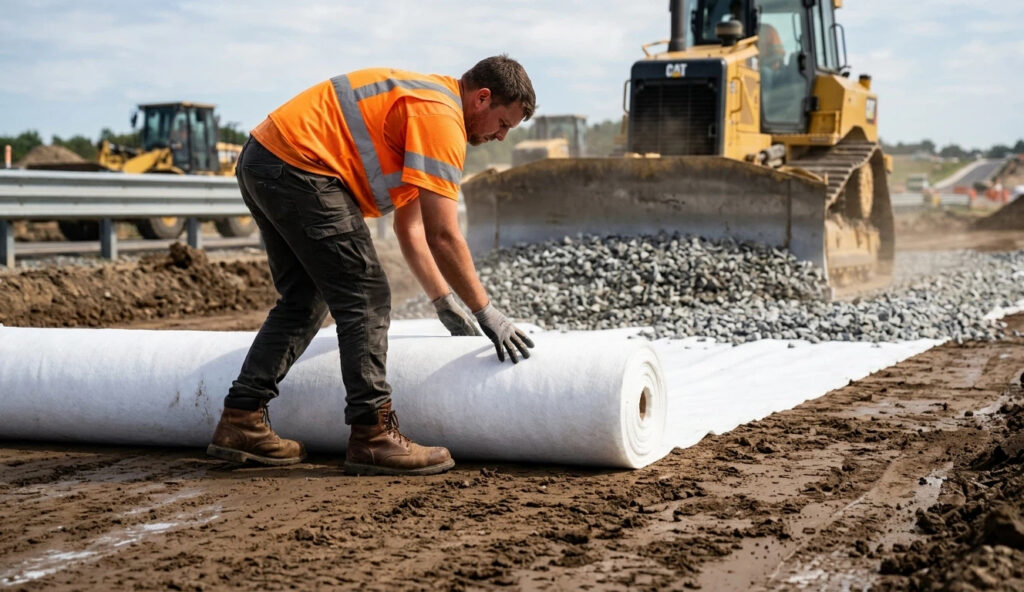
Once the fabric is positioned, crews must execute Subbase reinforcement with synthetic fabrics by backmixing the aggregate using a specific technique: always dump the crushed stone on previously covered areas and push it forward with a dozer or loader. Never allow heavy construction equipment to drive directly on the exposed Staple Fiber Geotextile sheet, as tire spinning or sudden braking will easily scar or misalign the stabilization boundary.
Long-Term Mitigation of Reflective Cracking and Pavement Rutting
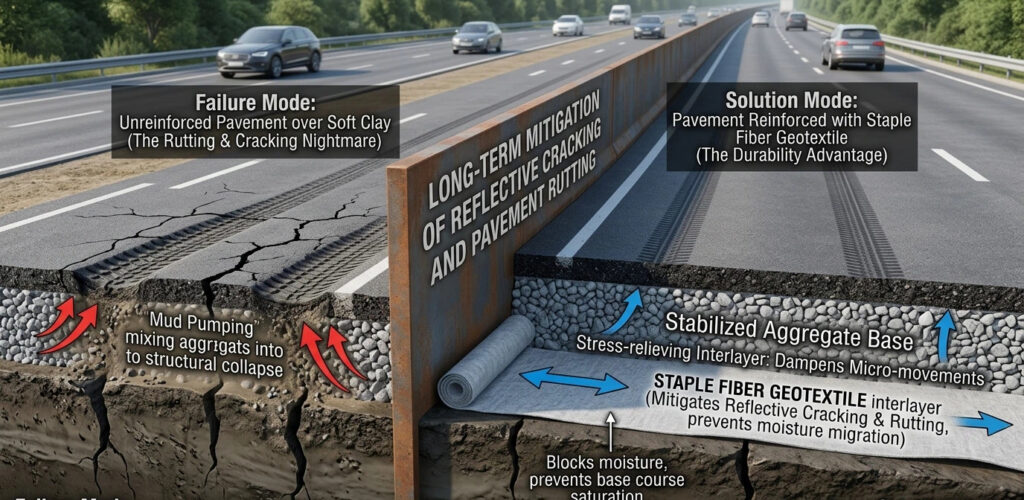
The benefits of utilizing a premium Staple Fiber Geotextile extend far beyond passing the initial proof-roll before inspection. Over a multi-year timeline, road surfaces undergo intense thermal expansion and contraction cycles alongside heavy traffic loading. In unreinforced roads built over soft clay, the inevitable shifting of the underlying subgrade transmits cracks directly upward into the wearing course, a failure mechanism known as reflective cracking.
The synthetic fabric layer acts as a stress-relieving interlayer that dampens and absorbs the micro-movements of the soft subgrade before those forces can shear the upper asphalt layer. Detailed mechanical modeling regarding how flexible nonwoven synthetic sheets distribute vertical shear deformation and arrest crack propagation profiles can be analyzed in the complete study published on the NCBI Materials Science Platform.
To analyze the microscopic stress-distribution behavior of nonwoven layers beneath flexible pavements over long service lives, pavement engineers can review the extensive long-term durability data hosted on the Europe PMC Engineering Archive. This peer-reviewed literature confirms that establishing a resilient subbase layer with a high-performance Staple Fiber Geotextile extends the functional life of asphalt overlays by up to 150%, saving municipalities and asset owners thousands of dollars in routine maintenance and crack-sealing costs.
Preventing the upward migration of moisture keeps the base course dry. Because water cannot accumulate directly beneath the asphalt pavement, the risk of moisture-induced stripping and severe wheel-path rutting is drastically mitigated, ensuring smooth driving conditions for decades.
Selecting the Right Staple Fiber Geotextile Spec for Your Project
Navigating the dense product datasheets provided by manufacturers can be confusing for purchasing managers who are balancing strict engineering compliance with tight budget limits. When comparing alternatives, always demand certified third-party testing documents that verify the mechanical properties of the Staple Fiber Geotextile under review.
For most light-to-medium duty road construction applications, a nonwoven fabric weighing between 150 g/m² and 250 g/m² provides the ideal balance of hydraulic permeability and separation capacity. However, if your project involves heavy industrial logging roads, mining transit paths, or heavy container yards, upgrading to a heavy-duty Staple Fiber Geotextile exceeding 300 g/m² is strongly recommended to handle the high static and dynamic tire pressures.
Choosing an experienced supplier who understands international ASTM and ISO testing standards ensures that the material delivered to your site matches the engineering requirements specified in the project blueprint. Investing in a proven, field-tested geotextile is a low-cost insurance policy that guarantees your road foundation remains rock-solid, protecting your firm from structural warranty claims and unexpected structural failures down the line.
Securing Road Foundations with Premium Synthetic Materials
Cutting corners on subgrade preparation is the fastest way to ensure a premature, multi-million dollar road failure. No matter how thick or expensive your final asphalt topcoat is, a road built over an unstable, shifting foundation will inevitably develop severe rutting, alligator cracking, and costly structural failures. Incorporating a high-performance Staple Fiber Geotextile into your surface preparation phase provides an impenetrable, load-distributing separation barrier that turns soft, unworkable soils into resilient, rock-solid platforms. For heavy contracting teams looking to optimize material usage, speed up proof-roll approvals, and protect long-term project margins, integrating a premium Staple Fiber Geotextile from ECOGEOMAT is the ultimate engineering upgrade for modern infrastructure development.
FAQ
What is the difference between filament and staple fiber geotextile options for soft subgrades?
Filament fabrics use continuous long strands, while a Staple Fiber Geotextile consists of shorter fibers needle punched together. For subgrade separation and soft soil stabilization, the three-dimensional pore structure of the staple fiber variant offers superior filtration, preventing fine clay from blinding the fabric while maintaining excellent drainage properties.
Can I use pins or staples to secure the fabric overlap on extremely soft mud?
On highly sensitive, soft clay subgrades, driving metal pins can tear the soft soil and pull the fabric downwards out of alignment. The safest field practice is to rely on the proper Geotextile overlap width for road construction combined with strategic sandbags or small aggregate piles to hold the sheets in place until the main subbase lift is spread.
How does a nonwoven fabric prevent moisture buildup in the road base?
The needle punching process creates thousands of microscopic pathways. When a heavy-duty Staple Fiber Geotextile is installed, it permits water to flow vertically out of the squeezing subgrade while blocking the passage of fine silt, relieving destructive pore pressure without clogging.