
Composite Geomembrane Installation: Why Geotextile Protection Layers are Mandatory
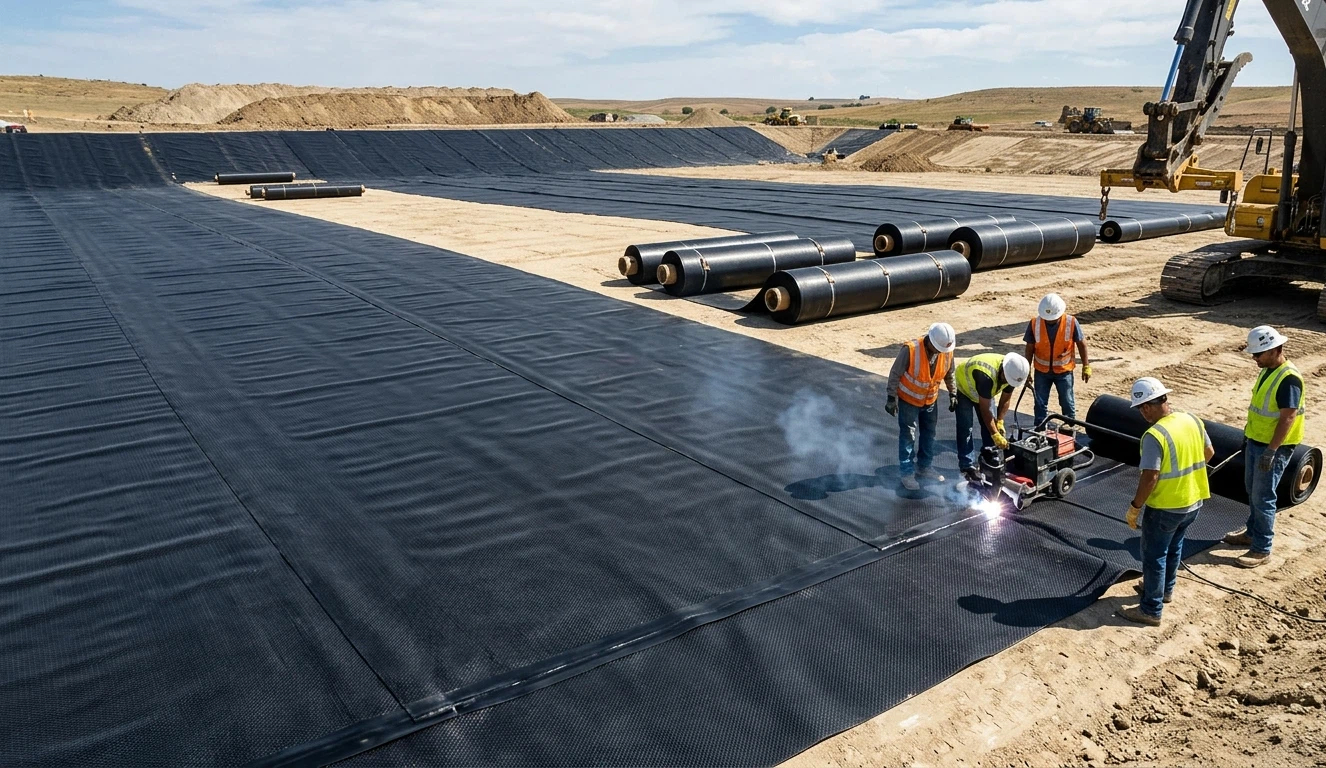
In modern hydraulic engineering, the integrity of a seepage barrier is the single most important factor determining the lifespan of a reservoir or industrial pond. While HDPE liners have long been the industry standard, the shift toward using a Composite Geomembrane has become mandatory in high-risk environments. The reason is simple: a geomembrane is an excellent hydraulic barrier but a poor structural one. Without a geotextile protection layer, even the highest-quality liner is susceptible to catastrophic failure during the most critical phase of a project—the backfilling of aggregate.
Engineering a sustainable containment system requires more than just high-quality plastic. It requires a synergy between materials that can handle hydraulic pressure and those that can withstand mechanical trauma. This article dissects the technical necessity of the “Golden Duo”—the composite pairing of non-woven fabric and geomembrane—and explores why this combination is the only viable solution for long-term seepage control in challenging terrains.
Table of Contents
What is a Composite Geomembrane?
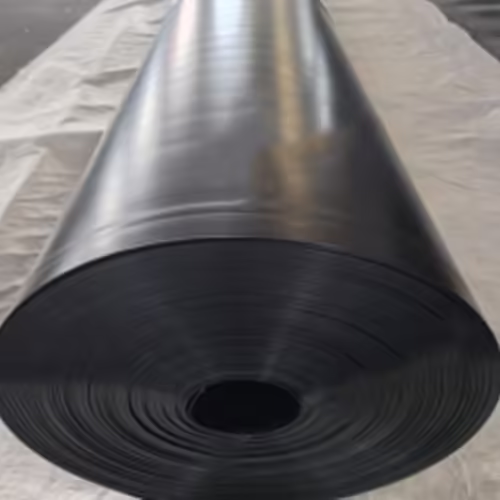
A Composite Geomembrane is a high-performance material created by heat-bonding or needle-punching one or more layers of non-woven geotextile to a thermoplastic liner, typically HDPE (High-Density Polyethylene). Unlike standard liners, which are single-ply, the composite structure serves two distinct functions: the liner provides the impermeable seal, while the geotextile acts as a sacrificial shield and a reinforcement mesh.
In the global market, these materials are classified by their weight and the thickness of the core liner. The manufacturing process is critical; high-end production lines ensure a consistent thermal bond that prevents delamination under stress. Because a Composite Geomembrane integrates the cushion layer directly onto the barrier, it eliminates the risk of fabric shifting during installation, a common issue when laying separate layers on steep slopes.
Why Use Non-Woven Geotextile with HDPE Liner in Reservoir Projects?
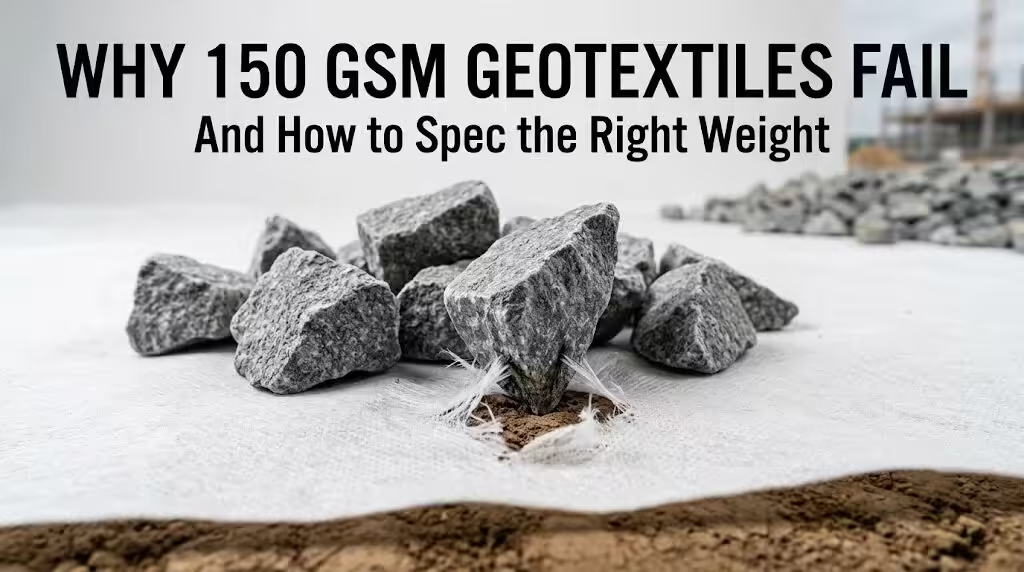
The primary question site managers ask is: Why use non-woven geotextile with HDPE liner in reservoir projects when a thicker liner might seem like a simpler solution? The answer lies in the physics of “Point Loading.” When heavy machinery begins backfilling earth and crushed stone over a liner, the weight is not distributed evenly. Sharp edges of stones create concentrated pressure points that can exceed the yield strength of the HDPE.
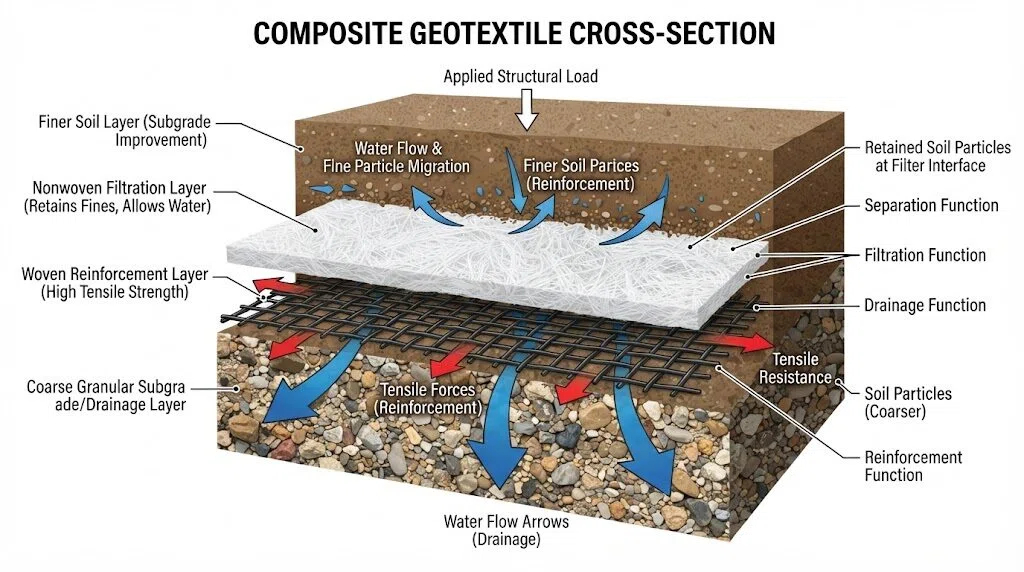
The geotextile protection layer functions as a mechanical buffer. Because non-woven fabrics are composed of a random network of synthetic fibers, they possess high elongation and tensile strength. This allows the fabric to deform around sharp objects, distributing the stress over a larger surface area and preventing the stone from ever reaching the impermeable core. Without this cushion, the microscopic “stress cracking” initiated during construction will eventually develop into a major leak under the immense hydraulic head of a full reservoir.
Utilizing a Composite Geomembrane significantly enhances the mechanical properties of non-woven geotextile as a cushion layer. By having the fabric factory-bonded, the system achieves a higher interface friction angle. This is vital for slope stability in reservoirs, as it prevents the “sliding” effect often seen with smooth HDPE liners.
Puncture Resistance and Mechanical Properties
The effectiveness of an installation is often measured by its CBR Puncture Strength. This metric determines the force required to push a standardized plunger through the material. A standalone 1.5mm HDPE liner may have high chemical resistance, but its puncture resistance is significantly lower than that of a Composite Geomembrane of equivalent weight.
In many industrial applications, low-carbon manufacturing goals are met by reducing the total volume of raw material needed while increasing durability. A Composite Geomembrane achieves this by optimizing the ratio between the barrier thickness and the protection fabric weight. Furthermore, including UV stabilization additives in the composite matrix ensures that the material does not degrade if left exposed to sunlight for extended periods during the construction phase.
Material Performance Metrics
| Feature | Standard HDPE Liner (1.5mm) | Composite Geomembrane (800g/m²) | Engineering Benefit |
| Primary Function | Seepage Barrier | Barrier + Physical Protection | Reduced risk during backfilling |
| Puncture Resistance | Moderate (approx. 2500N) | High (CBR > 4500N) | Prevents damage from sharp stones |
| Hydraulic Conductivity | Impermeable | Drainage + Barrier | Gas/Water migration management |
| Installation Complexity | Two-step process | Single-step deployment | Faster ROI & lower labor costs |
| Interface Friction | Low (Slippery) | High (Friction Grip) | Superior slope stability |
Preventing Seepage Failure During Backfilling
The most dangerous phase of any reservoir project is not the filling of the water, but the first 48 hours of aggregate placement. How to prevent HDPE liner damage during aggregate backfilling is a topic of intense study in civil engineering. Field data suggests that nearly 70% of leaks are caused by mechanical damage during the construction phase, rather than material degradation over time.
By deploying a Composite Geomembrane, the project gains a “built-in” safety factor. The non-woven layer also acts as a planar drainage medium. If a small amount of moisture or gas collects beneath the liner, the geotextile’s high hydraulic conductivity allows it to migrate to the venting system rather than forming “whales” (gas bubbles) that could lift and tear the liner. This dual-action—protection from above and gas management from below—is what makes the Composite Geomembrane the industry benchmark for long-term infrastructure health.
Best Practices for Installation in Dams and Reservoirs
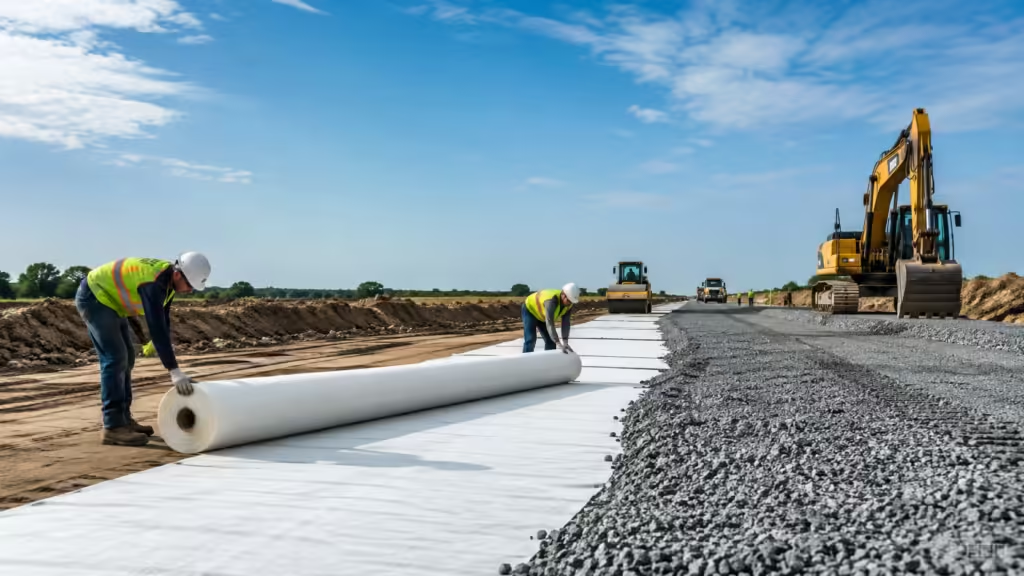
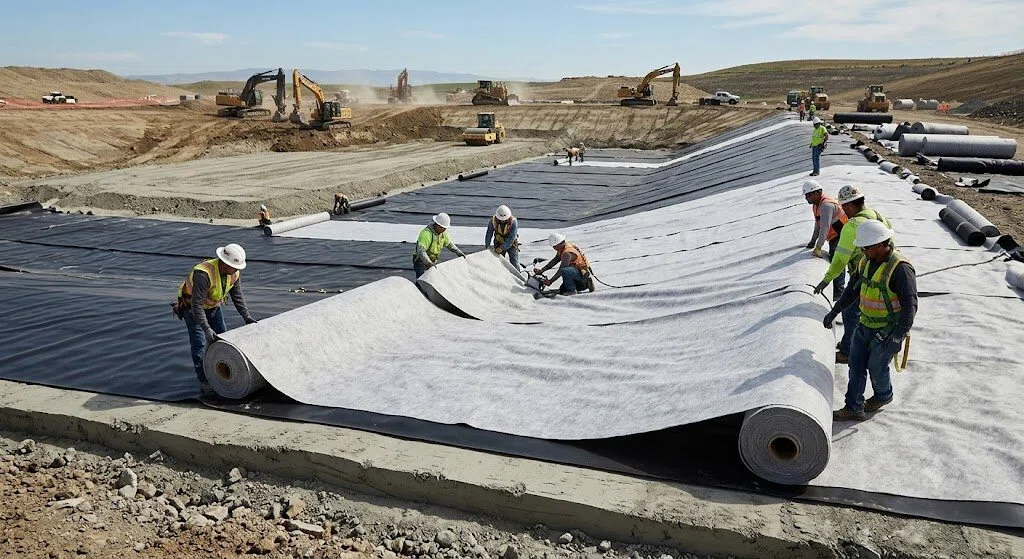
To maximize the benefits of a Composite Geomembrane, installation must follow strict protocols. It is not enough to simply roll out the material. The subgrade must be compacted and cleared of large debris. However, even with a clean subgrade, the geotextile protection layer remains the primary defense against the “unknowns” in the backfill material.
One of the best practices for composite geomembrane installation in dams is to ensure a generous overlap of the geotextile layers. While the HDPE core is welded using double-track wedge welders, the fabric layers should be heat-bonded or sewn to ensure continuous protection across the seam. This ensures that the mechanical protection is as continuous as the hydraulic barrier.
Furthermore, a Composite Geomembrane must be anchored properly at the crest of the slope. Because the non-woven fabric provides a “grip” to the soil, the tension on the weld seams is reduced, preventing stress-cracking over the decades. Regular site inspections should confirm that the UV stabilization remains effective and that no physical punctures occur during the deployment of the drainage stone.
Regulatory Standards and Hydraulic Safety
International engineering standards, such as those set by the International Geosynthetics Society (IGS), emphasize the necessity of the cushion layer. In high-pressure applications where the water depth exceeds 10 meters, a standalone liner is rarely approved without a 400g/m² or higher non-woven fabric accompaniment. A Composite Geomembrane meets these stringent requirements in a single, factory-controlled product.
- ASTM D4491: Measures the hydraulic conductivity of the geotextile to ensure it doesn’t impede necessary sub-liner drainage.
- ISO 10319: Defines the wide-width tensile properties of the Composite Geomembrane, ensuring it can withstand the shifting of the reservoir bed without tearing.
- GRI-GM13: The international standard for HDPE liners which provides the baseline for the core material used in any high-quality Composite Geomembrane.
Conclusion
The decision to specify a Composite Geomembrane is a decision to invest in the long-term viability of an asset. By acknowledging that a geotextile protection layer is a mechanical necessity rather than an optional add-on, engineers can eliminate the primary cause of seepage failure: construction-related damage.
Through a deep understanding of puncture resistance and the application of best practices for composite geomembrane installation in dams, the modern reservoir can achieve near-perfect containment for decades. In the world of high-stakes civil engineering, the “Golden Duo” of HDPE and non-woven fabric remains the most effective defense against the unpredictable forces of nature and the heavy demands of industrial construction. A properly installed Composite Geomembrane is not just a liner; it is a multi-layered insurance policy for your project’s environmental safety.
FAQ
Can I use a woven geotextile instead of non-woven for protection?
Generally, no. Non-woven fabrics provide a much higher “cushion” factor due to their thickness and fiber density. Woven fabrics are better for reinforcement but offer inferior puncture resistance for a Composite Geomembrane.
Is it cheaper to buy the liner and fabric separately?
While the material cost might be slightly lower, the labor cost for a two-stage installation is significantly higher. A factory-bonded Composite Geomembrane is faster to deploy and ensures the fabric doesn’t shift or bunch up during backfilling.
Does the color of the geotextile matter for UV stabilization?
White geotextiles are often preferred because they reflect sunlight, keeping the HDPE liner cooler and reducing the “wrinkling” caused by thermal expansion during daytime installation. This is a key part of low-carbon manufacturing efficiency, as it minimizes material deformation.