
Continuous Filament Geotextile: Reducing Rupture Risk in Railways, Airports, and Heavy Pavements
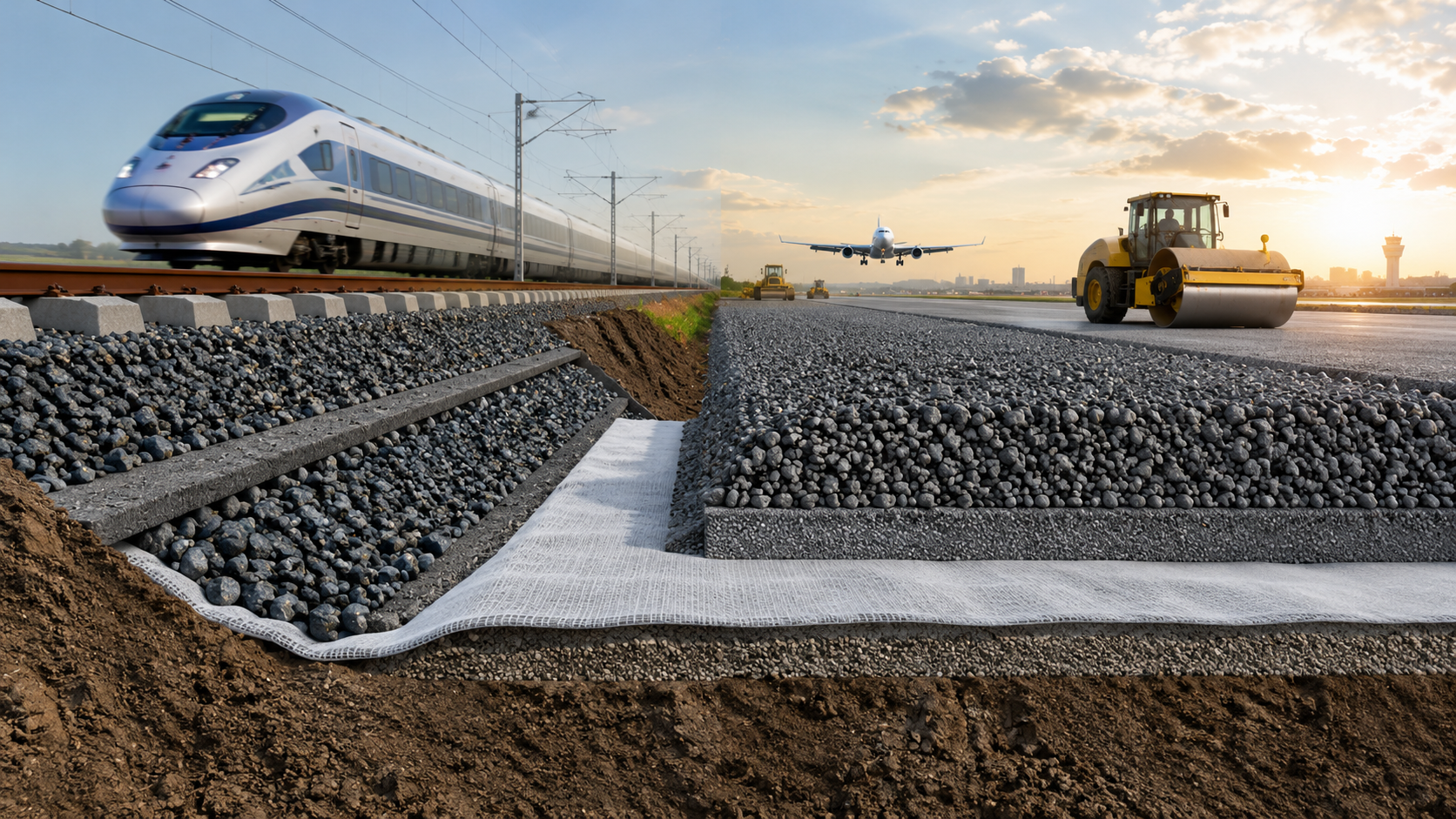
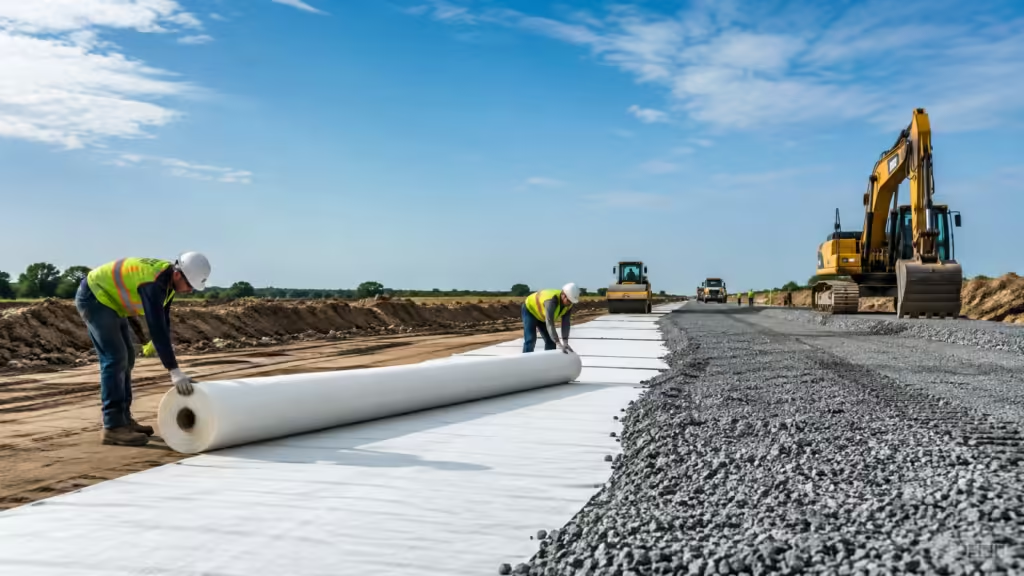
Continuous Filament Geotextile is specified when transport infrastructure cannot afford early material rupture, drainage failure, or long-term performance loss. In high-speed railway, airport runway, and heavy pavement projects, the geotextile layer is not just a fabric placed under aggregate. It is part of the foundation system that helps control separation, filtration, drainage, and long-term stability.
For transport infrastructure specialists and government tender teams, Continuous Filament Geotextile should be evaluated through tensile continuity, puncture resistance, durability, hydraulic performance, and lifecycle value—not only unit price.
Table of Contents
Why High-Load Projects Need More Than Standard Geotextiles
Railways, airport pavements, and heavy-duty roads face repeated dynamic loads. Train vibration, aircraft wheel loads, traffic pressure, water movement, and subgrade deformation all test the material over time.
A low-cost geotextile may pass a basic specification at delivery, but high-load infrastructure asks a harder question: will the material maintain performance after years of stress, moisture, and repeated loading?
In public infrastructure, the cheapest material is rarely the lowest-cost option if it increases maintenance frequency, settlement risk, or service interruption.
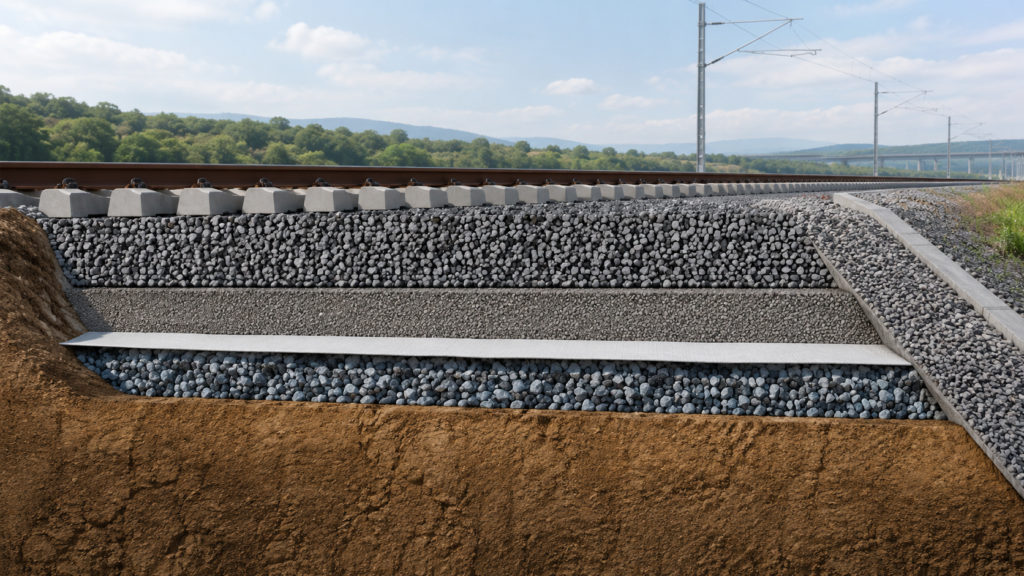
What Makes Continuous Filament Geotextile Different?
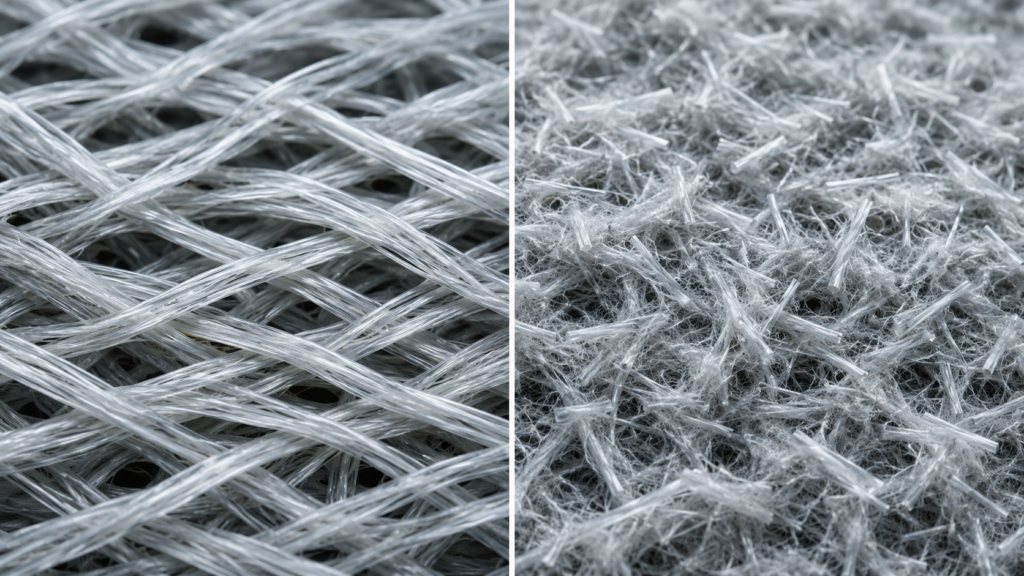
Continuous Filament Geotextile uses long, continuous fibers rather than short staple fibers. This structure reduces fiber-end discontinuity and helps the material maintain tensile continuity across the sheet.
A Continuous Filament Geotextile is especially valuable where the geotextile must resist puncture, stretching, tearing, and deformation during installation and service. Compared with lower-grade separation fabrics, continuous filament nonwoven geotextile products are often chosen for more demanding infrastructure foundations.
This is where Continuous Filament Geotextile fits the engineering logic: it supports multiple foundation functions while offering better structural continuity for high-stress environments.
How Continuous Filament Geotextile Helps Prevent Material Failure
Material failure in transport infrastructure is not always a sudden tear. It may appear gradually as tensile loss, clogging, particle migration, filtration decline, puncture damage, or deformation at the interface between layers.
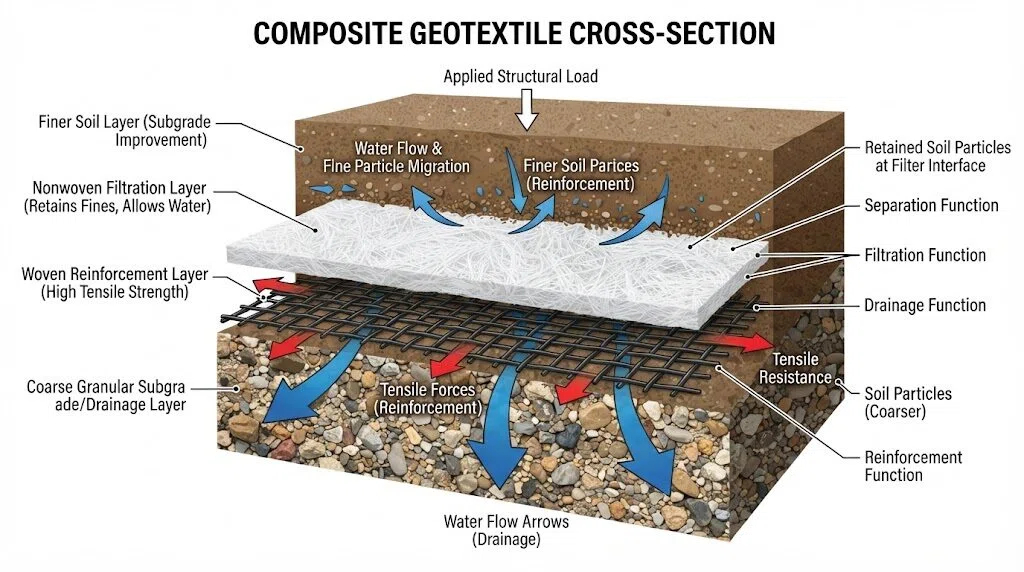
In high-load projects, Continuous Filament Geotextile helps reduce risk by supporting:
- Separation between aggregate and subgrade
- Filtration while limiting soil particle migration
- Drainage continuity
- Tensile stability under repeated load
- Puncture resistance during aggregate placement
- Reduced long-term performance decay
For high-load infrastructure, these functions should be considered together. If separation fails, drainage and stiffness can also decline. If filtration fails, fines may migrate. If tensile stability is weak, local deformation may grow into a maintenance issue.
Continuous Filament Geotextile for Railway Subgrade Stability
Continuous Filament Geotextile supports railway subgrade stability by helping keep the ballast, sub-ballast, and fine soil layers from mixing. This is important because repeated train loads can push fines upward or drive aggregate downward, reducing drainage and track support quality.
For high-speed railway projects, engineers often care about:
- Ballast contamination control
- Subgrade drainage
- Resistance to cyclic load
- Settlement control
- Long-term trackbed performance
- Reduced maintenance intervention
This is why geotextile for railway construction should not be selected by mass per unit area alone. Tensile strength, puncture resistance, permeability, opening size, durability, and installation survivability all matter.
Airport Runways and Heavy Pavements: Why Long-Term Performance Matters
Airport runways, taxiways, and aprons experience high wheel loads and strict service reliability requirements. A foundation problem may affect pavement smoothness, drainage, cracking risk, and operational uptime.
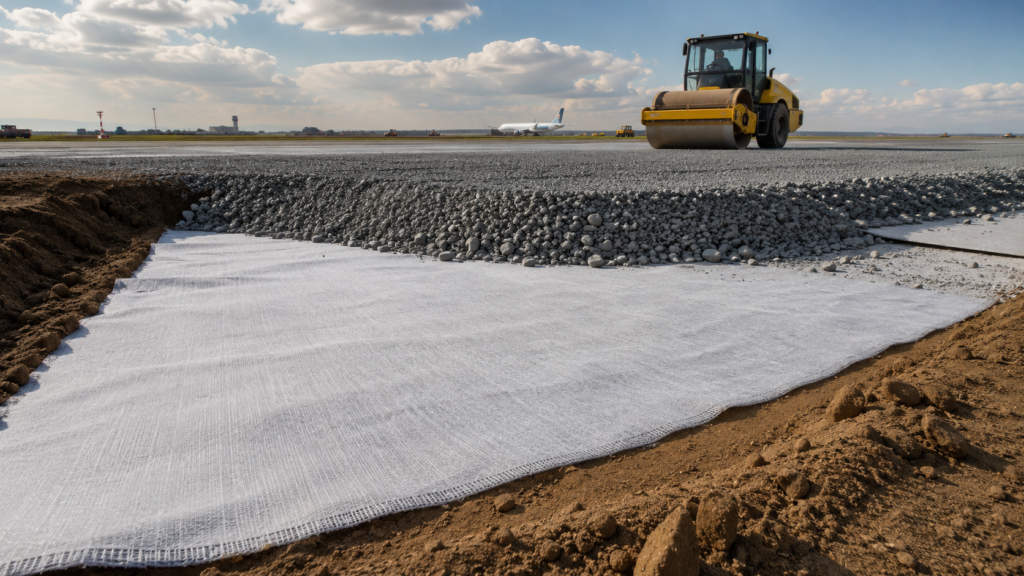
Continuous Filament Geotextile can be used as part of a pavement foundation strategy where separation, filtration, and long-term stability are required. In airport or heavy pavement projects, the key question is not only whether the pavement can be built, but whether the foundation system can preserve performance under repeated loading.
Continuous Filament Geotextile vs Staple Fiber Geotextile
Continuous Filament Geotextile and staple fiber geotextile may look similar on site, but their internal fiber structure is different.
| Selection Point | CFG | Staple Fiber Geotextile |
|---|---|---|
| Fiber structure | Long continuous fibers | Short fibers |
| Weak points | Fewer fiber ends | More fiber ends and bonding points |
| Tensile continuity | More stable | More dependent on bonding quality |
| High-load suitability | Stronger fit for demanding projects | More common in general applications |
| Typical use | Railways, airports, heavy pavements | Drainage, landscaping, general separation |
A Continuous Filament Geotextile is usually preferred when long-term geotextile performance, tensile stability, and installation survivability are critical. Staple fiber geotextile can still be suitable for many applications, but high-load transport projects need closer technical review.
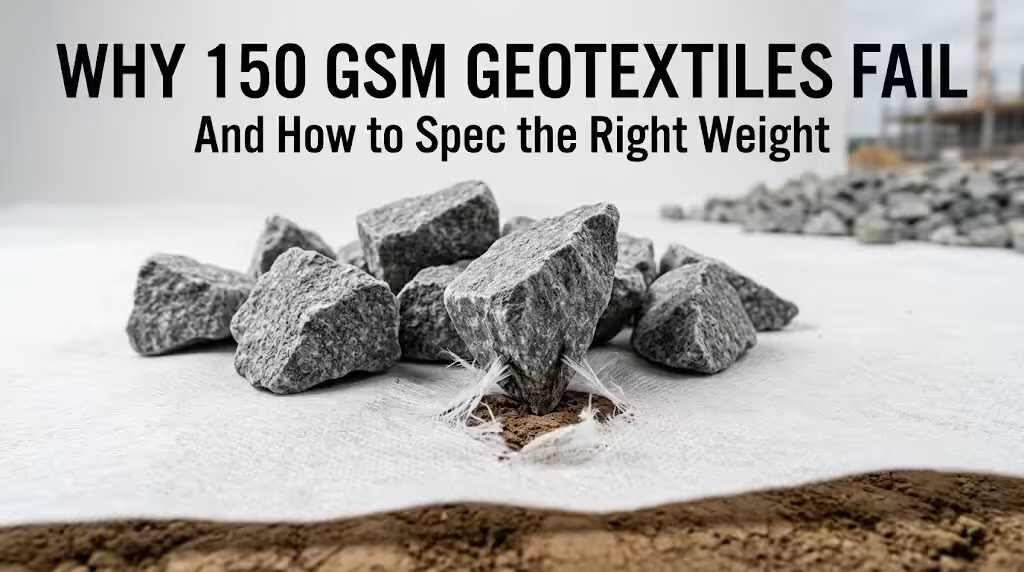
Pro Tip: Do not compare geotextiles only by weight. Two materials with the same gram weight may have very different tensile strength, elongation, puncture resistance, hydraulic behavior, and durability.
Key Specifications to Review in Infrastructure Tenders
When specifying Continuous Filament Geotextile, tender teams should ask for more than a product name. A serious technical specification should include measurable performance requirements.
Important items include:
- Tensile strength
- Elongation
- CBR puncture resistance
- Tear resistance
- Permeability
- Apparent opening size
- Mass per unit area
- Thickness
- UV resistance
- Durability
- Roll width
- Standard compliance
- Factory quality control records
- Third-party testing documentation
For government tender offices, this matters because vague specifications can lead to technically inconsistent bids. Clear performance requirements make supplier comparison more objective.
Lifecycle Value Beats Lowest Unit Price
The value of Continuous Filament Geotextile becomes clearer when the project is viewed over its full lifecycle. In railways, airports, and heavy pavements, failure cost is rarely limited to material replacement. It may include excavation, traffic disruption, downtime, inspection cost, repair scheduling, and public service impact.
For procurement teams, lifecycle value should include:
- Expected service life
- Installation survivability
- Batch consistency
- Supplier traceability
- Testing reliability
- Delivery capacity
- Technical support
- Compatibility with project standards
A cheaper geotextile may look attractive during procurement, but if it causes premature settlement, poor drainage, or layer contamination, the total cost of ownership can rise quickly.
Choosing a Supplier for High-Load Geotextile Projects
When specifying Continuous Filament Geotextile, supplier capability should be part of the evaluation. Infrastructure buyers should ask whether the supplier can provide technical datasheets, test reports, production consistency, custom roll sizes, and documentation aligned with project standards.
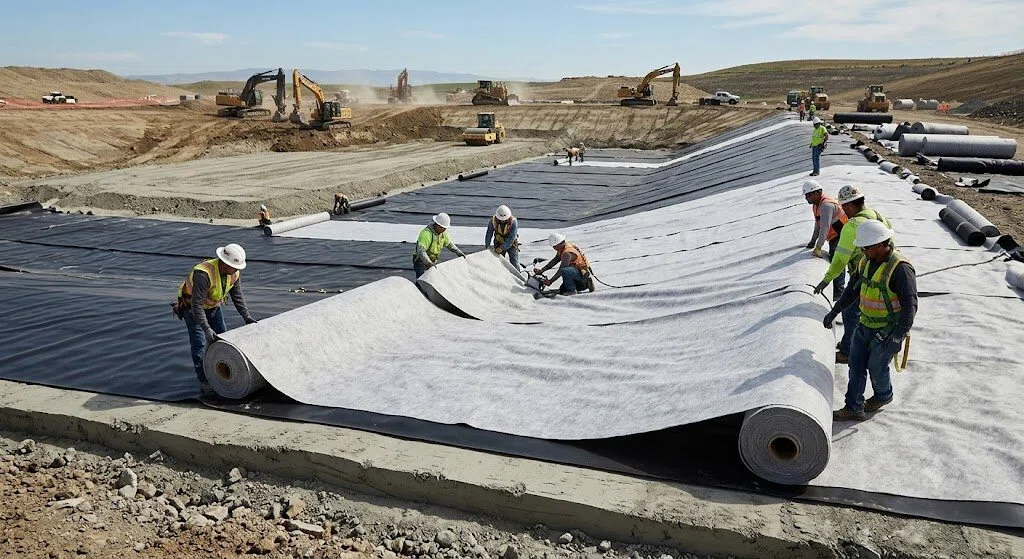
A good supplier should help the project team match product performance to application requirements, such as railway subgrade separation, airport runway foundation stabilization, or road base reinforcement.
Look for suppliers that can provide:
1.Clear product performance data
2.Consistent manufacturing quality
3.Third-party test reports
4.Roll traceability
5.Standard compliance support
6.Engineering communication
7.Production and delivery reliability
Conclusion
Continuous Filament Geotextile is most valuable where infrastructure must resist repeated load, water movement, puncture stress, and long-term performance decay. For high-speed railways, airports, and heavy pavements, the material is part of the foundation reliability strategy.
FAQ
What is Continuous Filament Geotextile?
Continuous Filament Geotextile is a geosynthetic material made from continuous fibers and used for separation, filtration, drainage, and reinforcement in civil engineering projects.
Why is it used in railway projects?
It helps maintain separation, drainage, and tensile stability under repeated train loads, vibration, and subgrade stress.
Is it suitable for airport runways?
Yes. It can be used in runway, taxiway, and apron foundations where separation, filtration, puncture resistance, and long-term durability are important.
How is it different from staple fiber geotextile?
Continuous filament products use long fibers with fewer weak points. Staple fiber geotextiles use shorter fibers and rely more on bonding and fiber distribution.