
Future Trends in Geosynthetic Materials
Table of Contents
Introduction
The modern world faces a critical challenge: building resilient, sustainable, and long-lasting infrastructure while minimizing environmental impact. In this pursuit, geosynthetic materials have become one of the most transformative innovations in civil and environmental engineering. They provide advanced solutions for soil stabilization, drainage, erosion control, and environmental protection across diverse sectors such as transportation, water management, waste containment, and renewable energy projects.
Over the past decade, the geosynthetic industry has evolved rapidly—from basic polymer-based products to highly engineered, intelligent, and eco-friendly systems. According to a report by Grand View Research, the global market for geosynthetics is expected to surpass USD 20 billion within the next few years, driven by urbanization, stricter environmental standards, and the growing demand for sustainable materials. This article explores the emerging trends, innovations, and future potential shaping the next generation of geosynthetic material technologies.
What Are Geosynthetic Materials and Why They Matter
Geosynthetic materials are synthetic polymer-based products designed to improve the performance and longevity of civil engineering structures. They function as barriers, reinforcements, separators, filters, or drainage aids—often serving multiple purposes in a single application.
Types of Geosynthetic Materials
- Geomembranes—Used for impermeable barriers in landfills, ponds, and reservoirs.
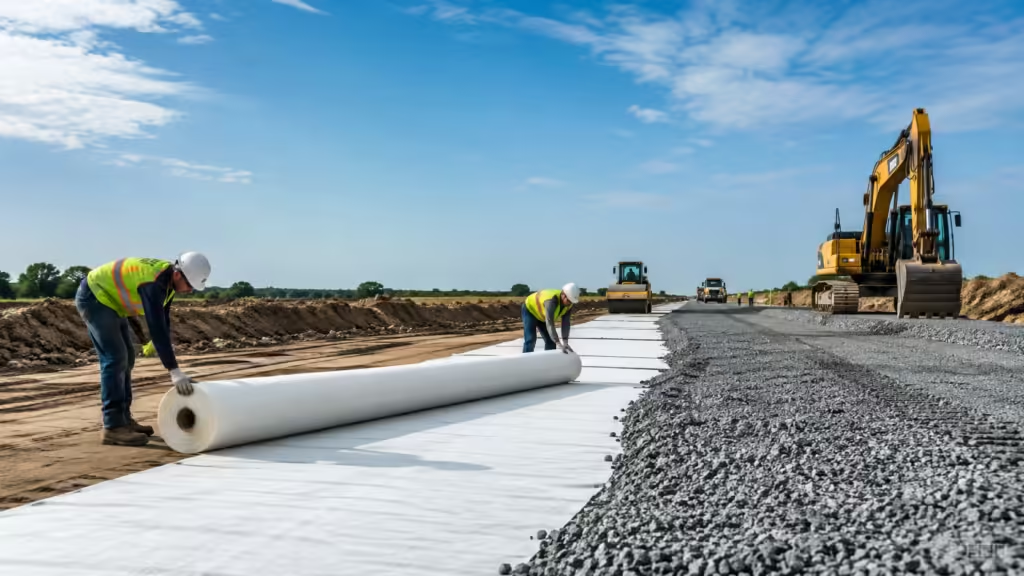
- Geotextiles—Non-woven or woven fabrics that aid in filtration, separation, and protection.
- Geogrids—Provide structural reinforcement for soil and pavement systems.
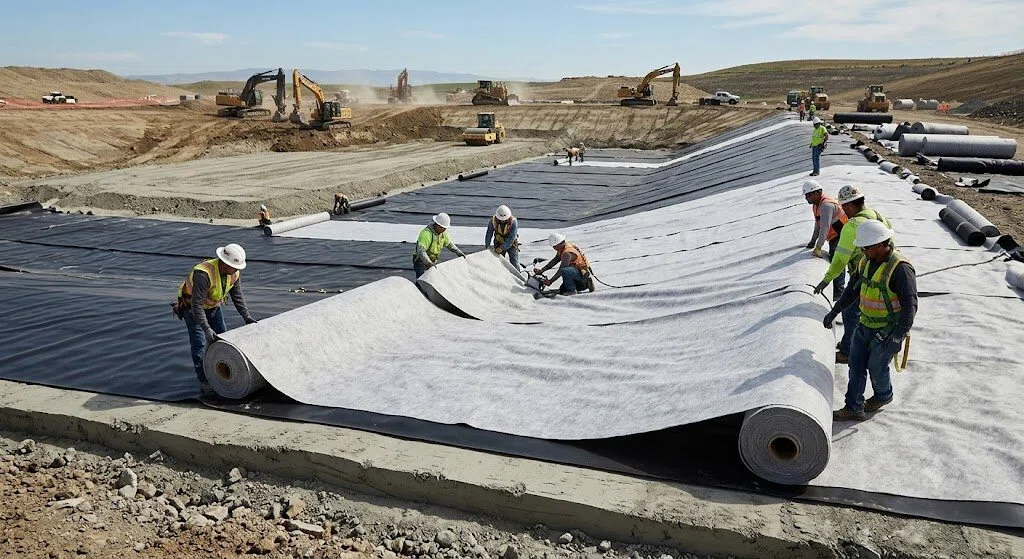
- Geonets and Geocomposites—Used for drainage and fluid transmission layers.
- Geocells—three-dimensional honeycomb structures that stabilize slopes and load-bearing surfaces.
Their versatility and adaptability make geosynthetic materials a core component in infrastructure resilience and environmental protection strategies.
Emerging Trends Shaping the Future of Geosynthetic Materials
Sustainable and Eco-Friendly Geosynthetics
The sustainability trend is redefining how geosynthetic materials are produced and applied. Manufacturers are increasingly incorporating recycled polymers, bio-based resins, and low-carbon production technologies to reduce environmental footprints. Recent R&D has focused on biodegradable geotextiles and recyclable HDPE geomembranes, which maintain durability while supporting circular economy goals.
According to the Geosynthetics Research Institute (GRI), sustainable manufacturing practices could reduce polymer waste by up to 30% in the next decade. This shift not only aligns with global sustainability targets but also appeals to environmentally conscious project developers.
Smart Geosynthetic Systems
A significant breakthrough lies in the integration of sensor-based monitoring systems into geosynthetics. Smart geosynthetic materials can now detect strain, stress, temperature variations, and leakage in real time. This innovation provides engineers with continuous data that improves decision-making, reduces maintenance costs, and prevents catastrophic failures.
Smart geosynthetics represent the convergence of materials science, data analytics, and IoT technology—a direction that will likely dominate high-value infrastructure projects in the future.
Advanced Manufacturing and Material Innovation
The development of nanocomposite polymers, 3D-woven fabrics, and thermal bonding techniques has revolutionized product strength and flexibility. These technologies enable materials that can withstand higher loads, UV exposure, and chemical degradation.
For example, nanocomposite-enhanced geotextiles offer a 20–40% improvement in tensile strength and durability compared to traditional non-woven fabrics. Additive manufacturing also allows for customized production, reducing waste and optimizing design for specific site conditions.
Multifunctional Geosynthetic Composites
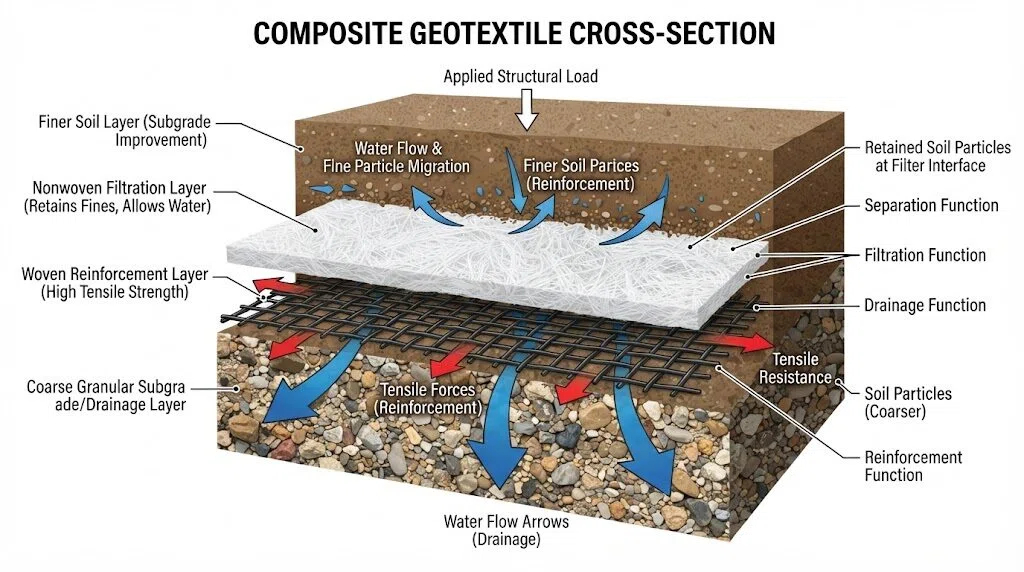
The future of infrastructure demands materials that can perform multiple tasks simultaneously. Geosynthetic composites, such as geomembrane–geotextile or geogrid–nonwoven combinations, integrate reinforcement, separation, and drainage into a single layer.
This reduces installation time, labor costs, and project complexity. These hybrid systems are particularly beneficial in landfills, mining, and transportation infrastructure, where multi-layered performance is crucial for long-term stability and cost efficiency.
Climate-Resilient Infrastructure Solutions
Climate change is pushing engineers to design materials capable of withstanding more severe weather events. Geosynthetic materials are increasingly used in flood control, slope stabilization, and coastal protection projects. Their ability to resist erosion, manage drainage, and reinforce soil makes them essential components of climate adaptation infrastructure.
By improving resilience and durability, these materials extend the life of structures while reducing maintenance and repair costs—a vital factor for sustainable urban growth.
Key Elements of Future-Ready Geosynthetic Materials

Material Innovation
Future geosynthetics will incorporate hybrid polymers that balance strength and flexibility. Developments in thermoplastic polyurethane (TPU) and polypropylene copolymers are setting new benchmarks for mechanical performance and environmental resistance.
Performance Optimization
Next-generation materials are being designed with enhanced permeability, tensile properties, and creep resistance. They are tailored for diverse applications ranging from soft soil reinforcement to hazardous waste containment.
Sustainability Metrics
As lifecycle assessment (LCA) becomes a key design factor, manufacturers are measuring carbon intensity, energy efficiency, and recyclability. Future infrastructure projects will likely prioritize materials with verified environmental impact data.
Comparison: Traditional vs. Next-Generation Geosynthetic Materials
| Feature | Traditional Geosynthetics | Next-Generation Geosynthetics |
|---|---|---|
| Material Base | HDPE, PP, PET | Recycled & bio-based polymers |
| Durability | High | Enhanced via nanotechnology |
| Sustainability | Limited | Eco-focused & recyclable |
| Functionality | Single-purpose | Multi-functional composites |
| Monitoring | Manual | Smart sensing & data feedback |
Future Challenges and Opportunities

Regulation and Standardization
The future success of geosynthetic materials depends heavily on global standardization. Harmonized performance testing (ASTM, ISO) will ensure consistency and quality across markets, promoting greater adoption in critical infrastructure.
Cost vs. Innovation Balance
While smart and sustainable materials offer superior performance, their higher initial cost can limit adoption. However, as production scales and demand grows, economies of scale are expected to reduce costs significantly.
Industry Education and Adoption
Bridging the knowledge gap remains vital. More engineers and contractors must be trained in geosynthetic applications to fully utilize their potential. Educational partnerships between academia and manufacturers are already accelerating this process.
Conclusion
The evolution of geosynthetic material technology represents a vital shift toward smarter, greener, and longer-lasting infrastructure. As sustainability and resilience become global priorities, geosynthetics will continue to play an indispensable role in shaping the future of construction, environmental management, and energy systems.
If you are looking for reliable, high-performance geosynthetic solutions for your next project, contact EcoGeo Material today. Our team specializes in developing advanced geosynthetic materials engineered for performance, sustainability, and long-term durability—helping you build a stronger, safer, and more sustainable future.
FAQ
What are geosynthetic materials made of?
Most are made from polymers such as polyethylene (PE), polypropylene (PP), or polyester (PET), engineered to provide specific mechanical and chemical properties for construction and environmental use.
Are geosynthetics environmentally friendly?
Yes. New-generation geosynthetics are developed using recycled and biodegradable polymers, significantly lowering carbon emissions during production.
What is the main advantage of using geosynthetics in infrastructure?
They improve soil stability, reduce erosion, extend structure lifespan, and minimize maintenance costs compared to traditional methods.
How do smart geosynthetics work?
They integrate sensors that collect real-time performance data such as pressure, temperature, or strain, helping engineers monitor and maintain infrastructure more efficiently.
Are geosynthetics suitable for extreme environments?
Yes, advanced formulations and coatings enhance UV, chemical, and thermal resistance, making them reliable even in harsh climates.