
Maximizing Geomembrane Lifespan: A Guide to Sustainable Materials and Lifecycle Management
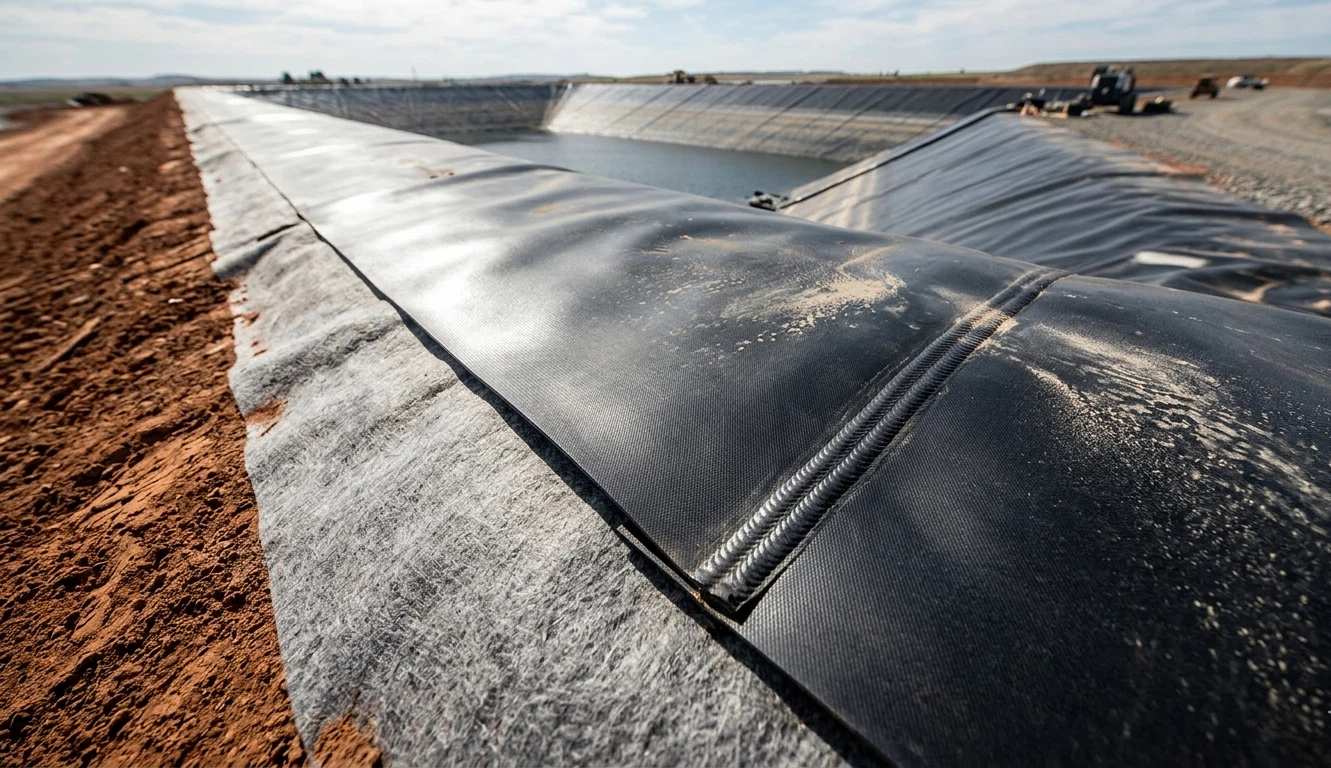
In modern civil engineering and environmental protection, the durability of containment systems is not just a technical requirement—it is a financial and ecological mandate. The geomembrane lifespan determines the long-term viability of critical infrastructure, ranging from mining leach pads to municipal reservoirs.
As the industry shifts toward a circular economy, stakeholders are increasingly weighing the benefits of a sustainable liner against traditional virgin materials. This guide analyzes the technical variables of durability, the emergence of recycled geomembrane options, and the total environmental impact of liner selection.
Table of Contents
Technical Drivers of Geomembrane Lifespan
The service life of a geosynthetic is not a fixed number; it is a degradation curve influenced by polymer chemistry and environmental exposure. For high-density polyethylene (HDPE), the geomembrane lifespan is typically divided into three stages: antioxidant depletion, induction time, and mechanical failure.
The Role of Oxidation Induction Time (OIT)
Oxidation induction time (OIT) is the primary metric for predicting how long a liner will resist oxidative degradation. High-quality liners complying with GRI GM13 standards utilize robust antioxidant packages to delay the onset of polymer breakdown. In exposed applications, UV resistance becomes the bottleneck. Carbon black dispersion is critical here; without it, the geomembrane lifespan could be reduced by decades in high-UV regions like Australia or the Southwestern United States.
Environmental Stress Cracking (ESC)
Beyond chemical aging, physical durability is dictated by resistance to stress cracking. A sustainable liner must maintain its multi-axial strain capacity over time. If the material is prone to brittle failure, even a chemically intact liner will fail under the weight of the overburden or during thermal expansion cycles.
The Rise of Sustainable Geomembrane Materials
Sustainability in geosynthetics is no longer an “extra”—it is often a regulatory requirement. The industry is actively exploring sustainable geomembrane materials that reduce the reliance on virgin resins without compromising performance.
Recycled Geomembrane: Opportunities and Risks
The use of a recycled geomembrane is gaining traction in non-critical applications. These liners often utilize post-industrial recycled resin, which significantly lowers the carbon footprint of geomembranes. However, engineers must be cautious. The recycled geomembrane applications are best suited for temporary works, secondary containment, or decorative ponds rather than hazardous waste landfills.
The primary concern with recycled content is the consistency of the OIT values. While a sustainable liner made from recycled materials supports the circular economy, it must still meet rigorous testing to ensure the geomembrane lifespan meets the project’s minimum requirements.
Geomembrane Lifespan in Wastewater Ponds
One of the most challenging environments for any liner is the industrial treatment facility. The geomembrane lifespan wastewater pond operators expect is usually 20 to 30 years. However, chemical exposure—specifically to hydrocarbons and high-pH liquids—can accelerate the leaching of antioxidants.
In these scenarios, a sustainable liner must be selected based on chemical compatibility charts. Selecting the wrong material can lead to “swelling,” where the liner absorbs chemicals, loses tensile strength, and fails prematurely. For geomembrane lifespan wastewater pond projects, HDPE remains the gold standard due to its inert nature, though specialized LLDPE or fPP may be used for superior flexibility in settling basins.
Comparing Liner Durability and Sustainability
When performing a Life cycle cost analysis (LCCA), engineers must compare the upfront cost of the material against its projected service life and environmental impact.
| Material Type | Expected Lifespan (Exposed) | Sustainability Profile | Best For |
| Virgin HDPE (GRI GM13) | 50+ Years | High energy intensity | Mining, Landfills, Potable Water |
| Sustainable Liner (TPO/fPP) | 30-40 Years | Recyclable at end-of-life | Roof reservoirs, Canals |
| Recycled Geomembrane | 10-20 Years | Low carbon footprint | Temporary containment, Agriculture |
| Bituminous Geomembrane | 40+ Years | High durability, low recyclability | Dam facing, complex slopes |
Economic and Environmental Impact Analysis
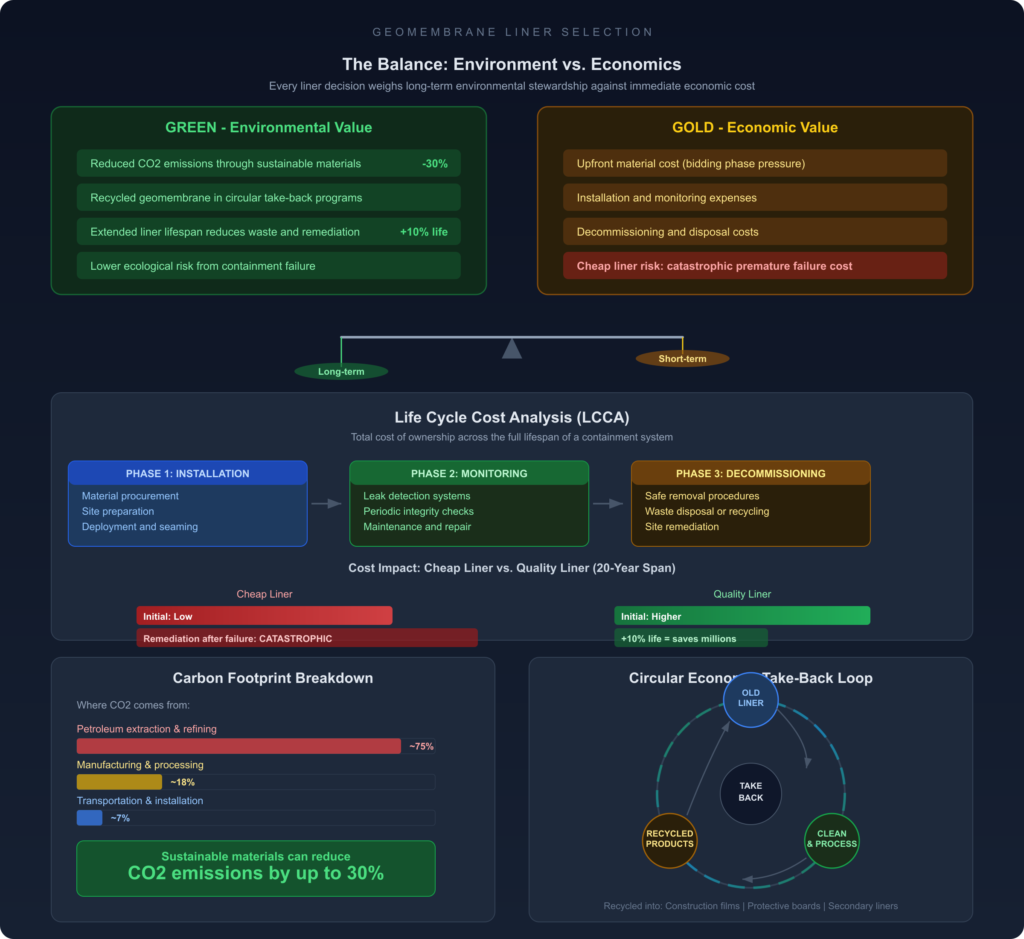
Choosing a liner is a balance of “Green” and “Gold.” A lower-quality, cheaper material might seem attractive during the bidding phase, but the economic impact of premature failure is catastrophic.
Life Cycle Cost Analysis (LCCA)
The Life cycle cost analysis (LCCA) of a containment system includes installation, monitoring, and eventual decommissioning. A liner that extends the geomembrane lifespan by just 10% can save millions in remediation costs.
Carbon Footprint and Circular Economy
The carbon footprint of geomembranes is largely determined by the extraction and refining of petroleum. By integrating sustainable geomembrane materials, manufacturers can reduce CO2 emissions by up to 30%. Leading firms are now implementing “take-back” programs where old liners are cleaned and reprocessed into recycled geomembrane for construction-grade films or protective boards.
Service Life Prediction and Maintenance
To ensure your geomembrane lifespan reaches its theoretical maximum, a rigorous maintenance and monitoring program is required.
- Service life prediction: Utilize “Arrhenius modeling” based on field-retrieved samples to calculate the remaining antioxidant levels.
- Leak Detection: Implement permanent geo-electric leak detection systems to identify micro-tears before they cause systemic failure.
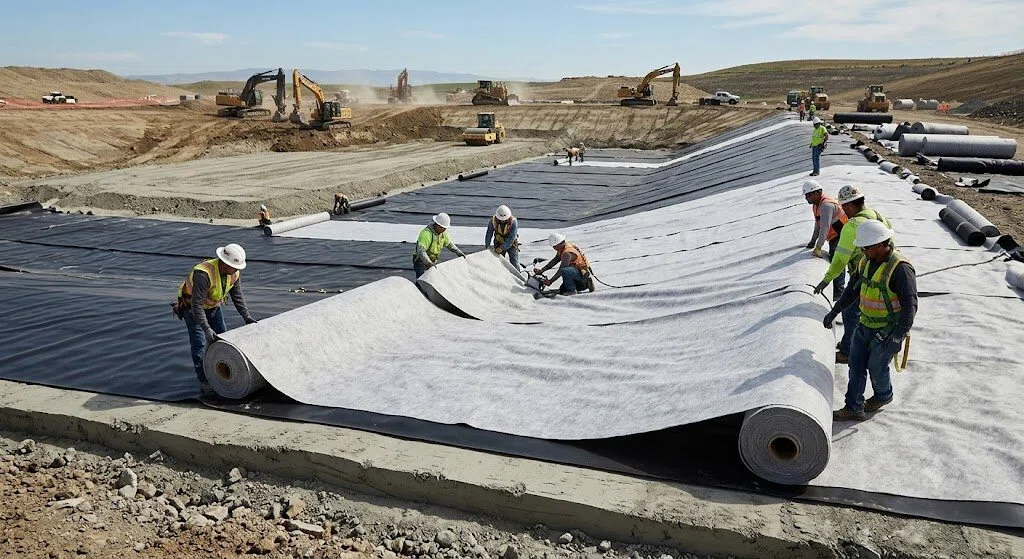
- Protection Layers: Use heavy-weight non-woven geotextiles to protect the sustainable liner from puncture by the subgrade or drainage stone.
The recycled geomembrane applications of the future will likely involve multi-layer “co-extrusion,” where a core of recycled material is sandwiched between two layers of high-performance virgin HDPE. This hybrid approach allows for a high geomembrane lifespan while maximizing the use of sustainable content.
Conclusion
https://ecogeomat.com/product-category/geomembrane/The geomembrane lifespan is the most critical variable in the containment industry. Whether you are specifying a sustainable liner for a LEED-certified project or evaluating recycled geomembrane applications for agricultural use, the focus must remain on long-term integrity. By prioritizing service life prediction and choosing high-performance sustainable geomembrane materials, we can protect both the environment and the bottom line.
FAQ
How long does an HDPE geomembrane last?
Under ideal conditions and buried in a controlled environment, the geomembrane lifespan of HDPE can exceed 100 years. In exposed conditions, it typically ranges from 20 to 50 years depending on UV exposure.
Is recycled geomembrane as strong as virgin material?
Generally, no. Recycled geomembrane usually has lower OIT values and higher variability in mechanical properties, which is why it is used for non-critical containment.
What is the best sustainable liner for a wastewater pond?
For a geomembrane lifespan wastewater pond project, a reinforced fPP (Flexible Polypropylene) or a high-grade HDPE with enhanced chemical resistance is recommended for its balance of durability and recyclability.
How is geomembrane lifespan tested?
Engineers use laboratory immersion tests and high-pressure OIT (HP-OIT) testing to simulate decades of aging in a few months.