
Geotextile Fabric for Erosion Control: Stop Soil Loss Behind Riprap
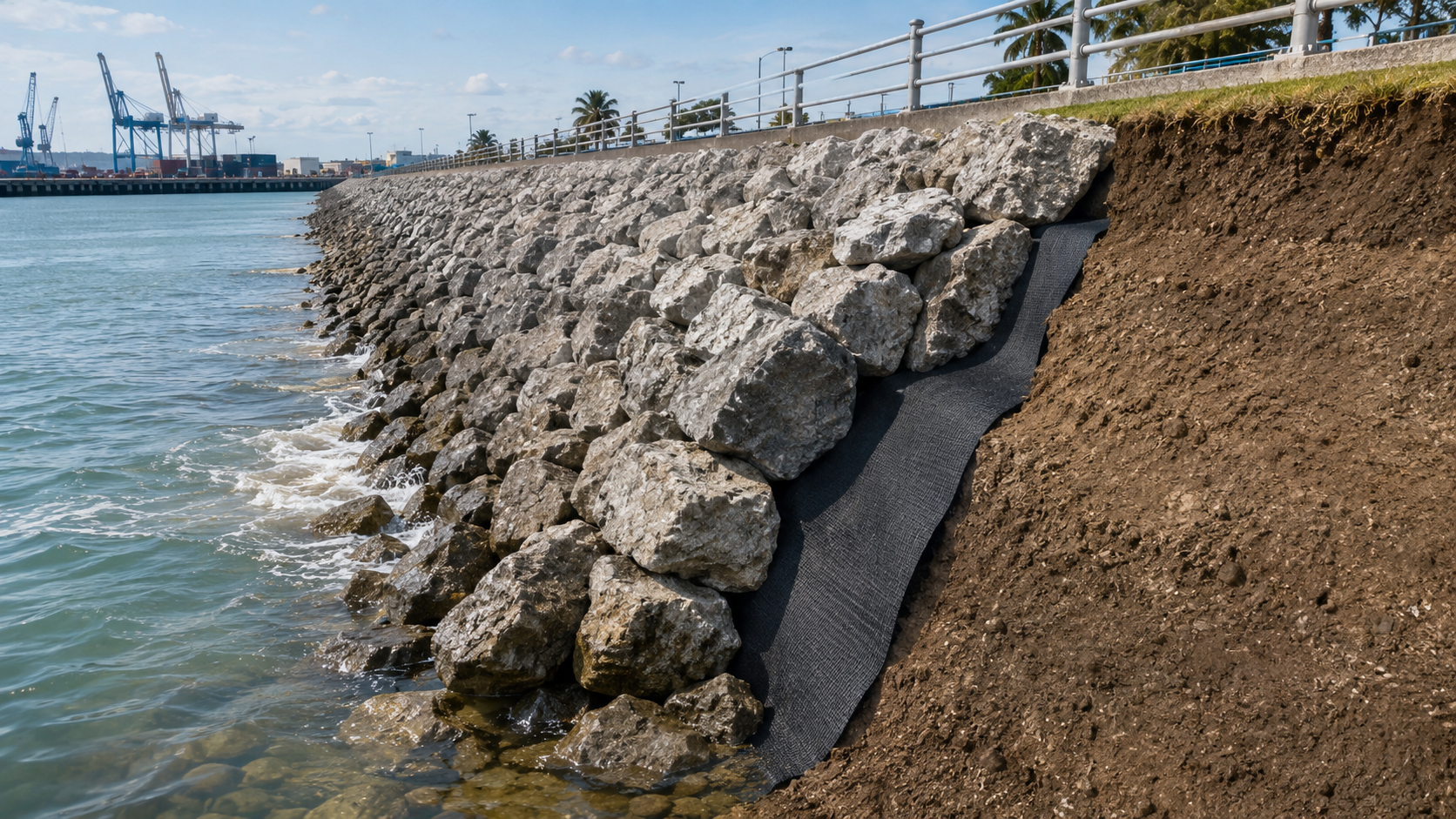
Coastal erosion is rarely just a surface problem. When waves, tides, runoff, and storm surge keep moving water through a shoreline slope, fine soil particles can wash out from behind rock armor or revetment systems. Over time, that hidden soil loss can lead to settlement, voids, slope instability, and expensive repairs.
That is why geotextile fabric matters in coastal and port engineering. The fabric is not the visible armor layer. Its job is quieter but critical: retain soil, allow controlled water movement, separate layers, and support long-term shoreline performance.
Table of Contents
Why Soil Loss Behind Shoreline Protection Matters
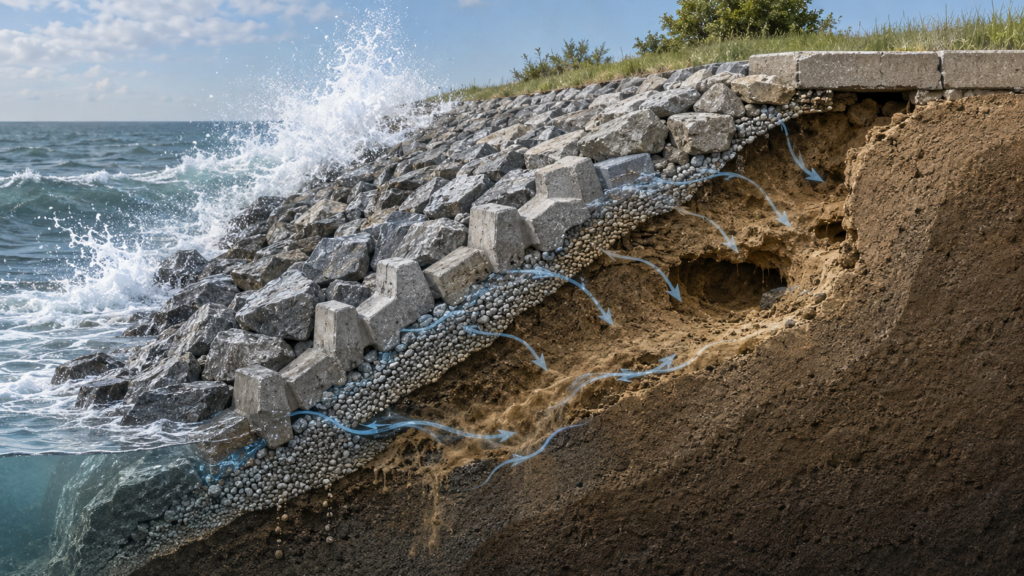
Riprap, armor stone, and concrete blocks are often used to absorb wave energy and protect exposed slopes. But these systems have voids. If there is no proper filter layer beneath them, water can move through the armor and carry fine soil particles out of the slope.
For port engineers and restoration contractors, this means erosion control is not only about placing larger stones. It is about preventing internal soil migration that weakens the slope from behind.
Geotextile Fabric Is a Filter Layer, Not Just a Sheet
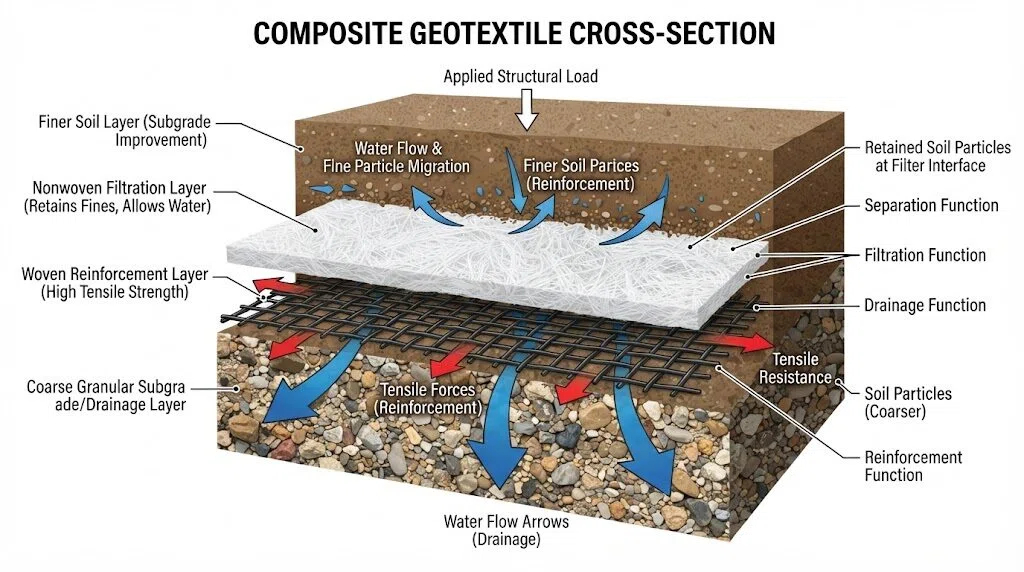
Geotextile fabric is often placed between the soil foundation and the armor layer. In shoreline protection, it works as a filter, separator, and soil retention layer.
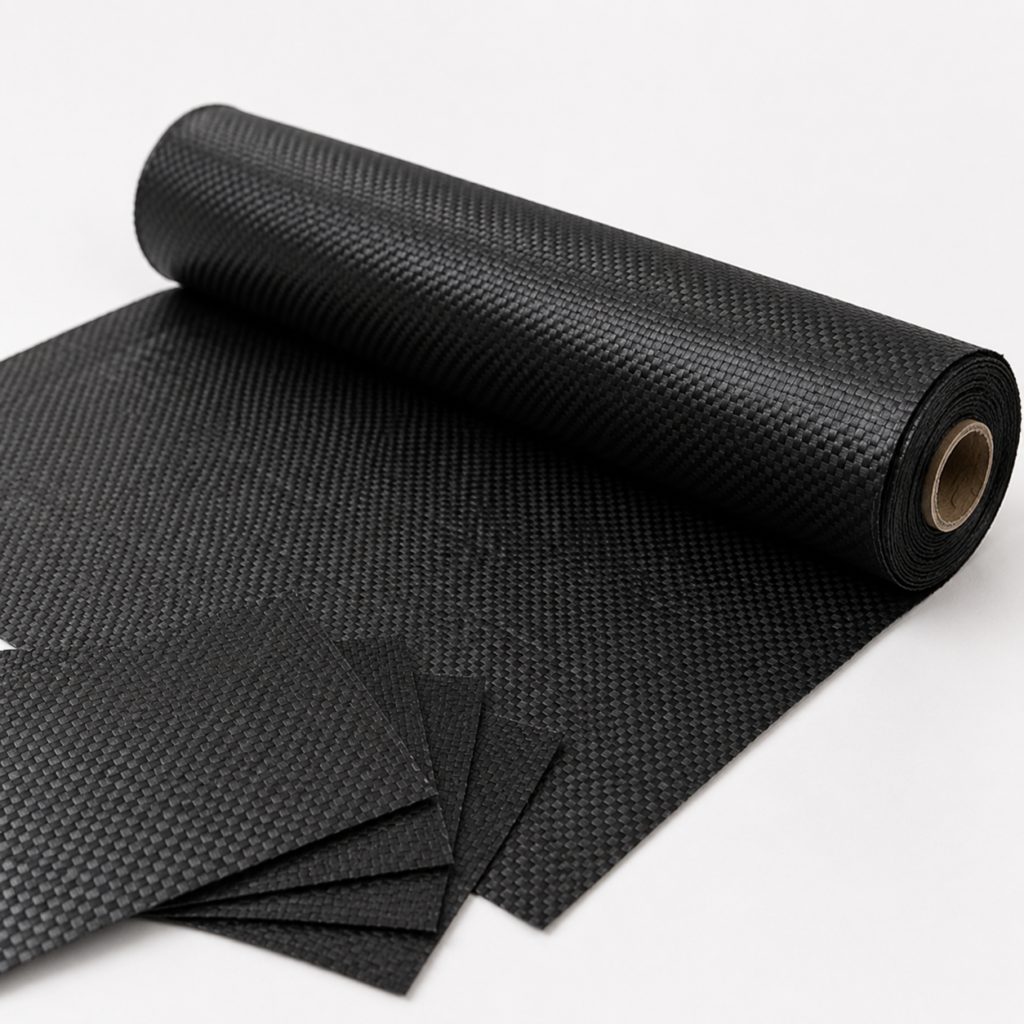
Its role is to:
- Allow water to pass through.
- Retain soil particles.
- Separate soil from riprap or aggregate.
- Reduce internal erosion.
- Improve installation stability.
- Support longer service life of revetment systems.
This is where woven geotextile fabric becomes useful in high-load shoreline projects. Its woven structure can provide stronger tensile performance and good soil retention when properly matched to soil type, hydraulic conditions, and installation requirements.
Key Pain Points in Coastal and Port Projects
Many shoreline failures happen because the filter layer is overlooked or poorly selected. The project may look stable after installation, but the slope can slowly lose soil underneath.
Common problems include:
1.Soil pumping through riprap voids
2.Slope settlement behind armor stone
3.Geotextile tearing during stone placement
4.Poor overlap between fabric rolls
5.Clogging due to wrong opening size
6.Edge exposure caused by wave action
7.Construction damage from equipment or sharp stones
Buyer Insight: If a shoreline protection system fails early, the material cost of the geotextile is rarely the main loss. The real cost usually comes from slope repair, rock replacement, downtime, equipment mobilization, and environmental disturbance.
How Geotextile Fabric Improves Erosion Control
The value of geotextile fabric is not only technical. It also affects project cost, installation reliability, and lifecycle performance.
In a riprap-protected shoreline, geotextile fabric helps create a stable interface between the armor layer and the soil. Water can pass through the fabric, but soil migration is reduced. This helps prevent void formation behind the armor layer.
For coastal erosion control, this creates three practical benefits:
- Better soil retention behind the armor layer
- Lower risk of slope voids and settlement
- More stable performance under repeated wave and runoff exposure
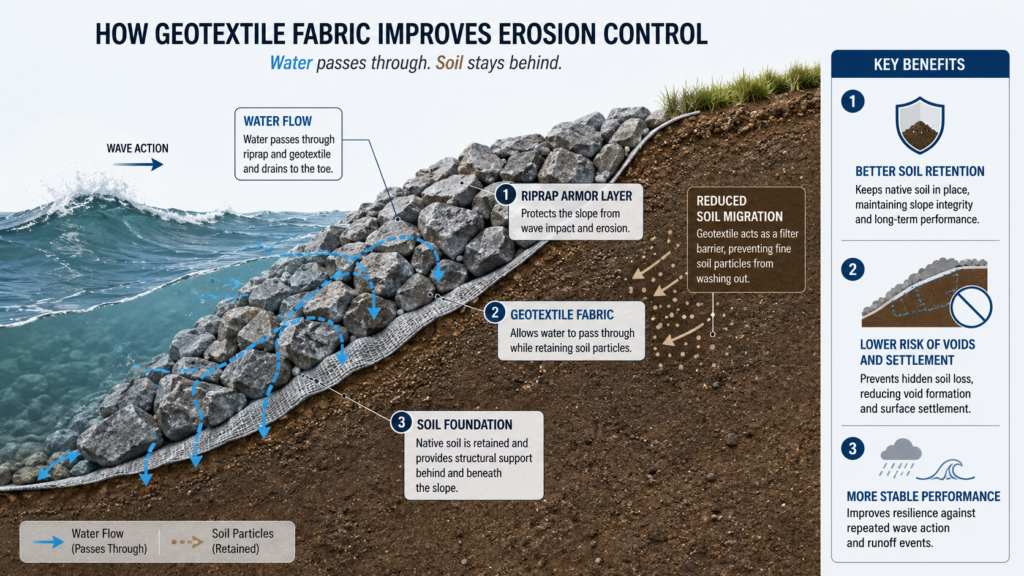
The result is not a maintenance-free shoreline. No material can promise that. But a properly selected geotextile layer can reduce one of the most common failure paths: hidden soil loss.
Where Geotextile Fabric Is Used in Coastal Projects
Geotextile fabric is useful in several shoreline and marine infrastructure applications.
In riprap revetments, it is commonly placed beneath rock armor to prevent soil loss while allowing water to drain. This is one of the strongest use cases for woven geotextile fabric when tensile strength and installation survivability are important.
In port embankments, geotextile fabric can help separate soft subgrade soil from fill material. This supports better layer integrity and reduces contamination between soil and aggregate.
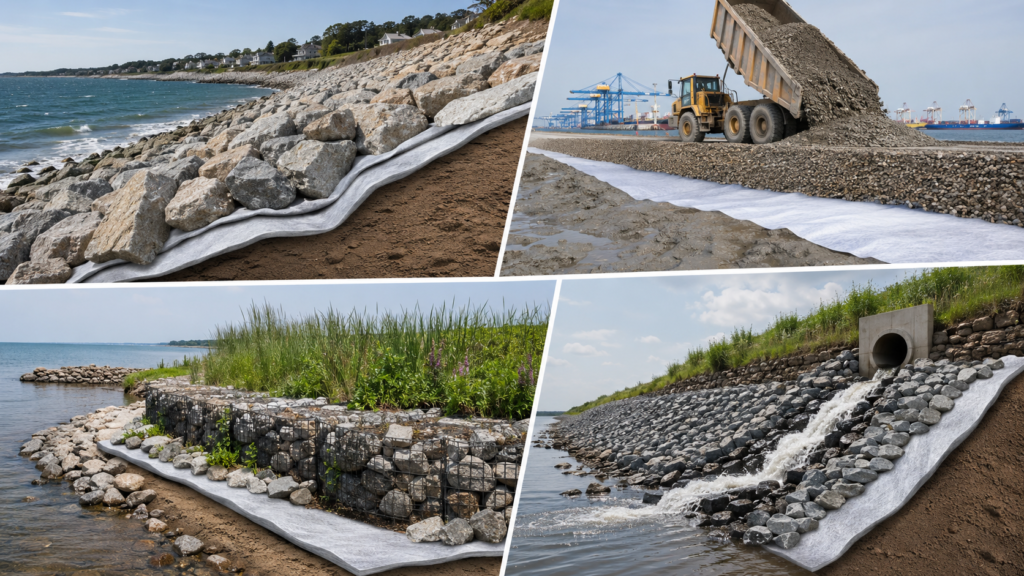
In drainage outlets and coastal slopes, the fabric can help protect soil around flow discharge points where concentrated runoff may accelerate erosion.
How to Choose Geotextile Fabric for Shoreline Protection
Selecting geotextile fabric for shoreline protection should begin with the failure mode. Is the slope losing soil? Is the riprap settling? Is the fabric at risk of puncture? Is drainage more important than reinforcement?
Key specifications to review include:
- Tensile strength
- Puncture resistance
- Apparent opening size
- Permeability
- UV resistance
- Seam strength
- Roll width
- Installation survivability
- Chemical resistance
- Project standard compliance
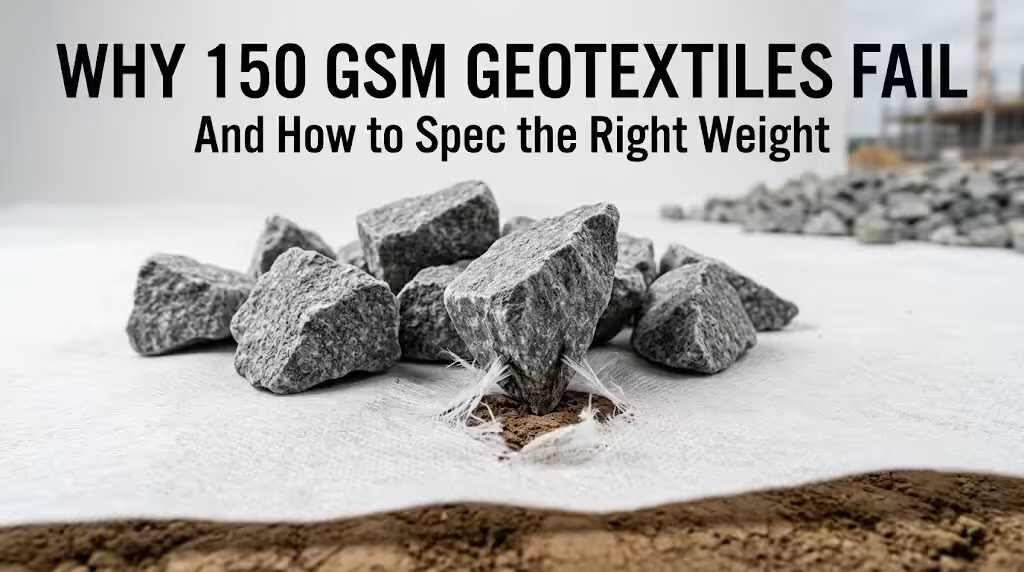
Do not choose only by weight. Mass per unit area can be useful, but it does not fully describe filtration behavior, tensile performance, puncture resistance, or suitability for site conditions.
For high-load coastal slopes and port infrastructure, woven geotextile fabric is often considered where soil retention, tensile strength, and resistance to construction stress are important. Nonwoven geotextiles may be more suitable where drainage and cushioning are the main priorities.
The better question is not “woven or nonwoven?” It is “which fabric function does this project need most?”
Installation Quality Can Decide Long-Term Performance
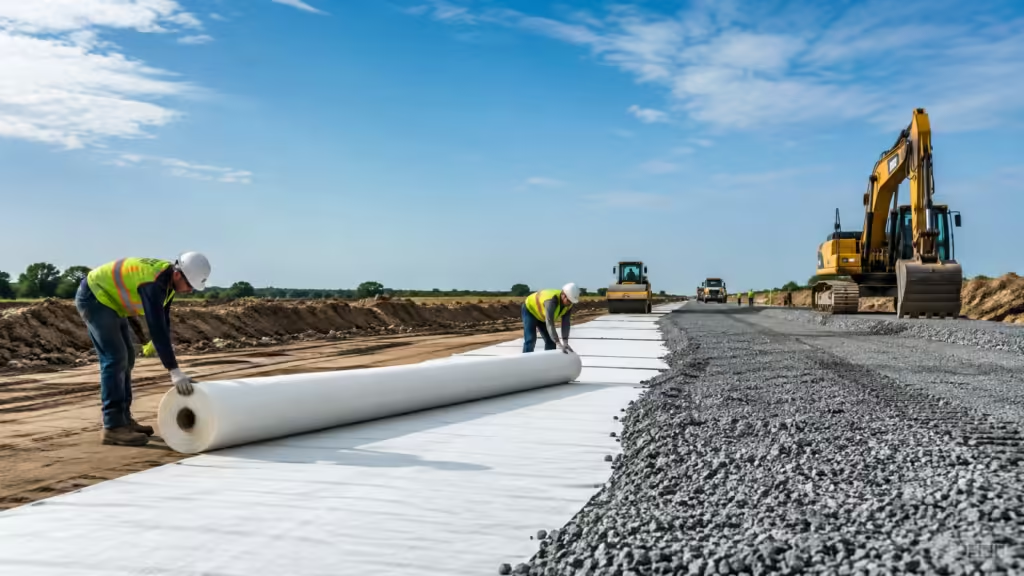
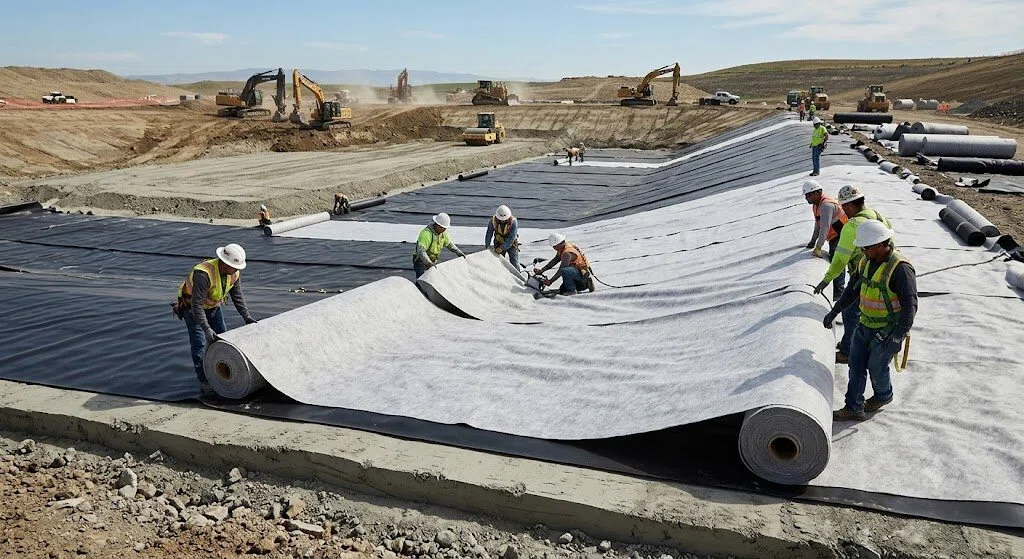
Even the right geotextile fabric can underperform if installation is poor. In coastal environments, installation damage is a major concern because heavy riprap and uneven subgrade surfaces can puncture or displace the fabric.
Good installation practice includes:
- Preparing the slope surface
- Removing sharp debris
- Using proper roll overlap
- Anchoring fabric edges
- Avoiding wrinkles and bridging
- Preventing equipment damage
- Placing riprap carefully from the base upward
- Protecting exposed fabric from sunlight before cover placement
Pro Tip: In marine projects, installation planning should consider tide windows, equipment access, stone placement method, and emergency protection if weather changes before the armor layer is completed.
Future Direction
Coastal projects are moving toward more performance-based material selection. Engineers are no longer looking only at first cost. They are also reviewing lifecycle value, installation risk, maintenance access, environmental impact, and long-term resilience.
This trend favors better documentation. Port authorities, environmental restoration firms, and contractors increasingly need technical datasheets, third-party testing, roll traceability, and project-specific specification support.
Geotextile fabric will continue to support both hard armor and hybrid shoreline designs. In heavy wave zones, it may support riprap and revetment structures. In sheltered areas, it may work with more nature-based shoreline systems. The best future designs will not treat geotextile as an accessory. They will treat it as part of the erosion control system.
Conclusion
Geotextile fabric for erosion control is most valuable where shoreline protection needs more than visible rock armor. It helps retain soil, control filtration, separate layers, and reduce the hidden erosion that can cause slope failure behind riprap.
For port engineers, coastal contractors, and environmental restoration companies, the right choice depends on soil conditions, wave exposure, slope design, riprap size, installation method, and long-term maintenance expectations.
Woven geotextile fabric can be a strong option when tensile strength, soil retention, and installation durability are critical. The best next step is to match the fabric specification to the project’s hydraulic and structural demands, then work with a supplier that can provide reliable testing data, consistent roll quality, and project-ready documentation.
FAQ
What is geotextile fabric used for in erosion control?
Geotextile fabric is used to separate soil from armor layers, retain soil particles, allow controlled water flow, and reduce erosion behind riprap or slope protection systems.
Is woven geotextile fabric suitable under riprap?
Yes. Woven geotextile fabric is often used under riprap where soil retention, tensile strength, and installation durability are important.
How does geotextile fabric prevent soil loss?
It works as a filter layer. Water can pass through, but soil particles are retained behind the fabric, reducing washout and internal erosion.
Woven or nonwoven geotextile: which is better for shoreline protection?
It depends on project needs. Woven geotextile is often selected for higher tensile strength and soil retention. Nonwoven geotextile is often used for drainage, cushioning, and filtration.
Can geotextile fabric prevent slope failure?
It can help reduce slope failure risk by improving separation, filtration, and soil retention, but it must be part of a properly designed shoreline protection system.
What should buyers check before ordering geotextile fabric?
Buyers should check tensile strength, puncture resistance, opening size, permeability, UV resistance, roll width, seam strength, and project standard compliance.