
GRI-GM13 Standard Guide: Mastering HDPE Quality Control for Global Bidding
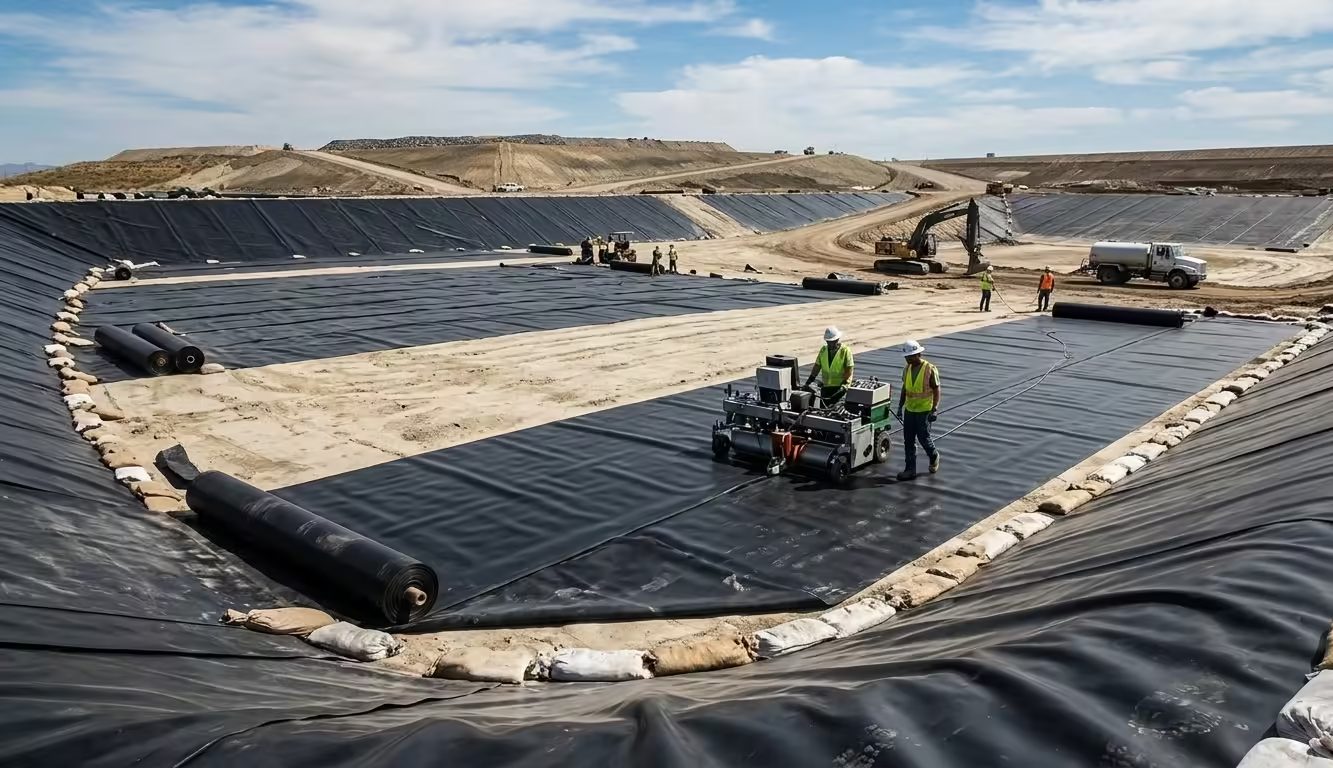
In the realm of international civil engineering and environmental containment, technical specifications serve as the bedrock of project longevity. For procurement officers and site engineers, the GRI-GM13 Standard is not merely a suggestion—it is the definitive benchmark for High-Density Polyethylene (HDPE) geomembranes. Established by the Geosynthetic Institute (GSI), this specification provides a rigorous framework that bridges the gap between raw material manufacturing and field performance.
Navigating the complexities of a global tender requires more than just a low price point; it demands a sophisticated understanding of material science and compliance. When a project specification cites the GRI-GM13 Standard, it is calling for a specific balance of chemical resistance, mechanical strength, and endurance against oxidative degradation. Failure to meet these metrics often leads to immediate disqualification in high-stakes bidding environments.
Table of Contents
Technical Framework of the GRI-GM13 Standard
The GRI-GM13 Standard was developed to address the variability in HDPE liner quality across different global manufacturers. Unlike general ASTM standards that may only cover specific test methods, GM13 is a “specification” that dictates exactly what values a material must achieve to be considered “Standard Grade.”
This specification is updated periodically by the Geosynthetic Institute to reflect advancements in polymer science. It categorizes requirements into four distinct areas: raw resin properties, physical properties of the sheet, mechanical properties, and endurance properties. For a manufacturer to claim compliance with the GRI-GM13 Standard, every roll of material must be traceable back to a batch that passed these multi-axial tests.
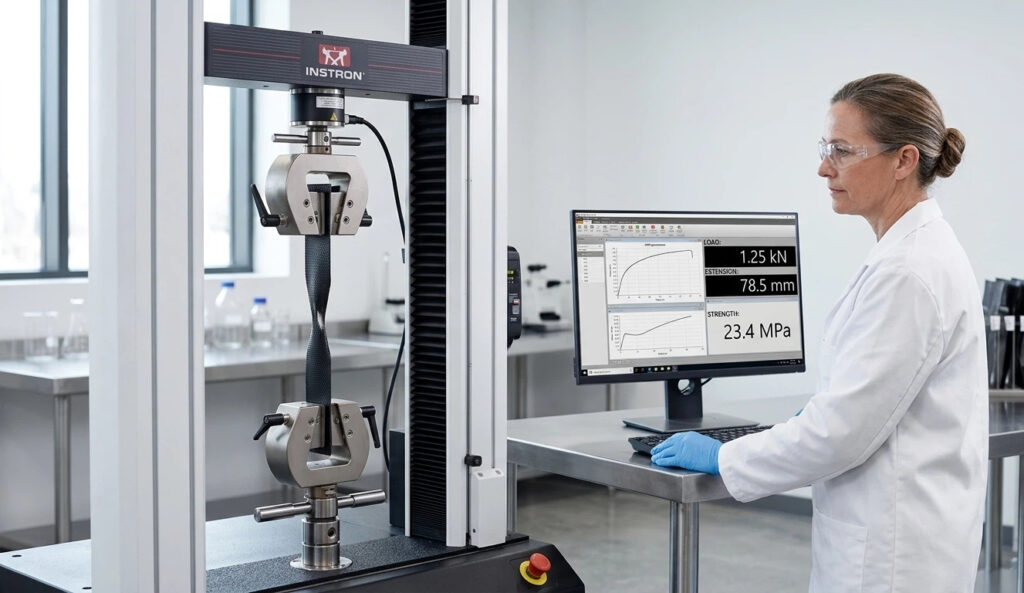
You can view the official list of current GSI specifications and their latest revisions at the Geosynthetic Institute (GSI) Official Site.
Essential Metrics in HDPE Quality Control
Effective HDPE Quality Control begins with the resin. The GRI-GM13 Standard mandates that the resin must have a density greater than 0.941 g/cm³. This high density is what gives the liner its exceptional chemical resistance, making it suitable for hazardous waste landfills and mining heap leach pads.
However, density is only the starting point. Two parameters in the GRI-GM13 Standard often cause the most confusion during technical audits:
1.Oxidative Induction Time (OIT)
This test measures the effectiveness of the antioxidant package added to the polyethylene. In the world of HDPE Quality Control, OIT is the primary indicator of how long a liner will last before it begins to embrittle. The GRI-GM13 Standard requires both Standard OIT (ASTM D3895) and High-Pressure OIT (ASTM D5885) to ensure the material can withstand long-term exposure to heat and oxygen.
2.Stress Crack Resistance (SCR)
Environmental Stress Crack Resistance (ESCR) is evaluated using the Notched Constant Tensile Load (NCTL) test. The GRI-GM13 Standard sets a minimum threshold of 500 hours for this test. If a liner fails at 300 hours, it might look identical to a 500-hour liner to the naked eye, but it will likely fail prematurely under the mechanical stresses of a real-world installation.
For a deeper dive into the mechanics of stress cracking, refer to the ASTM D5397 standard documentation.
Understanding the Difference Between GRI-GM13 and GRI-GM17
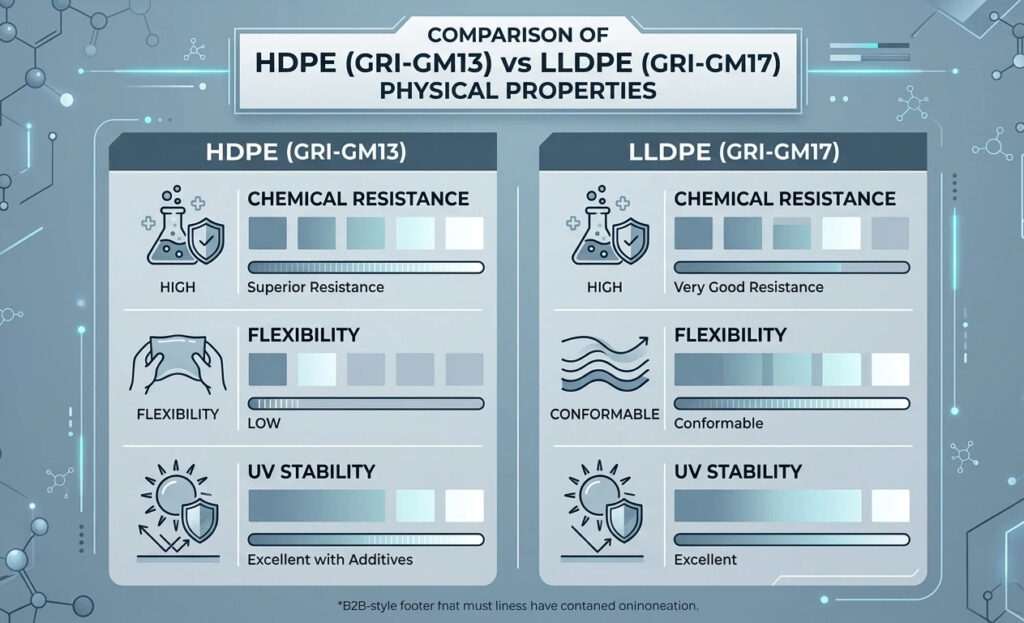
One of the most common errors in the bidding stage is the misapplication of materials. It is vital to recognize the difference between GRI-GM13 and GRI-GM17. While both are GSI specifications, they govern entirely different polymers.
GRI-GM13 is strictly for High-Density Polyethylene (HDPE), which is rigid and offers the highest chemical resistance. In contrast, GRI-GM17 governs Linear Low-Density Polyethylene (LLDPE). The difference between GRI-GM13 and its LLDPE counterpart lies in flexibility. LLDPE is much softer and more elongatable, making it ideal for capping systems where soil subsidence is expected.
However, in terms of sheer durability and UV resistance, the GRI-GM13 Standard remains the superior choice for exposed applications. Choosing the wrong specification can lead to catastrophic project failure, as LLDPE may not offer the chemical barrier required for aggressive industrial fluids.
How to Verify Third-Party Testing in International Tenders
In a globalized market, a manufacturer’s internal test report (MQA) is often not enough to satisfy the requirements of a sovereign wealth fund or an international NGO. To ensure the GRI-GM13 Standard is actually being met, third-party verification is non-negotiable.
When reviewing a bid, look for data from accredited laboratories such as TRI Environmental. A valid third-party report should correlate the roll numbers on-site with the sample numbers tested in the lab. If there is a discrepancy in the HDPE Quality Control documentation, the material should be flagged for re-testing.
Furthermore, the GRI-GM13 Standard requires a specific frequency of testing—usually one test for every 20,000 kg of resin or every 100,000 square feet of production. If a supplier provides a “typical” data sheet instead of “batch-specific” data, they are likely not in full compliance with the GRI-GM13 Standard.
Expert laboratory services and technical whitepapers on geomembrane verification can be found at TRI Environmental.
The Strategic Advantage of Compliance
Adhering to the GRI-GM13 Standard is a strategic move for any firm involved in international infrastructure. In many jurisdictions, including the EU and the United States, EPA regulations for landfill liners are built directly upon the foundations of the GRI-GM13 Standard.
From a financial perspective, the cost of a high-quality liner is a fraction of the total project cost, yet it is the single most important component for environmental protection. Investing in HDPE Quality Control at the procurement stage prevents the multi-million dollar liabilities associated with groundwater contamination.
When a supplier can demonstrate consistent adherence to the GRI-GM13 Standard, they provide the engineer of record with “design certainty.” This certainty is what allows for the 20-year or 50-year service life guarantees that modern environmental projects demand.
Conclusion
The GRI-GM13 Standard is more than a list of numbers; it is a global language of quality. By mastering the nuances of this specification, from OIT values to the difference between GRI-GM13 and GRI-GM17, procurement professionals can ensure they are getting exactly what they pay for.
In your next international tender, do not settle for “ASTM compliant” as a vague claim. Demand full adherence to the GRI-GM13 Standard and verify it with independent, third-party data. This is the only way to guarantee that your HDPE liner will perform as a reliable barrier for decades to come.
FAQ
What is the minimum thickness allowed under the GRI-GM13 Standard?
The standard covers thicknesses ranging from 0.75 mm to 3.0 mm. It is important to note that the “nominal” thickness must be met within a -10% tolerance for individual measurements.
How does UV resistance factor into HDPE Quality Control?
The GRI-GM13 Standard requires a minimum carbon black content of 2-3%. This provides the necessary screening to prevent UV rays from breaking the polymer chains during exposed storage or use.
Is there a difference between GRI-GM13 and ASTM D6693?
Yes. ASTM D6693 is a test method used to measure tensile properties. The GRI-GM13 Standard is a specification that tells you what the results of that ASTM test must be to pass.
Can a material meet the GRI-GM13 Standard if it uses recycled resin?
Technically, no. The GRI-GM13 Standard specifies that the resin must be “virgin” or “clean reworked” material from the same manufacturer. Post-consumer recycled resin is prohibited due to the risk of contaminants.
What is the “Oven Aging” requirement in the GRI-GM13 Standard?
Materials must undergo an accelerated aging process in a high-temperature oven for 90 days. After this, they must retain a high percentage of their original OIT value to prove long-term stability.