
HDPE vs LDPE Geomembrane: Is Chemical Resistance More Vital Than Flexibility?
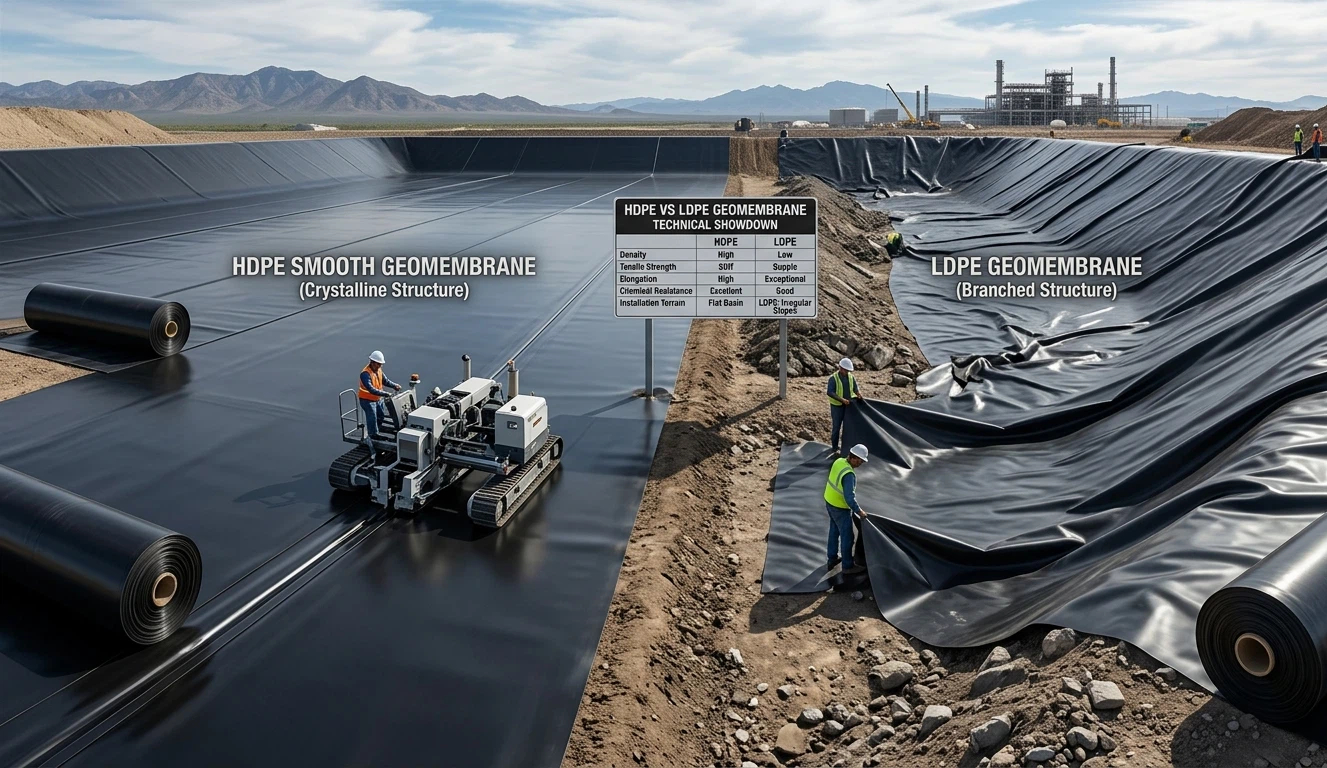
In the landscape of modern civil engineering, the integrity of a containment system is only as strong as its barrier. Selecting the wrong polymer can lead to catastrophic environmental leaks, regulatory fines, and project failure. When comparing HDPE vs LDPE geomembrane options, the decision is rarely about which material is “better” in a general sense, but rather which is “fit-for-purpose” based on specific site conditions.
Both High-Density Polyethylene (HDPE) and Low-Density Polyethylene (LDPE) are part of the same thermoplastic family, yet their mechanical behaviors diverge significantly due to their molecular architecture. This guide provides a rigorous technical analysis of the HDPE vs LDPE geomembrane debate to ensure your next containment project is built on a foundation of data-driven decisions.
Table of Contents
The Molecular Foundation: Stiff vs. Supple
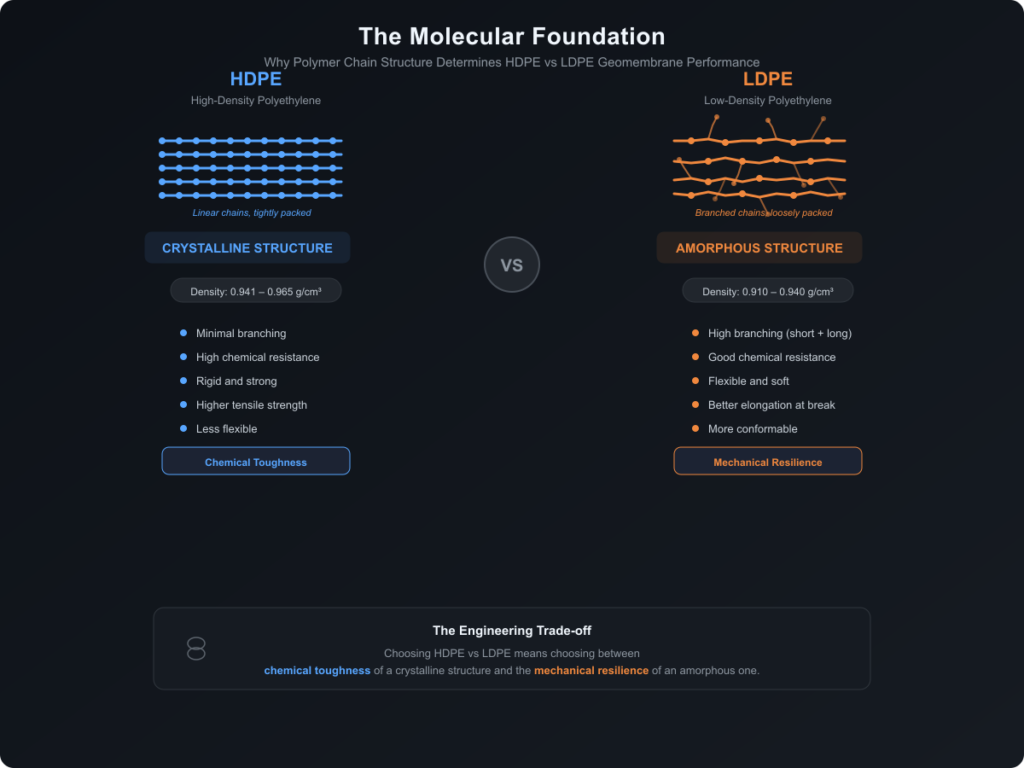
The core of the HDPE vs LDPE geomembrane distinction lies in polymer crystallinity. HDPE ischaracterized by a linear structure with minimal branching, allowing polymer chains to packtightly together. This results in a high-density material with a typical specific gravity between0.941 and 0.965 g/cm3.
Conversely, LDPE features a high degree of short and long-chain branching. This branching prevents the molecules from packing into a tight crystalline structure, resulting in a more amorphous, flexible material. When engineers evaluate HDPE vs LDPE geomembrane performance, they are essentially choosing between the chemical toughness of a crystalline structure and the mechanical resilience of an amorphous one.
HDPE Smooth Geomembrane: The Chemical Powerhouse
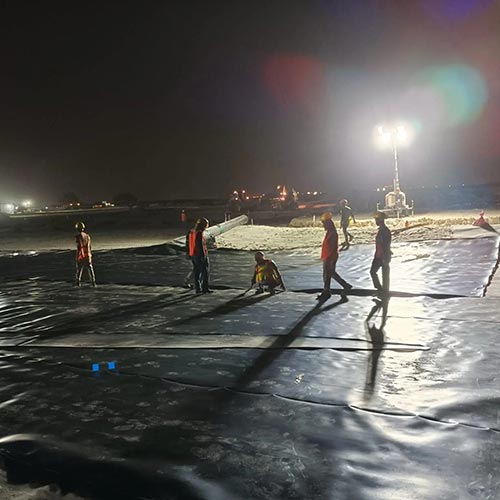
HDPE smooth geomembrane is the industry standard for high-stakes containment. Because of its dense molecular structure, it offers the highest level of chemical resistance among polyethylene liners. It is virtually impermeable to a wide range of acids, bases, and hydrocarbons, making it the premier choice for hazardous waste landfills and mining heap leach pads.
Beyond chemical resistance, HDPE smooth liner properties include exceptional UV stability. By incorporating high-quality carbon black, manufacturers ensure that these liners can remain exposed to direct sunlight for decades without significant oxidative induction time (OIT) loss. However, its rigidity means that the material is sensitive to environmental stress cracking if the subgrade is not perfectly prepared or if the material is subjected to localized tension.
LDPE Geomembrane: Excellence in Flexibility
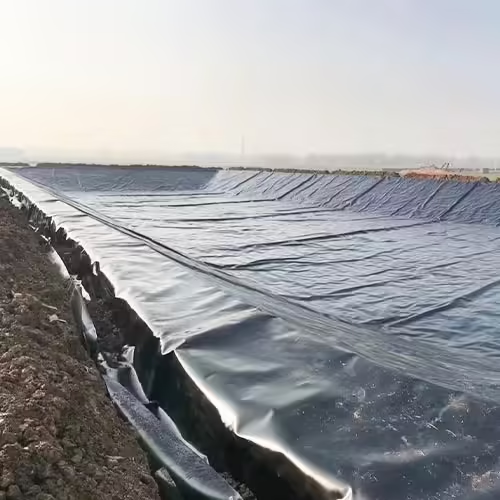
While HDPE is the powerhouse of strength, the LDPE geomembrane is the master of adaptability. Its primary advantage is flexibility, allowing it to conform to irregular terrains, steep slopes, and complex geometries without the risk of puncturing or “bridging.”
The LDPE liner properties make it particularly valuable in decorative ponds, agricultural reservoirs, and temporary containment covers. If your project involves a site with high seismic activity or shifting subgrades, the flexible geomembrane for pond liners (specifically LDPE or LLDPE) provides the necessary elongation to stretch with the earth’s movement rather than snapping under stress.
Technical Showdown: HDPE vs LDPE Geomembrane
To aid in the selection process, we have summarized the mechanical differences based on the global industry benchmarks GRI-GM13 (for HDPE) and GRI-GM17 (for LDPE).
| Technical Property | HDPE Smooth Geomembrane | LDPE Geomembrane |
| Tensile Strength | Very High (Superior Yield) | Moderate |
| Elongation at Break | High (~700%) | Exceptional (>800%) |
| Chemical Resistance | Excellent (Acids/Hydrocarbons) | Good (General purpose) |
| Flexibility | Rigid / Stiff | Highly Flexible / Supple |
| Stress Crack Resistance | High (Industry Standard) | Exceptional (Flexible) |
| UV Resistance | 20+ years (exposed) | 10-15 years (typically buried) |
| Common Application | Landfills, Mining, Waste Cells | Ponds, Canals, Water Storage |
This data confirms that a thorough HDPE vs LDPE geomembrane analysis is critical because the materials excel in entirely different mechanical environments.
Performance Trade-offs: Elongation and Chemical Shielding
A frequent point of discussion in the HDPE vs LDPE geomembrane selection process is the LDPE geomembrane elongation vs HDPE trade-off. In landfill applications, you need the material to stand its ground against aggressive leachate. In this scenario, a chemical resistant HDPE smooth liner is the logical choice because its density prevents chemical molecules from penetrating the polymer matrix.
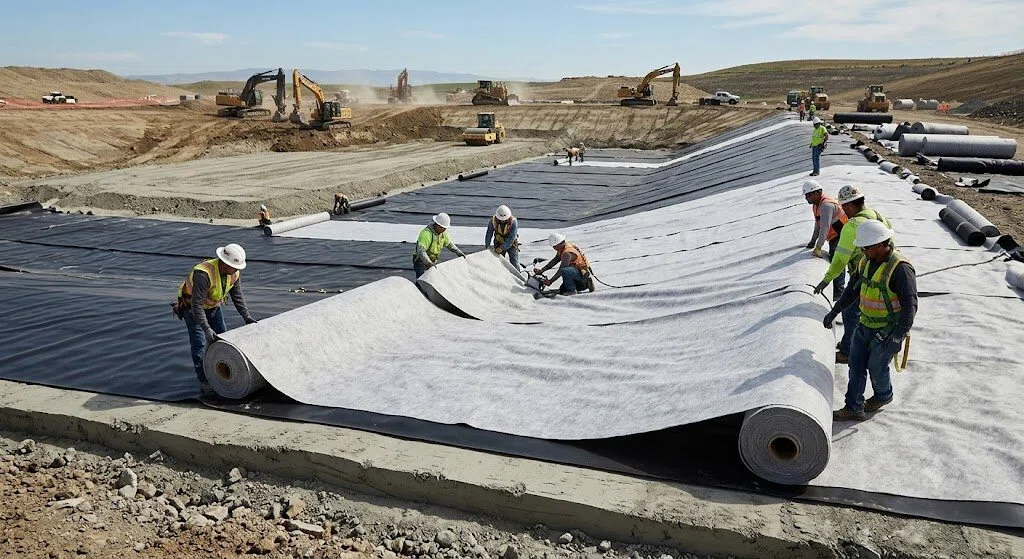
However, a rigid liner on a rocky slope is a recipe for disaster. The difference between HDPE and LDPE geomembrane becomes most apparent during installation. LDPE can be folded and unfolded repeatedly without creating “white stress marks” or creases that could later turn into cracks. This “mechanical forgiveness” is why LDPE remains the top choice for projects where perfect subgrade preparation is physically impossible.
Environmental Factors and Stress Cracking
Temperature plays a massive role in HDPE vs LDPE geomembrane longevity. HDPE has a high coefficient of thermal expansion and contraction. On a hot day, an HDPE liner can expand and form “whales” or waves; if these are welded into place, they can become points of stress when the material shrinks in the winter.
LDPE handles thermal stress much more gracefully. Because it is inherently more elastic, it can absorb these thermal cycles without the same risk of environmental stress cracking. When developing your geomembrane selection guide, you must account for the local climate and how often the liner will be exposed to extreme temperature swings.
Industry Standards and Quality Assurance
Regardless of which side of the HDPE vs LDPE geomembrane debate you fall on, quality assurance is paramount. You must ensure your supplier adheres to the Geosynthetic Institute (GSI) standards:
- GRI-GM13 (HDPE): Focuses on oxidative induction time, carbon black content, and density. Visit Geosynthetic Institute
- GRI-GM17 (LDPE/LLDPE): Focuses on multi-axial elongation and puncture resistance. Visit GSI Publications
Adhering to these polyethylene liners for containment standards is the only way to guarantee that the material delivered to the site matches the engineering properties required by the design.
Conclusion
Ultimately, the HDPE vs LDPE geomembrane decision comes down to the balance between chemical shielding and mechanical flexibility. If you are protecting groundwater from toxic chemicals in a flat, controlled basin, HDPE is your best asset. If you are lining a sprawling agricultural reservoir on uneven ground, the flexible nature of LDPE will ensure a leak-free outcome.
By utilizing a professional geomembrane selection guide and understanding the fundamental difference between HDPE and LDPE geomembrane, you can design systems that are both economically efficient and environmentally secure.
FAQ
Can I use LDPE for a hazardous waste landfill?
Generally, no. Most environmental regulations require the superior chemical resistance found in an HDPE smooth geomembrane for hazardous materials.
How does the welding process differ for these materials?
HDPE requires higher temperatures and pressures for wedge welding due to its higher melting point. LDPE is more “forgiving” and welds easily at lower temperatures, which can speed up installation.
Is there a cost difference in the HDPE vs LDPE geomembrane selection?
On a per-square-meter basis, the prices are often comparable, but LDPE may save you money on labor costs due to faster installation and less required subgrade refinement.
Which is the best geomembrane for mining heap leach pads?
HDPE is almost always the winner here because of its ability to withstand the heavy weight of the ore and the aggressive nature of the leaching chemicals.