
HDPE vs LLDPE Geomembranes: The Ultimate Chemical Resistance Guide
In environmental containment, the choice of liner material is often the single most critical factor in project longevity. The debate surrounding HDPE vs LLDPE Geomembranes is not merely about cost—it is about the fundamental molecular response of the material to specific stressors.
While both belong to the polyethylene family, their divergent manufacturing processes create distinct performance profiles. For engineers managing hazardous containment or large-scale water infrastructure, understanding the technical nuances of HDPE vs LLDPE Geomembranes is essential for mitigating environmental risk and ensuring regulatory compliance.
Molecular Structure: The Core Difference
The primary distinction between High-Density Polyethylene (HDPE) and Linear Low-Density Polyethylene (LLDPE) lies in their crystallinity.
- HDPE: Characterized by high density (>0.941 g/cm^3), it features minimal branching in its polymer chains. This creates a highly crystalline structure that acts as a superior barrier against molecular diffusion.
- LLDPE: Incorporates significant side-chain branching, which reduces crystallinity. This makes the material significantly more flexible and easier to install on uneven subgrades, though it changes how the liner reacts to chemical exposure.
When conducting a technical geomembrane comparison, HDPE typically offers higher tensile strength and lower permeability, while LLDPE excels in elongation and puncture resistance.
Chemical Resistance: HDPE’s Strongest Asset
For industrial applications, the choice often defaults to HDPE because it is the quintessential chemical resistant geomembrane. Its dense molecular packing provides an unparalleled defense against acids, bases, and many organic solvents.
In the management of harsh liquids, engineers frequently consult a geomembrane chemical compatibility chart to predict how the liner will swell or degrade over time. According to the Geosynthetic Institute (GRI) GM13 Standard, HDPE must meet rigorous requirements for oxidative induction time (OIT), ensuring it remains stable in aerobic and anaerobic
If you are dealing with aggressive leachates, HDPE is generally regarded as the best geomembrane for industrial effluent because it effectively resists the “plasticizing” effect that can weaken more flexible materials.
Mechanical Performance and Stress Cracking
A critical factor in the HDPE vs LLDPE Geomembranes analysis is Environmental Stress Crack Resistance (ESCR).
Historically, HDPE was more prone to stress cracking under high-tension loads. However, modern resin technology (such as bimodal resins) has significantly narrowed this gap. Conversely, the inherent flexibility of LLDPE makes it virtually immune to stress cracking.
In scenarios where the subgrade is prone to differential settlement, the high elongation properties of LLDPE are advantageous. However, for long-term chemical containment where structural rigidity is required, the mechanical stiffness of HDPE vs LLDPE Geomembranes remains the industry preference.
Application Scenarios: Wastewater and Lagoons
One of the most frequent questions from municipal consultants is the suitability of HDPE vs LLDPE for wastewater lagoons.
HDPE for Wastewater Lagoons
HDPE is preferred for large-scale wastewater ponds where the primary goal is total containment of contaminants. Its high UV resistance (governed by ASTM D5885 standards) ensures that exposed slopes do not degrade over decades of sun exposure.
LLDPE for Wastewater Lagoons
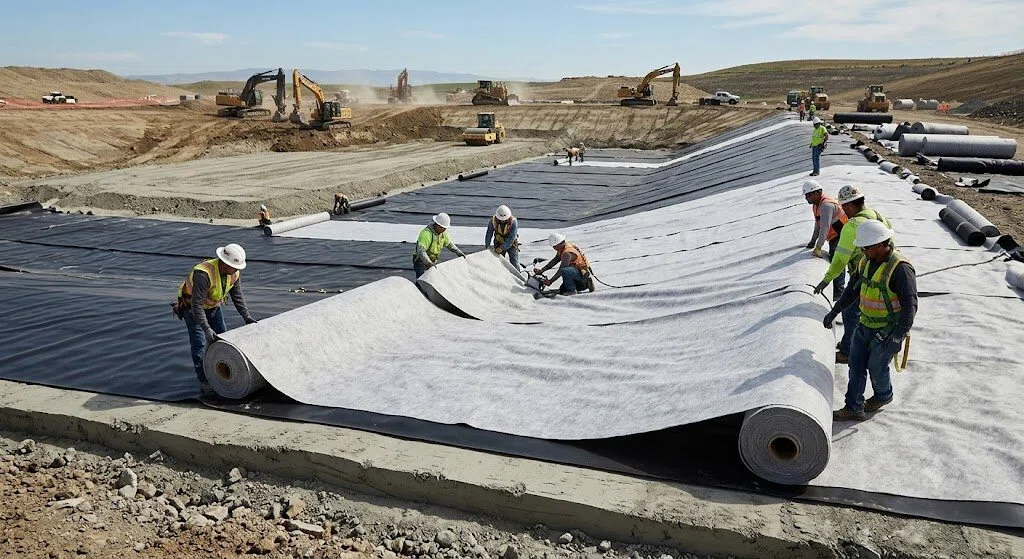
LLDPE is often chosen for smaller, complex lagoons or those with steep slopes and irregular geometries. Because it is more pliable, it conforms better to the terrain, reducing the risk of “bridging” during the installation process.
When deciding on HDPE vs LLDPE for wastewater lagoons, factor in the installation climate; LLDPE remains flexible in colder temperatures, making it easier to weld in sub-zero conditions.
Industrial Effluent and Mining
Selecting the best geomembrane for industrial effluent requires a deep dive into the specific chemical cocktails present.
In mining applications, particularly heap leach pads, the load-bearing capacity of HDPE vs LLDPE Geomembranes is tested under millions of tons of ore. HDPE’s ability to resist high-pressure chemical infusion makes it the standard for gold and copper mining.
For projects requiring an ultra-reliable chemical resistant geomembrane, HDPE’s low vapor transmission rate ensures that hazardous chemicals do not migrate into the local groundwater.
Comparison Matrix: HDPE vs LLDPE
To simplify your procurement process, here is a professional geomembrane comparison table:
| Property | HDPE (High-Density) | LLDPE (Linear Low-Density) |
| Chemical Resistance | Superior (Best for harsh acids/bases) | Good (Adequate for most liquids) |
| Flexibility | Low (Stiff, requires careful layout) | High (Very pliable, conforms to ground) |
| UV Resistance | Excellent (Standard for exposed use) | Good (Often requires cover) |
| Weldability | Standard (Requires expertise) | Excellent (Easier to weld/repair) |
| Primary Use | Landfills, Mining, Wastewater | Closure caps, Complex slopes, Water storage |
Choosing between HDPE vs LLDPE Geomembranes often comes down to a trade-off between chemical inertness and physical adaptability.
Cost-Benefit Analysis and Service Life
B2B procurement is driven by the total cost of ownership (TCO). While the raw material costs for HDPE vs LLDPE Geomembranes are often similar, the installation costs vary. HDPE may require more specialized welding equipment and longer installation windows due to its rigidity.
However, HDPE’s estimated service life in anaerobic environments can exceed 100 years. This longevity makes the investment in HDPE vs LLDPE Geomembranes more attractive for long-term municipal and industrial infrastructure.
Sourcing and Technical Verification
When you buy geomembranes online, you must demand a full set of quality control documentation. A reputable supplier should provide:
1.ASTM D5199 thickness verification.
2.ASTM D1505 density reports.
3.A comprehensive geomembrane chemical compatibility chart specific to their resin blend.
Verification of these parameters ensures that your choice in the HDPE vs LLDPE Geomembranes debate is backed by empirical data rather than marketing claims.
Conclusion
In summary, the decision for HDPE vs LLDPE Geomembranes hinges on your specific site conditions. If your project involves hazardous chemicals, long-term UV exposure, or massive structural loads, HDPE is the clear winner. If you are dealing with irregular topography, thermal expansion challenges, or require a faster installation, LLDPE is your best ally.
By prioritizing a chemical resistant geomembrane that meets international standards, you protect both your investment and the environment. The balance of HDPE vs LLDPE Geomembranes is a cornerstone of modern geosynthetic engineering.
FAQ
Is LLDPE cheaper than HDPE?
The prices are usually comparable. The real difference is in the installation labor and the long-term maintenance requirements of the project.
Can I use HDPE for landfill caps?
While possible, LLDPE is often preferred for caps because it can accommodate the settlement and subsidence of decomposing waste without tearing.
How does the HDPE vs LLDPE Geomembranes comparison apply to drinking water?
Both can be used if they are NSF-61 certified. However, HDPE’s lower permeability makes it a common choice for high-purity water reservoirs.
Where can I find a reliable geomembrane chemical compatibility chart?
Most manufacturers provide one based on their specific resin. For general guidelines, refer to the technical databases maintained by the Geosynthetic Institute.