
How to Engineer a Century-Lasting HDPE-GCL Composite Liner for Your Landfill
Table of Contents
Designers think in layers, and that’s the useful way to see containment: each layer has a job. If you’re choosing materials for a cap or base liner, weigh chemical resistance, puncture risk during installation, and how settlement will affect long-term performance.
Designing with HDPE-GCL: practical rules
Start with a clear site assessment — soil profiles, groundwater depth, and waste chemistry shape your decision. A carefully selected HDPE-GCL composite can reduce required clay thickness while still meeting leachate control targets. For municipal solid waste facilities the geomembrane thickness is commonly regulated (many guidance documents and manufacturers reference a 60-mil / ~1.5 mm minimum for HDPE liners in certain MSW applications).
Always confirm slope stability needs early. Textured or reinforced geomembranes may be required where shear stress is high, and the composite pairing of geomembrane + GCL must be detailed in the contract drawings and specification.
Choosing geomembrane thickness and pairing it with GCL
A pragmatic approach wins: use a geomembrane thickness that balances installation robustness and cost, and choose a GCL product with documented flux and swell properties. Standards and test frequencies for HDPE geomembranes and associated materials are defined in industry guides
GRI-GM13 references a comprehensive set of ASTM test methods to evaluate HDPE geomembrane properties, including but not limited to:
- ASTM D5199 – Thickness measurement
- ASTM D1505 / D792 – Density determination
- ASTM D4218 – Carbon black content
- ASTM D5596 – Carbon black dispersion
- ASTM D638 / D6693 – Tensile properties
- ASTM D1004 – Tear resistance
- ASTM D4833 – Puncture resistance
- ASTM D5397 – Stress crack resistance (Notched Constant Tensile Load Test)
- ASTM D3895 / D5885 – Oxidative Induction Time (OIT)
By anchoring each performance requirement to a specific, globally recognized test method, GRI-GM13 eliminates ambiguity and ensures consistency across laboratories, manufacturers, and project locations.
Remember, thicker is not always smarter: a high-quality GCL placed under a competent geomembrane can give equal or better long-term performance than an overly thick geomembrane alone, especially where differential settlement is a concern.
Final cover and closure: how HDPE-GCL contributes
Final covers must shed water, minimize infiltration, and survive root/animal disturbance. In constrained situations a geomembrane over a GCL makes the cap slimmer and lighter, while still meeting performance goals. State and regional guidance documents give specific installation and documentation requirements for closure systems — follow those procedures and record every seam test and anchor detail.
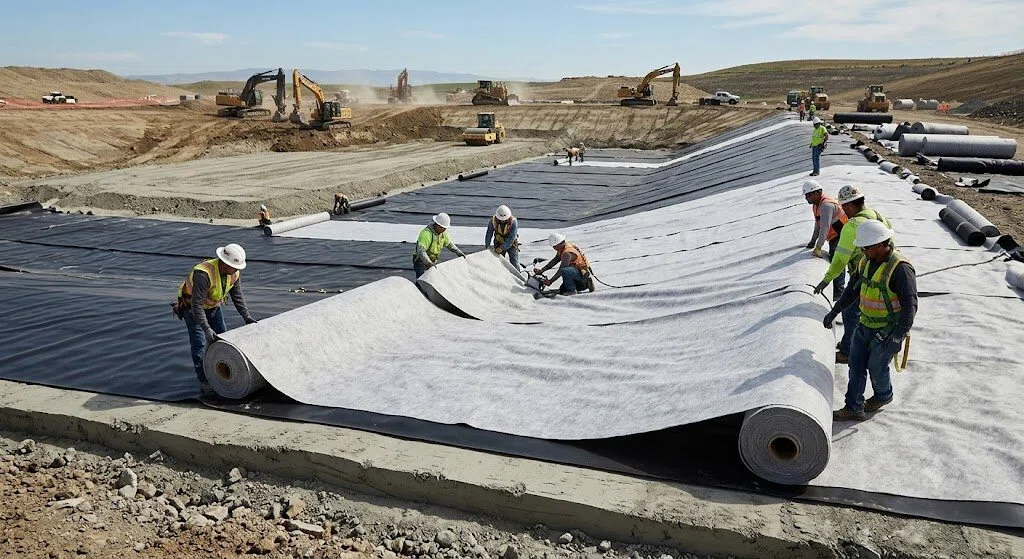
Execution matters: proper anchorage, overlap, and protection from construction traffic are non-negotiable. Where vegetation is planned, include root barriers or adequate protective cover over geomembranes and GCLs.
Testing, QA and standards to rely on
Factory certificates, seam weld records, destructive seam tests, and on-site spark or air tests for geomembranes are all part of modern QA. For GCLs, check manufacturing certificates for bentonite content, swell index, and permeability; require sample testing during procurement. Industry guides from GRI and specialist organizations outline sampling frequency and test suites to request.
Practical tips from the field
Pre-installation meetings, mock seaming tests, and a short demonstration seam on site cut risk dramatically. Capture roll numbers, lot numbers, and certificates of conformance in the QA log to make traceability simple.
If you specify HDPE-GCL, ask suppliers for permeation data, ASTM test sheets, and references from recent projects. When HDPE-GCL is used in a final cover system keep an accessible QA folder, and plan inspections during the post-closure period.
Remember: an HDPE-GCL composite is a system — not a single product. Operators who treat HDPE-GCL as disposable often find leaks; those who design and maintain it as a long-term system get the low flux and peace of mind they contracted for. Specify remedies, monitoring wells, and an emergency repair kit for the HDPE-GCL during turnover.
If you want to know more detailed information about HDPE-GCL, please click here.