
PET vs PP Geotextile: The Engineering Guide to pH Compatibility and Chemical Degradation Risk

When evaluating PET vs PP Geotextile for long-term infrastructure projects, the decision often boils down to more than just tensile strength or initial unit cost. For design institute engineers and project procurement managers, the stakes are significantly higher than simple material logistics. A wrong choice at the specification stage can lead to premature polymer degradation, potentially compromising the structural integrity of a multi-million dollar highway, landfill, or coastal defense system. Effectively navigating the selection process between PET vs PP Geotextile solutions requires a deep understanding of how synthetic polymers interact with varying soil chemistries.
The core of the challenge lies in the environment that the geosynthetic will inhabit for the next 50 to 100 years. Soil chemistry—specifically the fluctuating pH levels—interacts with these polymers in ways that are often invisible during the first few years of service but catastrophic a decade later. This guide provides a deep technical analysis of the variables that define the PET vs PP Geotextile performance gap to help you make an informed decision for your next project.
Table of Contents
Understanding Chemical Degradation in Subsurface Soils
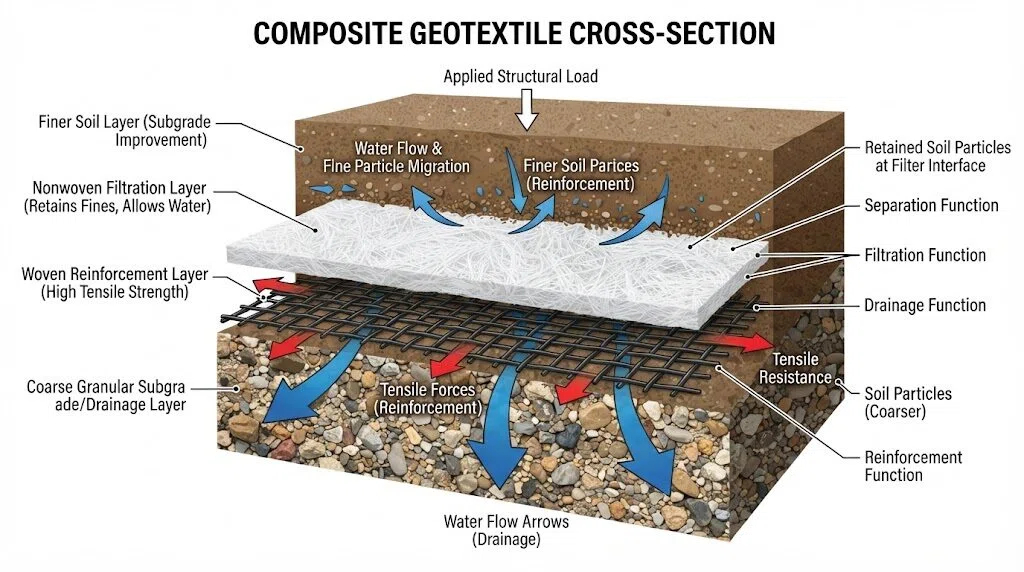
Every civil engineer is familiar with mechanical failure, but chemical degradation is the “invisible killer” of geosynthetics. In subsurface environments, polymers are subjected to oxidation and hydrolysis. While both PET and PP are durable, they react to soil chemistry in fundamentally different ways.
Polypropylene is naturally highly resistant to chemical attack. Because it is a non-polar carbon chain, it is almost entirely inert to both acids and alkalis. However, it is susceptible to oxidation, which can be accelerated by the presence of certain transition metals (like iron or manganese) found in specific soil types.
Polyester, on the other hand, is a polar polymer. Its ester bonds are vulnerable to the hydrolysis of polyester in soil, a process where water molecules break down the polymer chains. This reaction is significantly accelerated in alkaline environments. If you are working with concrete-stabilized soils, lime-treated subgrades, or coastal areas with high carbonate content, the chemical resistance of geotextiles becomes the primary design constraint.
PET vs PP Geotextile: Why pH Levels Dictate Service Life
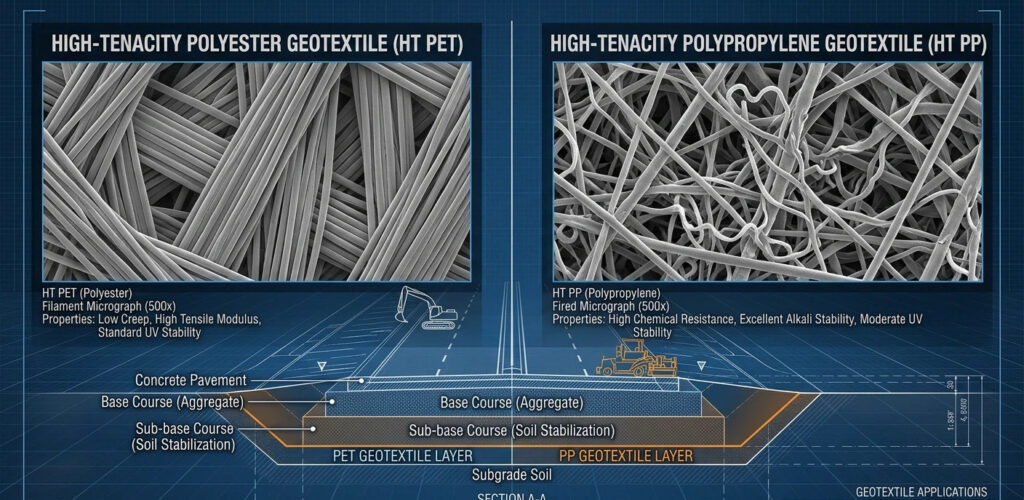
The most critical factor in the selection process is the pH level of the site. In technical terms, PET is generally considered safe for use in environments where the pH ranges from 2 to 9. Once the environment exceeds pH 9—common in areas where lime or cement is used for soil stabilization—the PET fibers begin to undergo alkaline hydrolysis, leading to a rapid loss of tensile strength. This is the fundamental differentiator in PET vs PP Geotextile chemistry.
For projects involving highly alkaline conditions, such as coal ash containment or cement-treated bases, an alkali-resistant geotextile made of polypropylene is the standard requirement. PP remains stable in pH levels ranging from 2 to 13, making it the superior choice for high-corrosion environments. Research published by the International Geosynthetics Society (IGS) confirms that the rate of strength loss in PET increases exponentially as the pH rises above the threshold of 10.
Assessing PET vs PP Geotextile for Creep Resistance
While PP wins the chemical battle in alkaline soils, PET often dominates in structural reinforcement applications due to its superior mechanical properties. Specifically, the long-term creep behavior of PET vs PP geotextile is a major differentiator for design engineers focusing on load-bearing structures.
Creep refers to the tendency of a solid material to move slowly or deform permanently under the influence of persistent mechanical stresses. Polyester has a much higher molecular weight and a more rigid molecular structure than polypropylene. Consequently, PET exhibits significantly lower creep strain. This means that under a constant load—such as the weight of an embankment—a PET geotextile will maintain its design thickness and strength far better than a PP equivalent over several decades.
If your project requires high-modulus reinforcement for a steepened slope or a retaining wall, the low-creep properties of our Polyester Geotextile make it the engineering-preferred choice. For designers, this mechanical edge often outweighs the chemical advantages of the alternatives in neutral or acidic soil conditions.
Identifying the Ideal PET vs PP Geotextile Environment
Despite the mechanical advantages of polyester, there are scenarios where PP is the only viable option due to extreme environmental stressors. Identifying the best geotextile for landfill leachate systems is a prime example. Leachate is a complex chemical cocktail that often includes high concentrations of surfactants and highly variable pH levels.
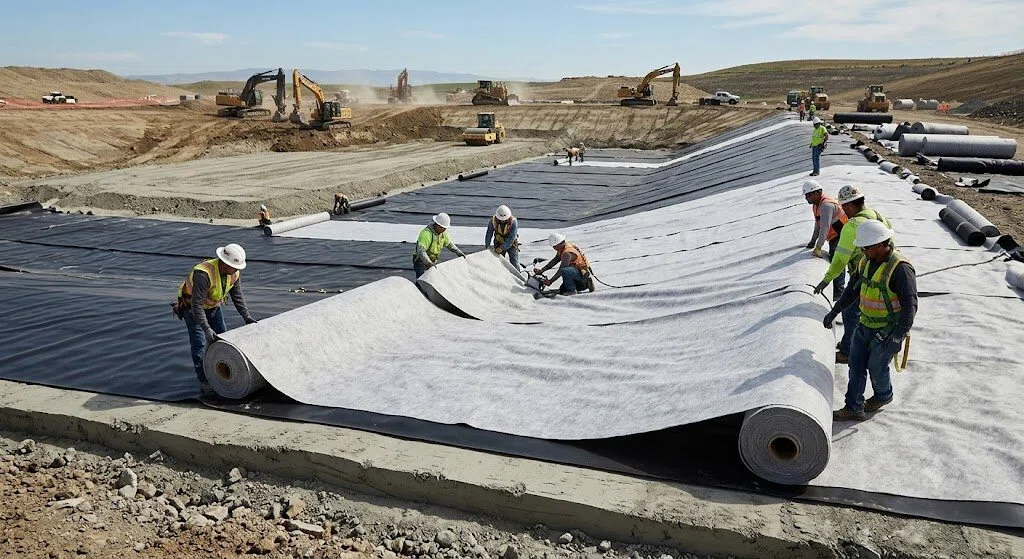
Polypropylene’s inert nature makes it the go-to for filtration and protection layers in environmental engineering. Our Polypropylene Geotextile is specifically engineered to resist the biological and chemical stressors found in waste management facilities. In these cases, the mechanical advantages of the PET vs PP Geotextile variants are secondary to chemical survival.
Another critical application is in coastal engineering. Seawater and salt-spray environments often involve fluctuating chemical compositions and high UV exposure during the construction phase. While PET has better UV resistance than untreated PP, modern PP geotextiles are fortified with carbon black and stabilizers to meet and exceed ASTM D4355 standards for UV degradation resistance.
Minimizing Total Cost of Ownership (TCO)
For procurement managers, the financial implications of the PET vs PP Geotextile choice are often viewed through the lens of initial cost. PP is generally lighter (lower specific gravity) and sometimes less expensive per square meter. However, the “cheapest” material often carries the highest risk of TCO if the environment is not properly assessed.
Consider the following procurement checklist for PET vs PP Geotextile acquisition:
1.Site pH Survey: If the soil pH is >9, ignore PET regardless of the price. The cost of failure outweighs any initial savings.
2.Design Life: For temporary works (less than 5 years), PET’s hydrolysis risk is negligible. For 100-year infrastructure, the material DNA must match the chemistry.
3.Logistics: Because PP is lighter, shipping costs for large-scale international projects can be 10-15% lower than PET.
4.Strength Requirements: If high tensile strength (e.g., >100 kN/m) is required with minimal elongation, PET is usually more cost-effective because you need less polymer mass to reach the strength target.
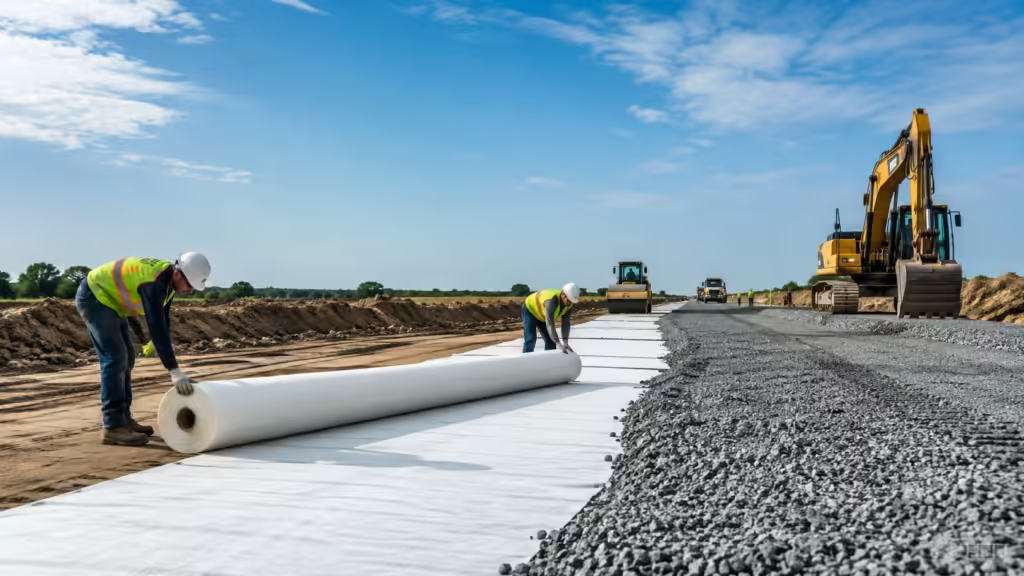
The cost-effectiveness of polyester geotextile for road stabilization is most evident in neutral or slightly acidic soils where high-modulus reinforcement is needed to reduce the required thickness of the expensive aggregate base.
Conclusion
Choosing the right material is not about finding a universal “winner,” but about matching polymer properties to geological reality. For design institutes, the priority remains long-term mechanical stability and chemical compatibility. For procurement managers, the goal is balancing technical safety with a logistics-optimized budget.
By understanding the technical nuances of PET vs PP Geotextile selection, you can avoid the costly mistake of choosing a polymer that dissolves in its own environment. Whether you require the high-modulus reinforcement of PET or the extreme chemical inertness of PP, ensuring the material matches the soil’s pH profile is the only way to guarantee the 100-year service life promised in your designs. Long-term success in building foundations starts with the right PET vs PP Geotextile.
FAQ
Can I use PET geotextile in a concrete-contact application?
Generally, no. The hydration of cement releases calcium hydroxide, creating a highly alkaline environment (pH 12-13). This will trigger hydrolysis in PET. Use PP for any application in direct contact with wet concrete or lime-stabilized soil.
Which material handles UV exposure better during construction?
Polyester (PET) has a naturally higher resistance to ultraviolet light. However, most high-quality polypropylene nonwoven geotextile properties include UV stabilizers (carbon black) that allow them to withstand several weeks of exposure without significant strength loss.
How do PET and PP compare in terms of water permeability?
Both can be manufactured as non-woven needle-punched fabrics with excellent hydraulic properties. The polymer type doesn’t significantly affect initial permeability, but PP’s chemical resistance ensures that its pore structure remains intact in corrosive environments.
What is the primary difference in “Creep” between the two?
Polyester is the “structural” fiber. Under a sustained load of 40% of its ultimate tensile strength, PET will typically deform less than 1-2% over its life, whereas PP may deform 10% or more. This is a critical factor when debating PET vs PP Geotextile for embankments.