
Retaining Wall Geotextile for MSE Walls: Controlling Lateral Earth Pressure and Preventing Wall DeformationMSE
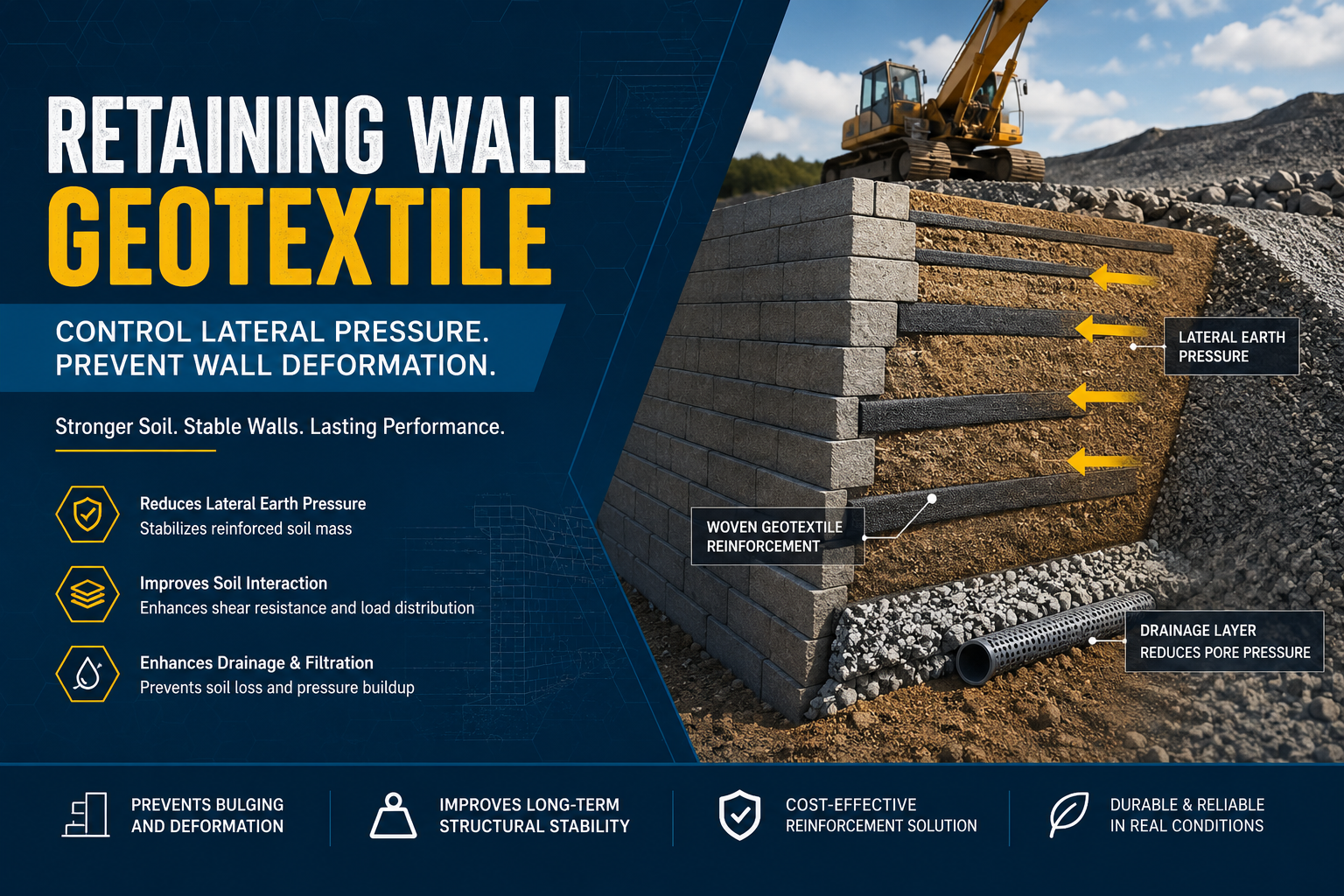
When a mechanically stabilized earth (MSE) wall starts to bulge, crack, or slowly lean outward, the real issue is rarely the facing panels—it is almost always excess lateral earth pressure building up behind the reinforced zone. This is exactly where Retaining Wall Geotextile becomes a structural control layer rather than just a separation fabric.
In practical field conditions, Retaining Wall Geotextile is used to stabilize soil mass, improve load distribution, and reduce deformation caused by uneven compaction or poor drainage. If you are dealing with wall movement, settlement, or long-term creep in reinforced soil structures, this guide will show you how Retaining Wall Geotextile actually works in real engineering scenarios, not theory.
Table of Contents
Why MSE walls start to bulge under lateral earth pressure
Most deformation problems in reinforced soil walls are not sudden failures. They develop slowly due to pressure imbalance.
In MSE systems, soil tries to expand laterally under load. If reinforcement is weak or improperly spaced, the face panels absorb the stress.
This is where Retaining Wall Geotextile plays a stabilizing role.
Common field failure pattern:
- Compaction inconsistency behind facing panels
- Water accumulation increasing pore pressure
- Insufficient tensile reinforcement
- Soil creep under sustained load
At this stage, Retaining Wall Geotextile acts as a tensile restraint layer, redistributing stress horizontally instead of allowing outward movement.
How Retaining Wall Geotextile controls deformation in real soil systems
Unlike rigid structural elements, Retaining Wall Geotextile works through soil interaction.
When installed in layered form, it:
- Interlocks with soil particles
- Restrains lateral deformation
- Improves shear resistance of backfill
- Reduces differential settlement near facing units
From a field perspective, Retaining Wall Geotextile does not “hold” soil like a wall. It converts unstable soil into a composite mass.
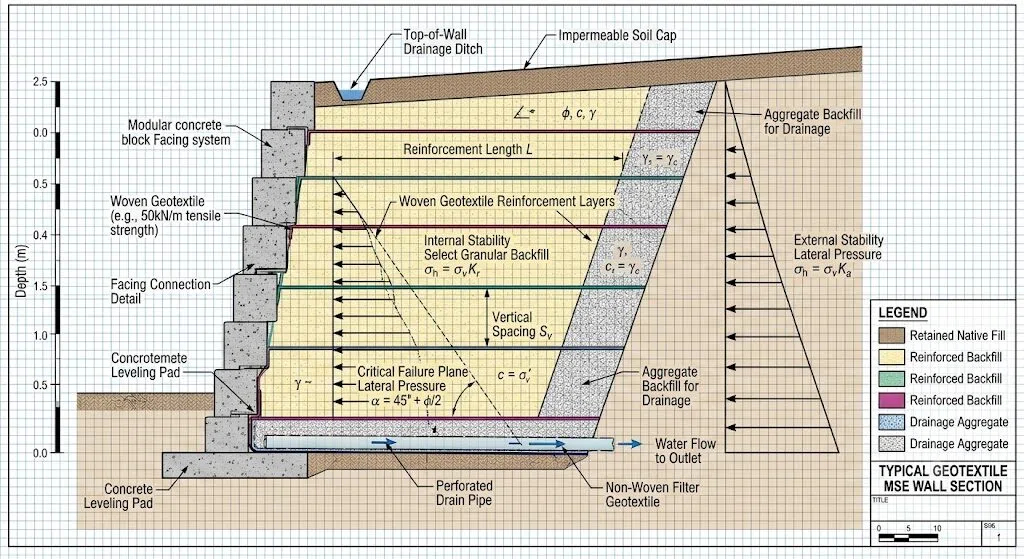
Woven geotextile vs geogrid in MSE reinforcement zones
A frequent engineering question is whether woven geotextile can replace geogrid.
The answer depends on load type and soil condition.
Practical comparison in field use:
- Geogrid: higher tensile strength, used in heavy structural walls
- Woven geotextile: better soil confinement and filtration control
- Hybrid systems: used in soft soil + drainage-sensitive zones
In real projects, Retaining Wall Geotextile is often selected when:
- Soil has fine particles
- Drainage control is critical
- Differential settlement risk is high
In many hybrid MSE systems, Retaining Wall Geotextile is placed closer to drainage layers, while geogrids carry primary tensile loads.
Drainage behavior and why pressure buildup destroys walls
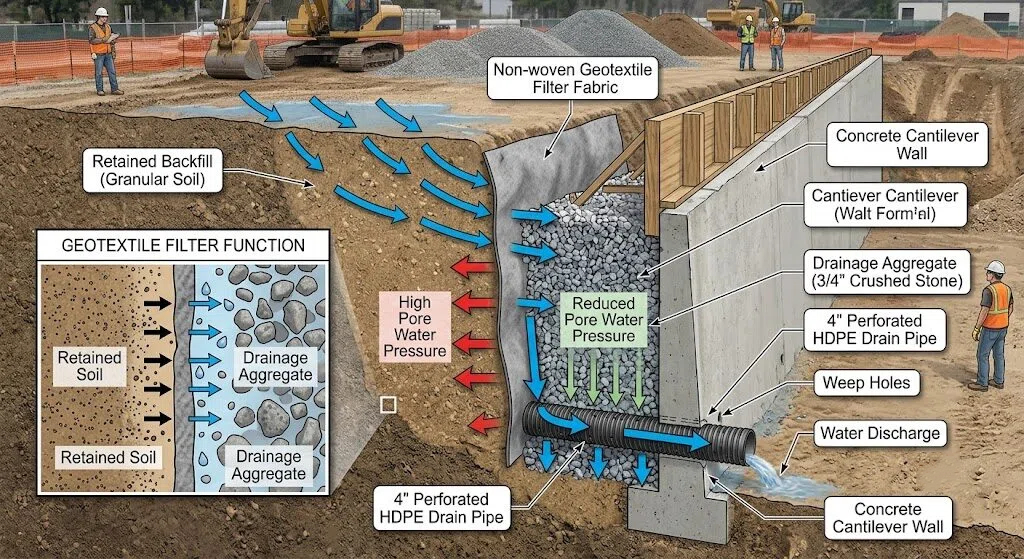
One of the most overlooked causes of wall deformation is trapped water.
When pore water pressure increases, effective stress decreases, and soil becomes more fluid-like under load.
EPA construction stormwater guidance highlights how unmanaged runoff increases soil instability
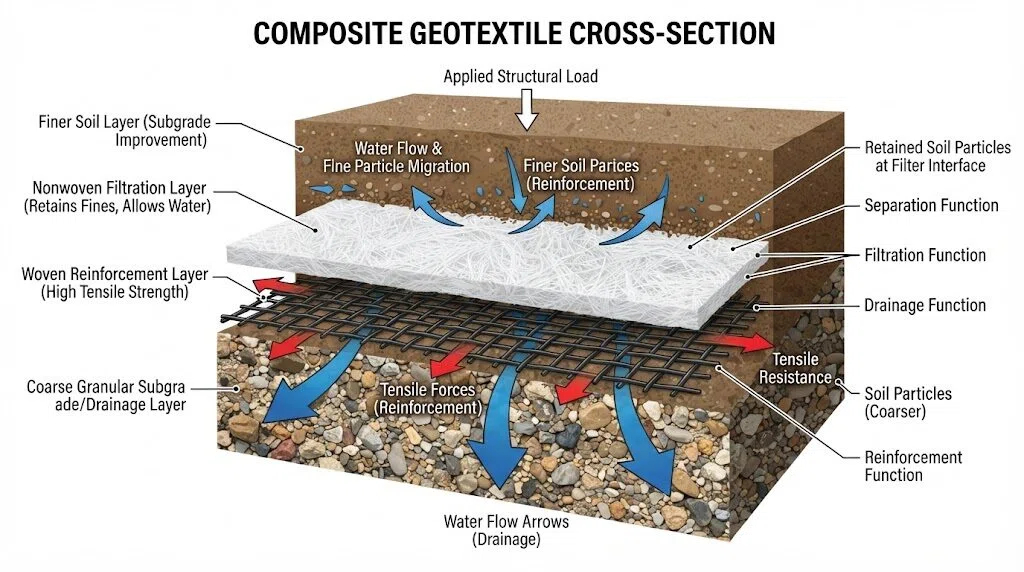
In this context, Retaining Wall Geotextile is not only reinforcement—it also functions as:
- Filtration barrier
- Soil particle retention layer
- Drainage pathway stabilizer
Without it, fine particles migrate and clog drainage systems, increasing hydrostatic pressure behind the wall.
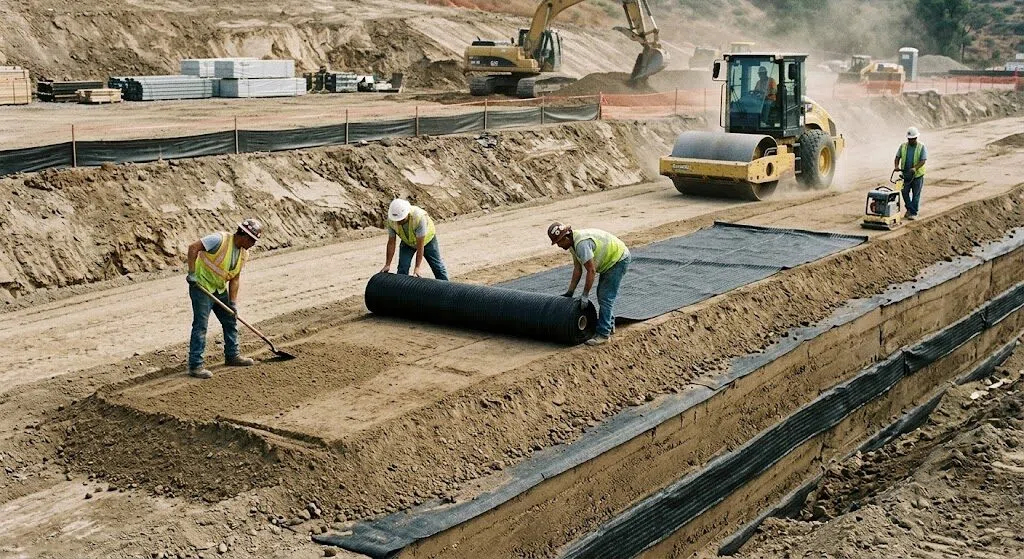
Installation mistakes that lead to wall failure
Most failures are not material failures—they are installation errors.
Field observations show three recurring issues:
1.Incorrect layer spacing
If Retaining Wall Geotextile spacing exceeds design limits, stress distribution becomes uneven.
2.Poor backfill compaction
Compaction near facing panels must be controlled in thin lifts.
3.No drainage continuity
Blocking drainage layers increases lateral load dramatically.
ASTM D4595 standard outlines tensile testing requirements for geosynthetics under sustained load.
In practice, Retaining Wall Geotextile must be tensioned and anchored properly during each lift installation, not simply laid into soil.
Material selection for high lateral pressure retaining systems
Not all woven geotextiles behave the same under load.
When selecting Retaining Wall Geotextile, engineers typically evaluate:
- Tensile strength retention over time
- Creep resistance under sustained load
- Permeability vs filtration balance
- Soil interaction friction coefficient
For practical product reference (woven reinforcement type used in field applications):
In high-load MSE walls, Retaining Wall Geotextile is often layered in multiple reinforcement zones rather than single placement.
When Retaining Wall Geotextile actually prevents failure
In field engineering, Retaining Wall Geotextile is most effective in:
- Highway embankment reinforcement zones
- Retaining walls on soft clay foundations
- Coastal soil stabilization systems
- Industrial yard elevation structures
In these cases, Retaining Wall Geotextile reduces deformation not by resisting force directly, but by converting soil into a unified reinforced mass.
Final engineering takeaway
In real MSE construction, structural stability is not achieved by facing units alone but by how effectively soil is transformed into a reinforced composite mass. When properly selected and installed, Retaining Wall Geotextile directly reduces deformation caused by lateral earth pressure, especially in drainage-sensitive or soft soil environments.
Ignoring reinforcement behavior almost always leads to long-term wall movement. Properly designed systems using Retaining Wall Geotextile distribute loads, stabilize backfill, and significantly reduce structural deformation risk.
If there is one takeaway from field practice, it is this: most retaining wall failures start in the soil, not the structure—and Retaining Wall Geotextile is what changes that soil behavior at scale.
FAQ
Does geotextile reduce lateral earth pressure?
Yes. It redistributes stress and reduces localized deformation.
Can geotextile replace geogrid in MSE walls?
Only in low to medium load conditions or hybrid systems.
What causes bulging in retaining walls?
Poor drainage, weak reinforcement, and uneven compaction.
Where is woven geotextile most effective?
In soil filtration + reinforcement zones behind retaining structures.
How many layers are typically used?
Depends on wall height, but usually multiple reinforcement zones are required.