
Advanced Geomembrane Sealing Guide: Mastering Complex Technical Interfaces
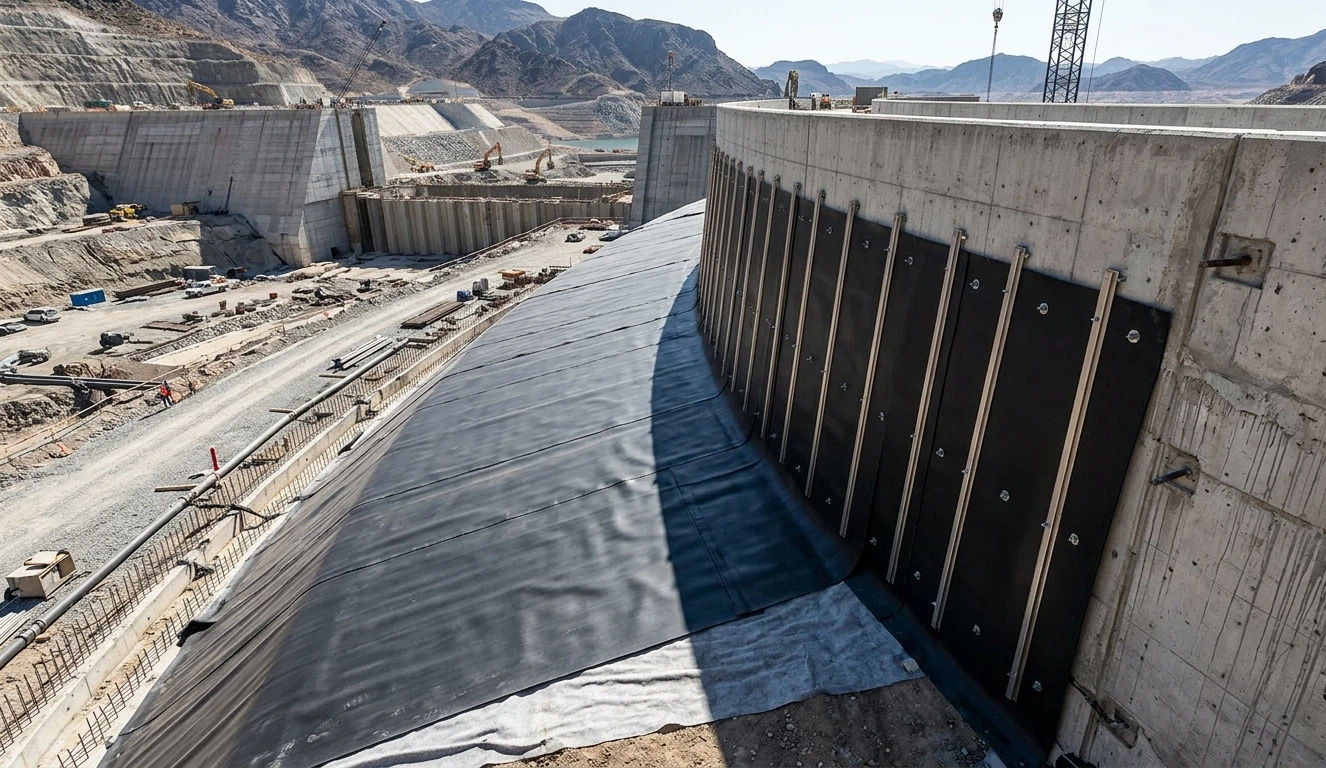
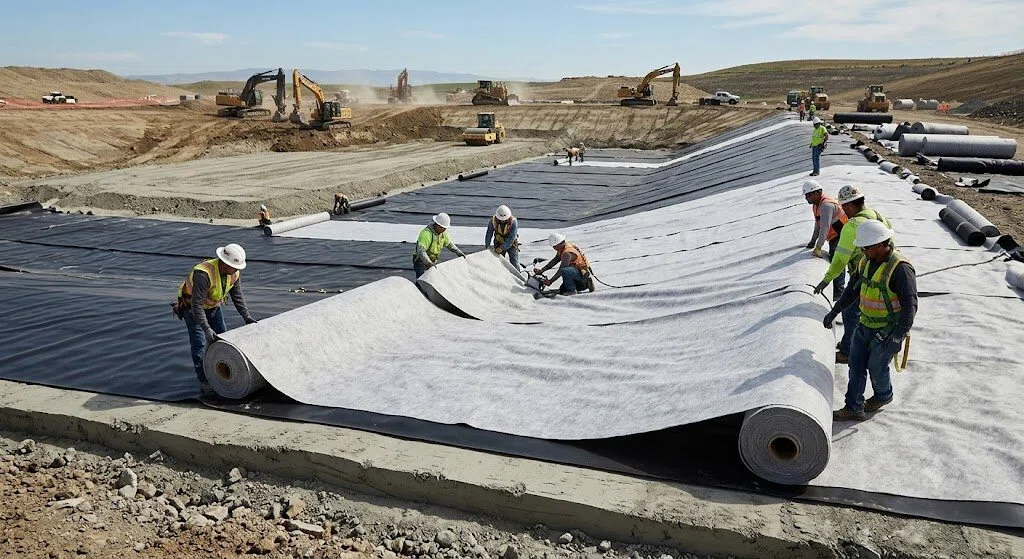
In large-scale containment projects, such as dams, landfills, and chemical lagoons, the primary geomembrane liner is only as strong as its weakest connection. While welding two flat sheets of HDPE is relatively straightforward, the true challenge lies in the precision required for Geomembrane Sealing at irregular points: concrete walls, pipe penetrations, and corner transitions.
Statistically, over 80% of leakages in hydraulic structures occur not within the field seams, but at the “termination” or “connection” points. This technical guide explores the advanced methodologies for ensuring long-term containment integrity in demanding environments.
Table of Contents
The Fundamentals of Professional Geomembrane Sealing
Achieving a flush Geomembrane Sealing interface involves more than just adhesive; it requires a deep understanding of material stress and mechanical anchoring. Because geomembranes and concrete have vastly different coefficients of thermal expansion, the connection must be able to withstand significant movement without compromising the seal.
Concrete Structures: The Batten Bar System
Connecting a flexible polymer liner to a rigid concrete structure is a fundamental difficulty in dam engineering. Effective Geomembrane Sealing to concrete structures typically requires a mechanical anchoring system rather than a simple chemical bond.
Batten Bar Systems and Anchoring
The industry standard for Geomembrane Sealing to concrete involves the use of stainless steel (SS316) or aluminum batten bars. These bars apply uniform pressure across the liner, sandwiching a high-quality sealant or a neoprene gasket against the concrete surface.
To achieve a leak-proof Geomembrane Sealing Detail, the concrete surface must first be “grinded” to a smooth finish (referencing CSP 3 standards). Any protrusions will puncture the membrane under the pressure of the batten bar. The use of chemical anchors spaced every 150mm ensures that the compression remains constant even under high hydraulic head pressure.
Pipe Penetrations: The “Pipe Boot” Methodology
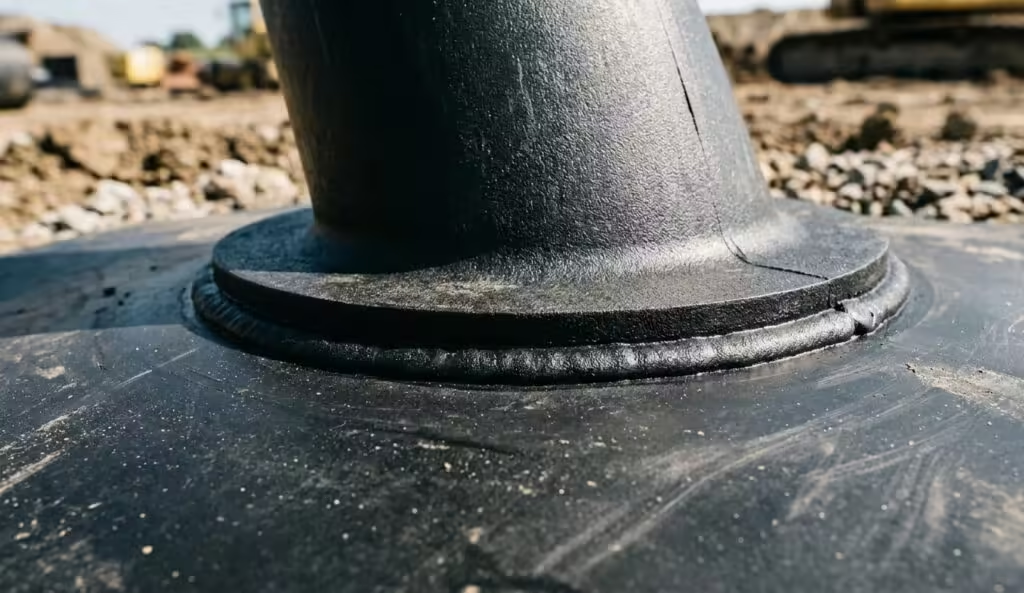
In water treatment and dam projects, pipes frequently pass through the liner. This creates a 360-degree irregular joint that is prone to failure if the Geomembrane Sealing is handled with standard tapes or simple mastic.
Prefabricated vs. Field-Fabricated Boots
For the most reliable results, engineers prefer prefabricated “Pipe Boots.” These are conical or cylindrical shrouds made of the same material as the primary liner (HDPE or LLDPE).
1.The “flange” of the boot is hot-wedge or extrusion welded to the primary liner.
2.The “sleeve” of the boot is secured to the pipe using multiple stainless steel hose clamps.
Applying a thick bead of water-swelling mastic between the pipe and the boot sleeve adds a secondary layer of protection to the Geomembrane Sealing assembly.
Stress Management at Corners and Sumps
Corners are stress-concentration zones. When a liner is installed too tightly in a corner (“bridging”), it will eventually tear under the weight of the water. This creates a high-risk area for any Geomembrane Sealing around drainage sumps or irregular basin floors.
To optimize the Geomembrane Sealing in these areas, technicians use “rub sheets” or reinforcement patches. These are extra layers of geomembrane extrusion-welded over the corner seams to provide mechanical redundancy. In dam projects, specialized Geomembrane Sealing Detail drawings often specify a “cushion layer” of non-woven geotextile beneath the liner at irregular concrete corners to prevent abrasion.
Addressing Dams and High-Head Pressure
When answering the question of how to seal geomembrane to concrete structures in dam projects, one must consider the extreme hydraulic pressure. In these scenarios, a single batten bar may not be enough to ensure permanent Geomembrane Sealing performance.
Double-termination systems are often employed. This involves a primary mechanical seal and a secondary “infill” seal where a specialized grout or resin is injected into a pre-cast reglet in the concrete. This redundancy is essential because modern Geomembrane Sealing in dams must often withstand decades of submerged service without the possibility of easy repair.
Reference: Industry best practices for geomembrane installation in hydraulic structures can be found through the International Association of Geosynthetic Installers (IAGI).
QA/QC: Testing the Integrity of Connections
You cannot manage what you cannot measure. After completing the Geomembrane Sealing, it is mandatory to perform non-destructive testing on every foot of the termination.
- Vacuum Box Testing: Ideal for checking the extrusion welds around pipe boots where air-pressure testing is impossible.
- Spark Testing: Used for Mechanical attachment of geomembrane to concrete to ensure the membrane hasn’t been nicked during the bolting process.
Maintaining a high standard of Geomembrane Sealing requires a dedicated Quality Assurance (QA) log for every single termination point, including bolt torque values and sealant batch numbers.
Material Selection: HDPE vs. LLDPE in Sealing
The flexibility of the material dictates the success of the Geomembrane Sealing detail. While HDPE is the gold standard for chemical resistance, LLDPE or reinforced fPP may be preferred for HDPE liner pipe penetration detail work due to their superior multi-axial elongation properties.
Preventative Maintenance Schedule
| Component | Inspection Frequency | Action Item |
| Batten Bars | Annually | Check for bolt loosening or gasket extrusion. |
| Pipe Boots | Semi-annually | Inspect hose clamps for corrosion or tension loss. |
| Exposed Terminations | Quarterly | Look for UV degradation or “bridging” stress. |
| Sealant Beads | Annually | Ensure the sealant remains elastic and bonded. |
Conclusion
The complexity of Geomembrane Sealing at irregular structures is the ultimate test for any geosynthetic installer. Whether it is the precision required in a technical detail or the brute force of a mechanical anchor in a dam project, the objective remains the same: zero leakage.
By following the rigorous standards outlined in this guide, engineers can ensure that their containment systems remain secure against the most aggressive environmental challenges. The mastery of Geomembrane Sealing translates directly to the long-term safety and ROI of your infrastructure investment.
FAQ
What is the best sealant for connections to concrete?
Polyurethane-based sealants or specialized butyl mastics are preferred for their excellent adhesion to both concrete and polymer surfaces, as well as their long-term elasticity.
Can I use power-actuated fasteners (nails) for anchoring?
Generally, no. For professional results, expansion anchors or chemical anchors with threaded rods are required to provide the necessary clamping force over time.
How do I handle sealing when the concrete is wet?
Standard sealants will fail. You must use a moisture-insensitive epoxy or specialized “wet-surface” gaskets, or wait for the concrete to dry to a maximum moisture content of 5%.
Is a single hose clamp enough for a pipe boot?
In high-pressure applications, we recommend using at least two stainless steel clamps, offset by 180 degrees, to ensure uniform 360-degree pressure.