
How to find a reliable Geomembrane Manufacturer for the project
In the world of civil engineering and environmental containment, the margin for error is non-existent. Whether you are lining a 50-hectare tailings pond in Chile or a municipal landfill in Southeast Asia, the integrity of your project rests entirely on a thin layer of high-density polyethylene. For procurement managers, the challenge is not just finding a product; it is identifying a geomembrane manufacturer that can withstand the scrutiny of international engineering standards and the rigors of long-haul logistics.
When the stakes involve millions of dollars in environmental liability, a low-cost quote is often a red flag rather than a bargain. Reliable sourcing requires a deep dive into technical benchmarks, resin transparency, and the operational capacity to deliver on time. This guide breaks down the essential criteria for vetting suppliers to ensure your project remains leak-free for decades.
Table of Contents
Can Your Supplier Handle “Mega-Project” Timelines?
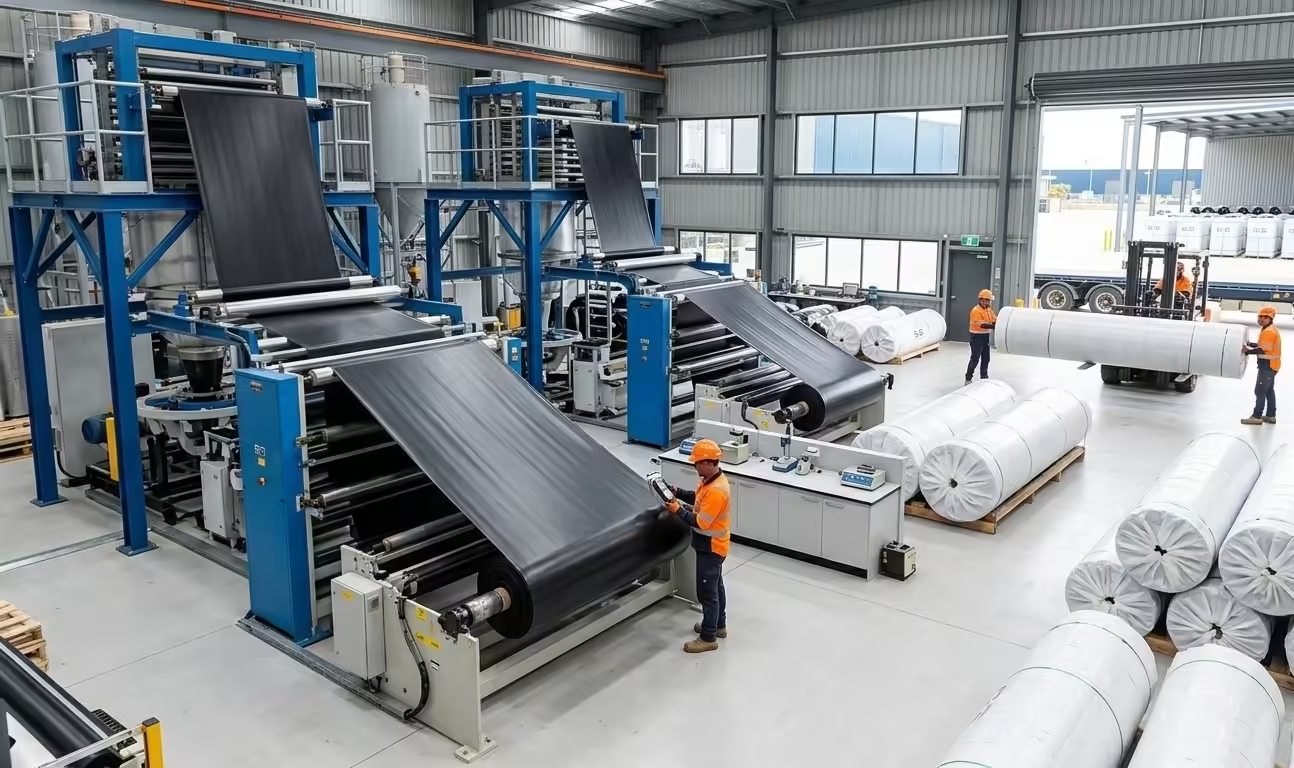
The first hurdle in finding a professional geomembrane manufacturer is verifying their actual production throughput. Many small-scale operations claim global reach but struggle to maintain consistency over large orders. For an international project requiring 500,000 square meters or more, you need to verify that the facility operates multiple high-width extrusion lines.
Ideally, look for a factory utilizing European or high-end domestic three-layer co-extrusion technology. This hardware ensures that the “carbon black” and UV stabilizers are distributed evenly through the membrane’s thickness, preventing premature oxidative degradation. If a factory’s machinery is outdated, the thickness deviation (measured via ASTM D5199) will vary wildly, creating weak points that lead to stress cracking during installation.
Why is GRI-GM13 so important?
In the geosynthetics industry, “quality” isn’t a subjective term—it’s a data-driven metric. Any top-tier geomembrane manufacturer must have an on-site laboratory that operates 24/7. It is not enough for a supplier to show you a generic test report; they must provide batch-specific Mill Test Reports (MTRs) that correlate directly to the rolls delivered to your site.
The global benchmark for HDPE liners is the GRI-GM13 standard, established by the Geosynthetic Institute (GSI). This specification dictates the minimum requirements for properties like Oxidative Induction Time (OIT), puncture resistance, and carbon black content. During your vetting process, ask for the OIT test results. This specific test measures the material’s resistance to thermal-oxidative degradation. If a supplier cannot produce consistent OIT data, they are likely using recycled resins or inferior stabilizers.
When you evaluate hdpe geomembrane liner manufacturers, check if their lab is GAI-LAP accredited. This accreditation ensures that the lab’s testing equipment and personnel meet the highest international precision standards, reducing the risk of “false positives” on quality checks.
How to conduct an audit of a Geomembrane Manufacturer
Physical or virtual inspections are the only way to peel back the marketing layers of a potential partner. Knowing how to audit a geomembrane factory for large international projects is a specialized skill that focuses on the supply chain as much as the product.
Start with the resin silos. A reliable geomembrane manufacturer should be using 100% virgin resin from recognized global suppliers like Chevron Phillips, Dow, or Sabic. If you see bags of “regrind” or unidentified pellets near the extrusion intake, the mechanical properties of the finished liner will be compromised. Ask to see the resin purchase receipts; a legitimate factory will have no problem proving they use premium raw materials.
Secondly, observe the quality control station at the end of the production line. Technicians should be taking samples from every second or third roll to test for tensile strength (ASTM D6693) and tear resistance (ASTM D1004). If the rolls are being wrapped and moved to the warehouse without immediate testing, their QC process is purely ornamental.
Bulk Purchase Logistics
The technical quality of the liner is irrelevant if it arrives at the job site damaged. This is where bulk purchase logistics becomes a critical differentiator. International shipping is brutal; rolls are subjected to extreme heat in tropical ports, high humidity, and the mechanical stress of multiple crane transfers.
A professional geomembrane manufacturer understands that the core of the roll is its backbone. For large projects, rolls should be wound on heavy-duty steel or reinforced plastic cores to prevent “telescoping” or collapsing under the weight of stacked units. Furthermore, UV-protected outer wrapping is essential. While the HDPE itself is UV-stable, the edges of the rolls can suffer if exposed to direct sunlight for months in a port or a desert staging area.
Discuss the loading plan early. Proper bulk purchase logistics involves maximizing the weight capacity of each shipment while ensuring that the rolls are secured with specialized slings. This prevents the “nicking” of the membrane edges, which could otherwise lead to seam failures during the welding process on-site.
What Separates Elite HDPE Geomembrane Liner Manufacturers from Trade Firms?
The internet is flooded with “suppliers” who are actually small trading companies with no production assets. For large-scale projects, you must deal directly with the source. Elite hdpe geomembrane liner manufacturers offer more than just a product; they provide technical submittal packages that include chemical compatibility charts, installation guides, and long-term warranty documentation.
When you interact with a direct geomembrane manufacturer, you gain access to their technical engineers. If your project involves a unique chemical environment—such as high-acidity mining leach pads—a direct manufacturer can adjust the resin formulation or stabilizer package to meet those specific needs. A middleman cannot provide this level of engineering support.
Furthermore, direct manufacturers are more likely to have ISO 14001 environmental management certifications. In 2026, many international tenders require proof of sustainable manufacturing practices, making this an essential box to tick during your procurement audit.
Summary
Selecting a geomembrane manufacturer for an international project is a high-stakes decision that requires a balance of technical verification and logistical foresight. By focusing on GRI-GM13 compliance, auditing the raw material supply chain, and insisting on professional bulk purchase logistics, you eliminate the variables that lead to project failure.
Remember, the goal is to find a partner who understands that their product is the last line of defense between a project’s success and an environmental disaster. When you find a geomembrane manufacturer that welcomes your audit and provides transparent data, you have found the foundation for a successful long-term partnership.
The quality you accept during the procurement phase is the quality you will have to live with for the next 30 years. Choose a geomembrane manufacturer that values precision as much as you do.
FAQ
How long does it take for a geomembrane manufacturer to produce 100,000 square meters?
A high-capacity factory can typically produce this volume in 3 to 5 days, depending on the thickness. However, you must factor in the testing time (usually 48 hours for OIT tests) and logistics scheduling.
What is the most common failure found during a factory audit?
The most frequent issue is “thickness variation.” Many factories try to save on resin by running the liner slightly thinner than the specified gauge. Always check the automatic thickness gauges on the production line.
Is there a difference in quality between blown film and flat die extrusion?
Both can meet GRI-GM13. Blown film is generally better for large-scale smooth liners due to its balanced molecular orientation, while flat die is often used for structured or textured liners. A versatile geomembrane manufacturer will usually offer both.
Why is virgin resin so important for hdpe geomembrane liner manufacturers?
Recycled resin contains impurities that drastically reduce the material’s “stress crack resistance” (ASTM D5397). In a pressurized or loaded environment, liners made with recycled content will crack prematurely.