
Hydraulic Conductivity: Why Bad Flow Calculations Cause Water Accumulation
Hydraulic Conductivity is not just a number on a drainage product sheet. In high-permeability projects, it helps decide whether water can move through a drainage layer fast enough to prevent ponding, pressure build-up, and long-term drainage failure. This guide explains what the parameter means, how it affects water flow rate, why poor flow calculation causes water accumulation, and what buyers should check before selecting geosynthetic drainage materials.
Table of Contents
What Does Hydraulic Conductivity Mean in Drainage Design?
In drainage design, Hydraulic Conductivity describes how easily water can move through soil, a porous medium, or a drainage material under a hydraulic gradient.
The point is not only “does the material have voids?” The real question is whether those voids can carry enough water under project conditions.
The USGS unsaturated-zone water flow chapter explains Darcy’s law as a foundation for water flow through soil columns. In simple terms, flow depends on the material’s ability to transmit water and the driving hydraulic gradient.
For drainage material selection, Hydraulic Conductivity helps engineers estimate whether the drainage layer can keep up with inflow from rainfall, groundwater, leakage, or surface runoff.
That matters in projects such as:
- landfill drainage
- retaining wall drainage
- green roof drainage
- road subgrade drainage
- slope drainage
- tunnel drainage
- sports field drainage
- erosion control systems
If the value is misunderstood, the drainage design may look acceptable on paper but fail during heavy water load.
Hydraulic Conductivity vs Permeability: Are They the Same?
Hydraulic Conductivity and permeability are related, but they are not exactly the same.
Permeability usually describes how easily a material allows fluid to pass through it. Britannica’s page on permeability in geology explains that permeability is connected with the transport of fluids through a material.
In engineering drainage work, the value is more practical because it reflects water movement under specific flow conditions. It depends on material structure, pore space, water properties, and hydraulic gradient.
A simple way to separate them:
| Term | Practical Meaning | Why It Matters |
|---|---|---|
| Permeability | Material’s ability to transmit fluid | Describes the medium itself |
| Drainage conductivity | Water movement through the medium under gradient | Helps estimate drainage performance |
| Flow rate | Actual volume moving through the system | Determines whether water accumulates |
| Drainage capacity | System ability to remove water | Depends on material and design |
The mistake buyers make is treating these terms as interchangeable. A material can look “permeable,” but if the actual drainage capacity is lower than the incoming water, accumulation still happens.
How Does Hydraulic Conductivity Affect Water Flow Rate?
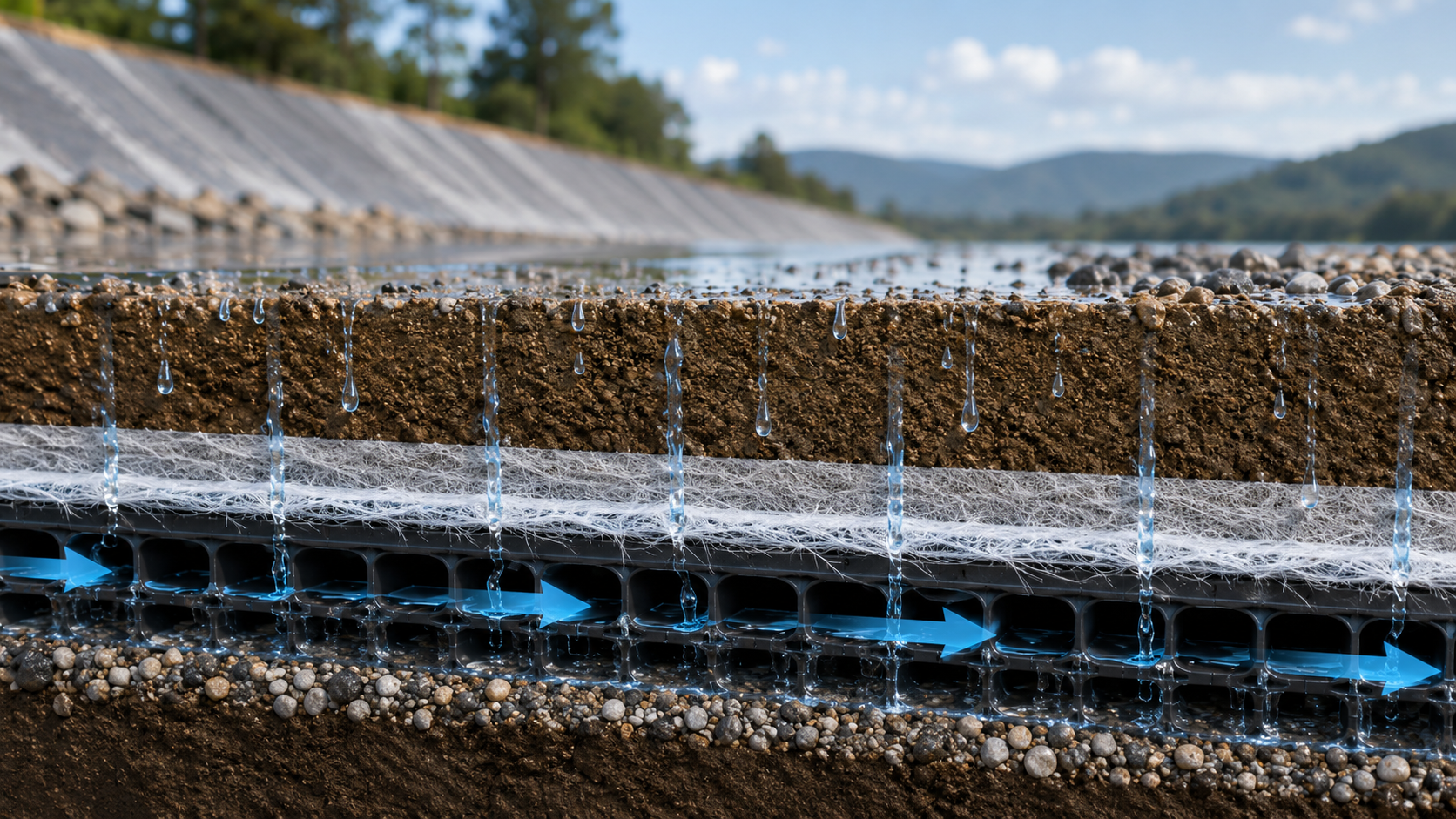
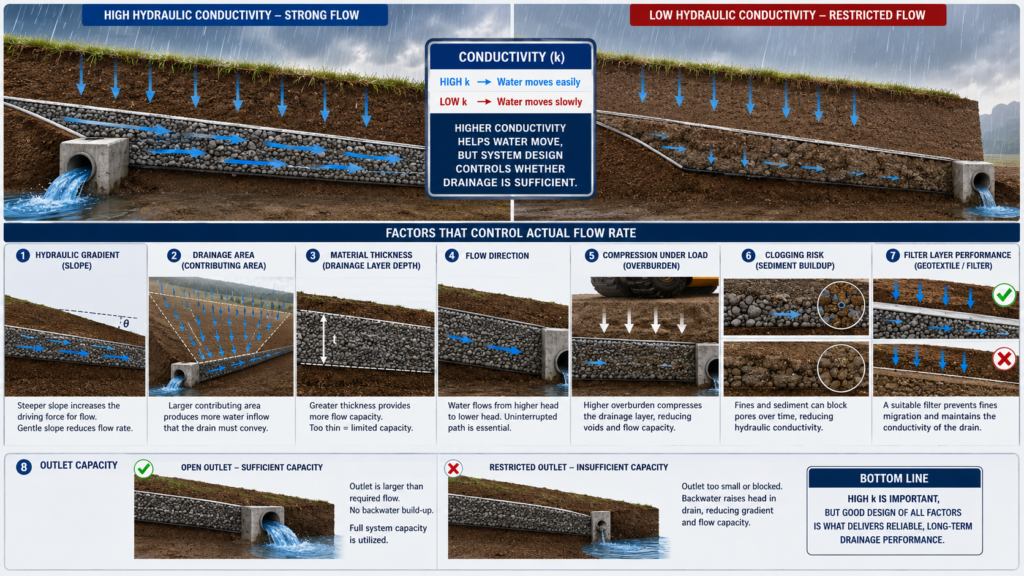
Hydraulic Conductivity affects water flow rate because it helps determine how easily water can pass through the drainage layer.
Higher values usually mean easier water movement. But actual water flow rate also depends on:
1.hydraulic gradient
2.drainage area
3.material thickness
4.flow direction
5.compression under load
6.clogging risk
7.filter layer performance
8.outlet capacity
Britannica’s article on hydrologic sciences notes that water flow through soil depends on the gradient of hydraulic potential and the physical properties of the medium. That is why a product value alone is not enough.
Think of it this way: Hydraulic Conductivity tells you how easily water can move, but system design decides whether that movement is enough.
A high value cannot overcome a blocked outlet, a flat slope, a crushed drainage layer, or a clogged filter.
Why Do High-Permeability Projects Still Have Water Accumulation?
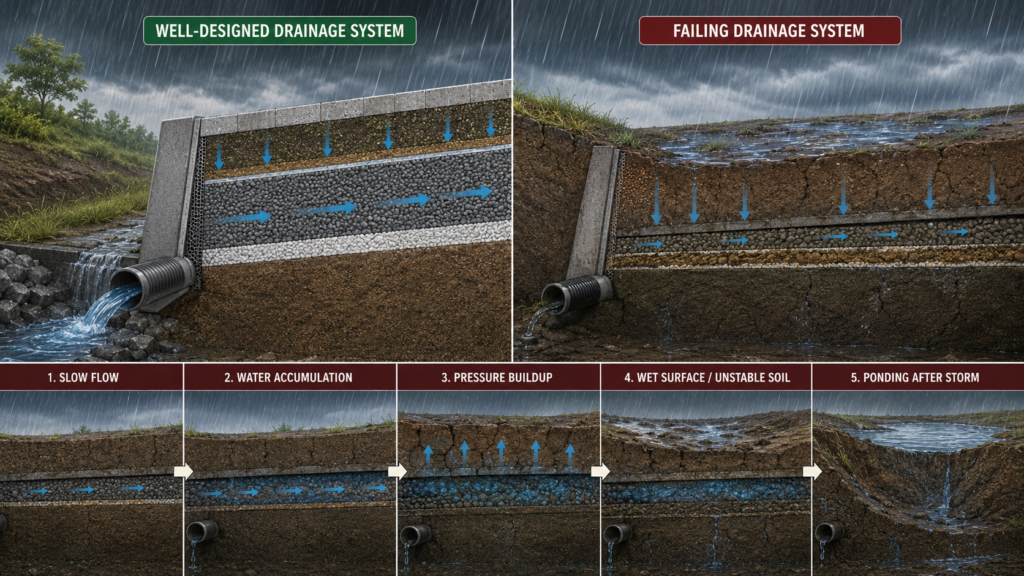
High-permeability projects can still fail when inflow is higher than actual drainage capacity. This is the core reason poor flow calculation causes water accumulation.
Common causes include:
- the design water load is underestimated
- peak rainfall is not considered
- the drainage layer is too thin
- the hydraulic gradient is too low
- product data is read without test conditions
- the material compresses under soil or structural load
- sediment clogs the filter layer
- the outlet cannot discharge fast enough
- installation direction does not match flow direction
EPA’s page on green infrastructure and flood mitigation explains that stormwater management becomes more important as heavy precipitation events become more intense. In practical drainage projects, that means peak inflow should not be ignored.
Water accumulation usually starts quietly. First, water drains more slowly than expected. Then the drainage layer begins to hold water. After that, pressure builds up, the surface stays wet, soil becomes unstable, or the project shows ponding after storms.
How Should Buyers Read Hydraulic Conductivity in Product Parameters?
When buyers review this value in product parameters, they should not stop at the number.
The value should be checked together with the unit, test condition, material thickness, flow direction, compression condition, and intended application. For geosynthetic drainage products, buyers should also compare flow capacity, drainage structure, filter compatibility, and long-term clogging risk.
If you are reviewing drainage material data, use these hydraulic conductivity product parameters as a reference point for how performance values may be presented.
Buyers should ask:
| Parameter Check | Why It Matters |
|---|---|
| Unit | Prevents calculation mistakes |
| Test method | Shows how the value was measured |
| Flow direction | Vertical and horizontal flow can differ |
| Thickness | Affects drainage space |
| Compression condition | Real projects load the material |
| Gradient | Flow changes with slope or head difference |
| Filter layer | Poor filtration can reduce long-term flow |
| Outlet design | Water must have a path to leave |
The main point is simple: Hydraulic Conductivity does not work in a lab chart. It works inside a system.
What Drainage Projects Need Higher Flow Capacity?
Projects with fast inflow, large catchment area, high groundwater, or limited storage space usually need higher drainage performance.
This parameter becomes especially important in:
- green roofs exposed to stormwater peaks
- landfill covers and drainage layers
- retaining walls with groundwater pressure
- road bases where trapped water weakens support
- slope drainage systems
- tunnels and underground structures
- sports fields that must drain quickly
- erosion control projects exposed to rainfall runoff
EPA’s page on the economic benefits of green infrastructure notes that green infrastructure can reduce surface flow, pooling, and seepage in localized flooding areas. That idea connects directly to drainage material selection: water must move away before it becomes a damage source.
For high-permeability drainage projects, Hydraulic Conductivity should be compared with expected inflow, actual drainage capacity, and outlet conditions.
When Is High Drainage Performance Not Enough?
High drainage performance helps, but it does not guarantee a dry system.
A drainage layer can still fail when the system around it is poorly designed. For example, a high-performance geosynthetic drainage material may still cause water accumulation if the outlet is blocked or the filter fabric clogs.
High performance is not enough when:
1.the drainage outlet is undersized
2.the slope is too low
3.the material is compressed too much
4.the filter layer allows fine particles to clog the core
5.installation overlaps block flow paths
6.water load exceeds design assumptions
7.long-term maintenance is ignored
This is why engineers should treat drainage as a system, even when Hydraulic Conductivity looks strong. The product value is important, but so are surrounding soil, filter layer, slope, outlet, installation quality, and safety factor.
How Do You Avoid Flow Calculation Mistakes?
To avoid water accumulation, the calculation should begin with the real water load.
A practical workflow is:
1.Estimate peak inflow from rainfall, groundwater, or leakage.
2.Confirm the flow direction through the drainage material.
3.Check Hydraulic Conductivity and flow capacity under relevant conditions.
4.Apply the correct hydraulic gradient.
5.Consider compression under project load.
6.Add a safety factor for clogging and aging.
7.Confirm that the outlet can discharge water fast enough.
8.Match filter layers with soil particle size.
9.Review installation details before construction.
The Wikipedia article on Darcy’s law gives the classic relationship between flow through a porous medium, hydraulic gradient, and material conductivity. The engineering lesson is practical: flow is not a guess. It needs inputs that match the field condition.
What Should Buyers Check Before Choosing Drainage Materials?
Before selecting drainage materials, buyers should connect the lab value with real project risk.
Use this checklist:
- What is the expected water load?
- What is the required water flow rate?
- Is the project flow vertical, horizontal, or both?
- What hydraulic gradient is available?
- Will soil or structure compress the drainage layer?
- Is clogging likely over time?
- Is a filter layer required?
- Is the outlet large enough?
- Does the product data match the installation condition?
- Is a safety factor included?
This checklist is especially useful when buyers compare geosynthetic drainage material, drainage mats, geocomposite drainage layers, or erosion control products.
The EPA Soak Up the Rain page includes video resources showing how stormwater can be managed where it falls. For technical buyers, those visuals can help connect runoff, drainage path, and water accumulation risk.
Conclusion
Hydraulic Conductivity matters because it connects drainage material performance with real water movement. In high-permeability projects, water accumulation often happens when the flow calculation is too optimistic, the drainage layer is undersized, or the system does not match field conditions. Buyers should review water flow rate, drainage capacity, test conditions, compression, clogging risk, filter design, and outlet capacity before choosing a material. A strong drainage design does not rely on one number alone; it matches Hydraulic Conductivity with the real flow demand of the project.
FAQ
What is Hydraulic Conductivity?
It describes how easily water can move through a soil, porous medium, or drainage material under a hydraulic gradient.
Why is it important in drainage design?
It helps engineers estimate whether a drainage layer can move water fast enough to prevent accumulation, pressure build-up, or drainage failure.
Is it the same as permeability?
No. Permeability describes how easily a material transmits fluid. This parameter is more specific to water movement under flow conditions.
How does it affect water accumulation?
If the drainage layer cannot move water as fast as water enters the system, water can accumulate even when the material looks permeable.
What should buyers check in product parameters?
Buyers should check the value, unit, test method, flow direction, material thickness, compression condition, clogging risk, and outlet design.
Is a high value always better?
Not always. A high value helps, but drainage performance also depends on filter design, slope, compression resistance, outlet capacity, and installation quality.