
UHMW vs HDPE: Which Material is Best for Your Application?
Welcome to My Blog!
Before we dive into the content, if you’re interested in our products or have any questions, please feel free to visit our Contact Us page on the website. Our team is ready to assist you with inquiries, orders, or any support you may need.
Now, let’s get started on our journey together. I hope you find the content here insightful, engaging, and valuable.
Table of Contents
Introduction
Choosing between UHMW vs HDPE is a common challenge in engineering, manufacturing, construction, and industrial design. Both materials come from the polyethylene family, but their performance differences can significantly impact durability, cost, and long-term efficiency. Understanding the properties of each material helps you select the right one for your application—whether you’re designing machinery components or building heavy-duty outdoor structures.
This guide breaks down the differences between UHMW vs HDPE, including performance, durability, cost, and practical use cases, supported by real technical data and industry-tested insights.
Understanding UHMW Vs HDPE
What Is HDPE?
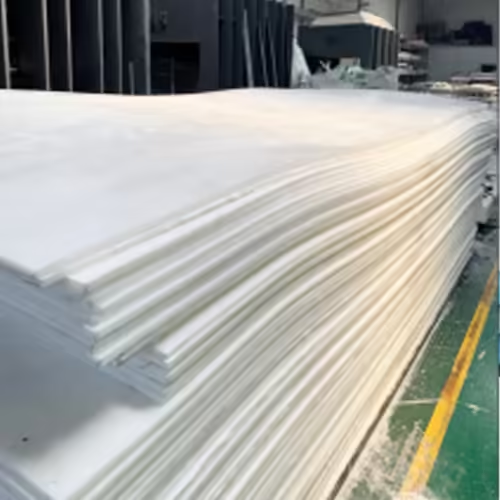
HDPE (High-Density Polyethylene) is a widely used thermoplastic known for its good strength-to-weight ratio, excellent chemical resistance, and cost-effectiveness. According to common polymer reference data, HDPE has a density range of 0.93–0.97 g/cm³ and is often used in containers, liners, cutting boards, and structural components.
What Is UHMW?
UHMW (Ultra-High-Molecular-Weight Polyethylene) is a premium engineering plastic with a molecular weight in the range of 3 to 6 million g/mol—significantly higher than standard HDPE. This gives UHMW exceptional abrasion resistance, very low friction, and impressive impact strength. It’s often used in high-wear environments like conveyor systems, liners, marine fenders, and industrial machinery.
Key Material Comparison Table
| Property | HDPE | UHMW |
|---|---|---|
| Molecular Weight | 200k–500k | 3M–6M |
| Density | 0.93–0.97 g/cm³ | 0.93–0.94 g/cm³ |
| Impact Strength | Moderate | Very High |
| Abrasion Resistance | Good | Excellent |
| Friction Coefficient | Low | Very Low |
| Chemical Resistance | Excellent | Excellent |
| Working Temperature | -50°C to 80°C | -150°C to 90°C |
| Cost | Low | Higher |
This table demonstrates why UHMW is typically chosen for high-wear mechanical environments, while HDPE remains a cost-efficient option for general-purpose applications.
Performance Differences
Impact Resistance
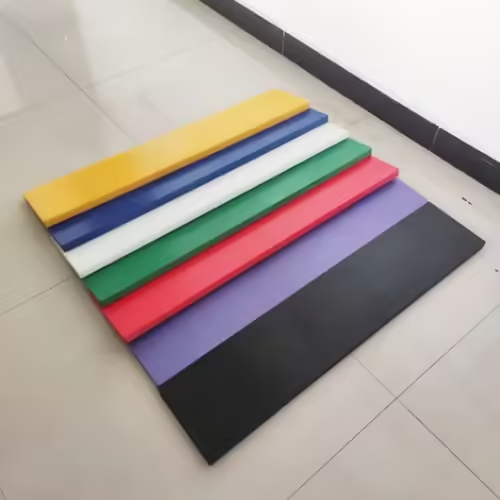
UHMW offers exceptional impact resistance due to its ultra-long polymer chains. It is almost impossible to break under normal use, making it ideal for high-impact liners, bumpers, and mechanical wear pads. HDPE performs well in everyday structural applications but cannot match the shock-absorbing capabilities of UHMW.
Abrasion Resistance
One of the biggest differences in the uhmw vs hdpe comparison is wear resistance. UHMW can withstand constant sliding, scraping, and friction without losing thickness. It’s widely used in industries that handle aggregates, minerals, or high-abrasion materials. HDPE still offers good abrasion resistance, but it wears faster under continuous mechanical stress.
Surface Friction
UHMW has an extremely low coefficient of friction—almost comparable to PTFE—making it ideal for sliding components. HDPE is smooth but not as slippery, so it is used more often in static structures or everyday plastic products.
Chemical and Moisture Resistance
Both materials resist acids, alkalis, solvents, and moisture. They do not absorb water, swell, or rust, making them suitable for outdoor environments, marine applications, and chemical processing.
Temperature and Weather Performance
UHMW remains ductile even at extremely low temperatures, which makes it suitable for cold-climate applications like freezer conveyors or outdoor mechanical components. HDPE performs well in standard temperature ranges but becomes less impact-resistant in freezing conditions.
Cost and Manufacturing Considerations
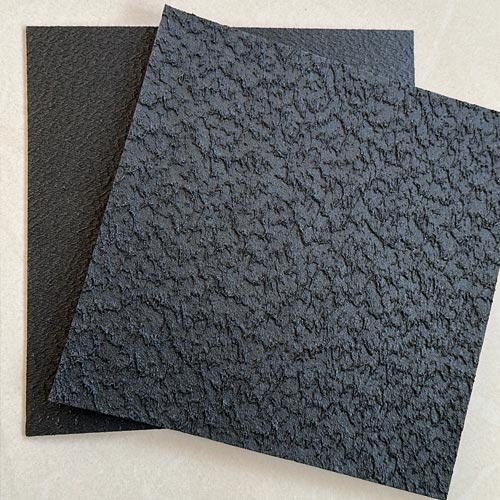
In most industries, material cost plays an important role in selection. HDPE is significantly more affordable and easier to process through extrusion, molding, or sheet forming. UHMW requires specific machining techniques because of its toughness, making it more expensive.
If your application requires heavy friction, sliding contact, or long-term abrasion resistance, UHMW’s higher price is justified. If your project demands structural integrity without heavy wear, HDPE can achieve excellent results at a lower cost.
Applications of UHMW Vs HDPE
Common HDPE Applications
HDPE is preferred where cost efficiency, chemical resistance, and strength are required without extreme wear conditions.
Examples include:
- Ground protection mats
- Water and chemical storage tanks
- Agricultural components
- Plastic lumber and construction panels
- Cutting boards and food processing surfaces
- Pipe systems and liners
Its versatility makes HDPE suitable for general industrial and commercial use.
Common UHMW Applications
UHMW is the better choice for heavy mechanical demands, especially where sliding, impact, or abrasive materials are involved.
Typical uses include:
- Conveyor wear strips
- Hopper and chute liners
- Marine fender pads
- High-impact machine components
- Snowplow cutting edges
- Wear-resistant pads for industrial vehicles
Its performance advantages shine in high-stress operational environments where HDPE cannot provide adequate longevity.
Environmental Durability: Which Lasts Longer?
UV Resistance
HDPE has better UV stability than UHMW and can be enhanced with stabilizers for outdoor exposure. UHMW requires additives to prevent degradation in extended sunlight.
Chemical Resistance
Both materials hold strong against chemicals, although UHMW performs slightly better in high-abrasion chemical environments where mechanical stress is also present.
Temperature Tolerance
UHMW remains flexible and impact-resistant at very low temperatures, while HDPE becomes stiffer.
Abrasion and Wear
This is where UHMW clearly outperforms. It handles continuous friction and sliding superiorly, retaining thickness and structural integrity far longer.
How to Choose Between UHMW Vs HDPE
When comparing uhmw vs hdpe, the decision usually depends on four main factors:
- Required wear resistance
- Expected mechanical load
- Environmental conditions
- Budget and project scale
If you need maximum longevity under friction, UHMW is the best choice. If you need economical strength and chemical resistance, HDPE is often sufficient.
FAQ
Is UHMW stronger than HDPE?
Yes. UHMW offers much higher impact and abrasion resistance, making it stronger in demanding applications.
Can HDPE replace UHMW?
Only in environments where friction and wear are minimal. Otherwise, UHMW is the better choice.
Why is UHMW more expensive than HDPE?
UHMW has a significantly higher molecular weight and requires specialized manufacturing, increasing production cost.
Is UHMW safe for food contact?
Yes. Both UHMW vs HDPE are commonly used in food processing and meet typical food-grade material standards.
Which material is more suitable for outdoor exposure?
HDPE performs better outdoors unless UHMW is specially UV-stabilized.