
Woven vs Non woven Geotextile: Reinforcement or Filtration?
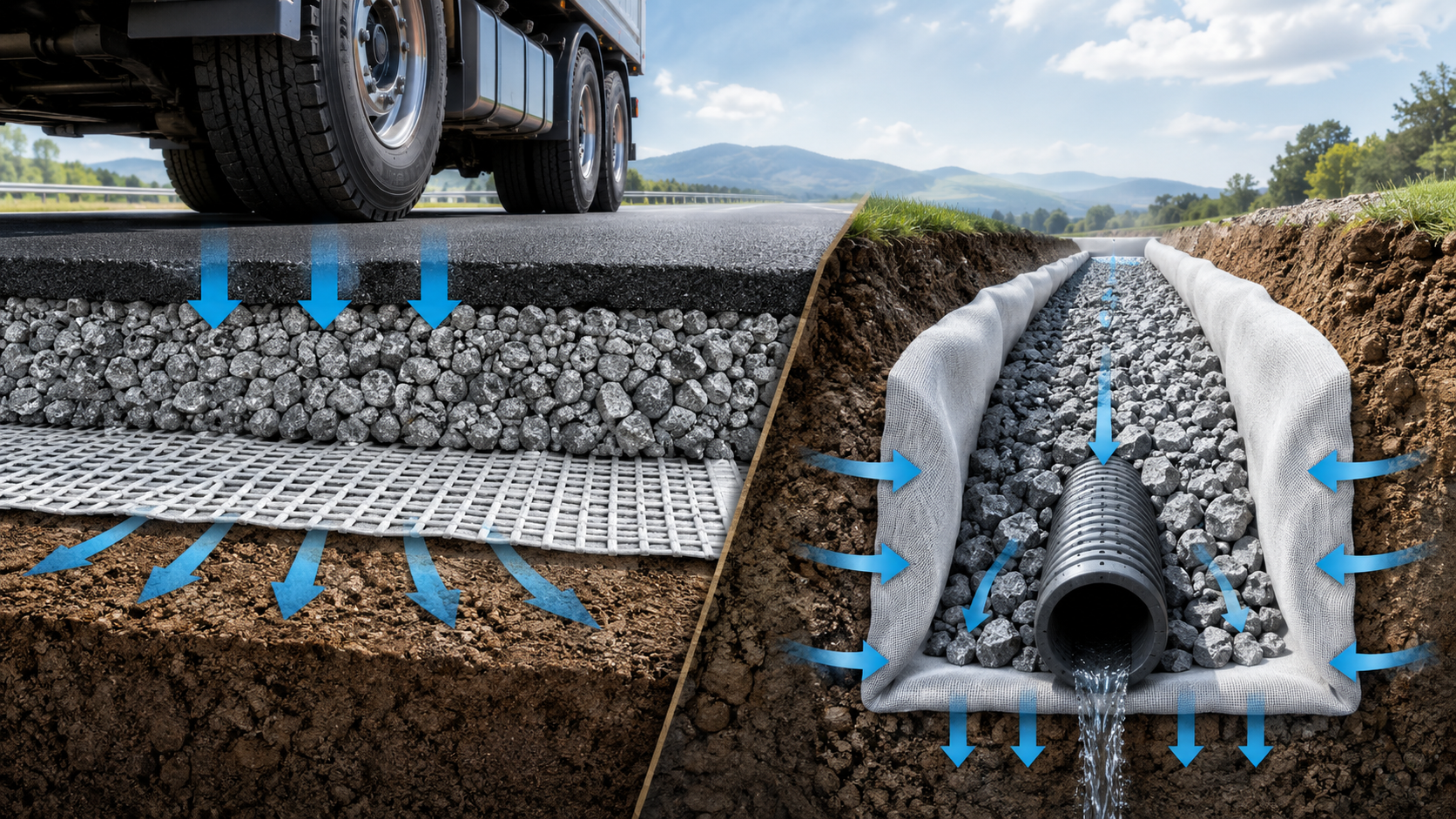
Woven vs Non woven is not just a fabric comparison. In real civil engineering projects, it is usually a function decision: does the site need reinforcement and separation, or does it need filtration, drainage, and protection?
Many buyers make the mistake of choosing by price, GSM, or what is “commonly used.” That can lead to poor drainage, weak road stabilization, soil migration, clogged filters, or wasted material. This guide explains Woven vs Non woven geotextile selection by project function, soil condition, load, water flow, and long-term performance.
Table of Contents
Why Woven vs Non woven Is Really a Function Decision
The main question is not which material is “better.” The better question is what the geotextile must do in the ground.
The International Geosynthetics Society training material on Geosynthetic Types and Functions explains that geotextiles are used for separation, filtration, drainage, reinforcement, and erosion control applications. That is the right starting point for Woven vs Non woven selection.
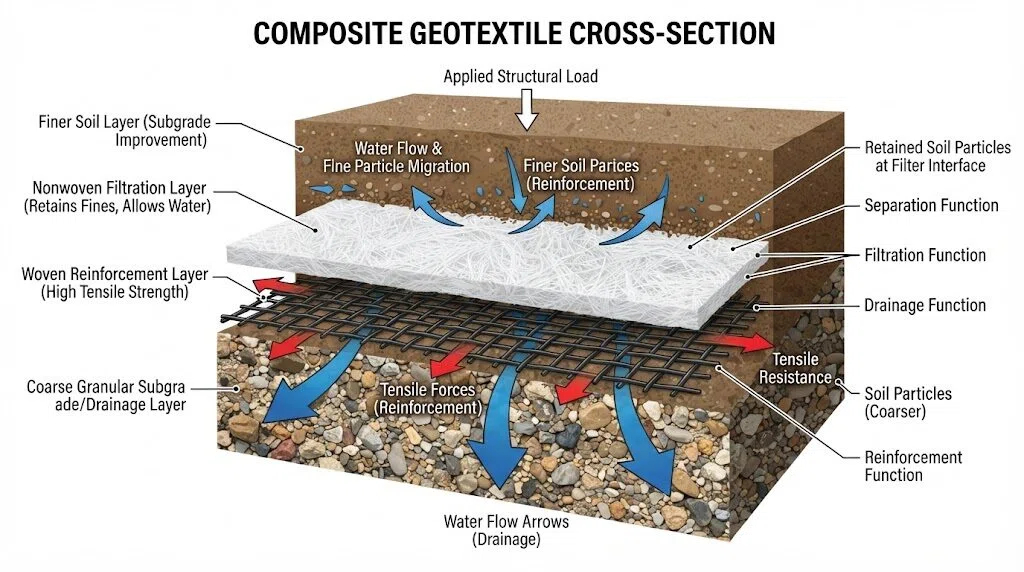
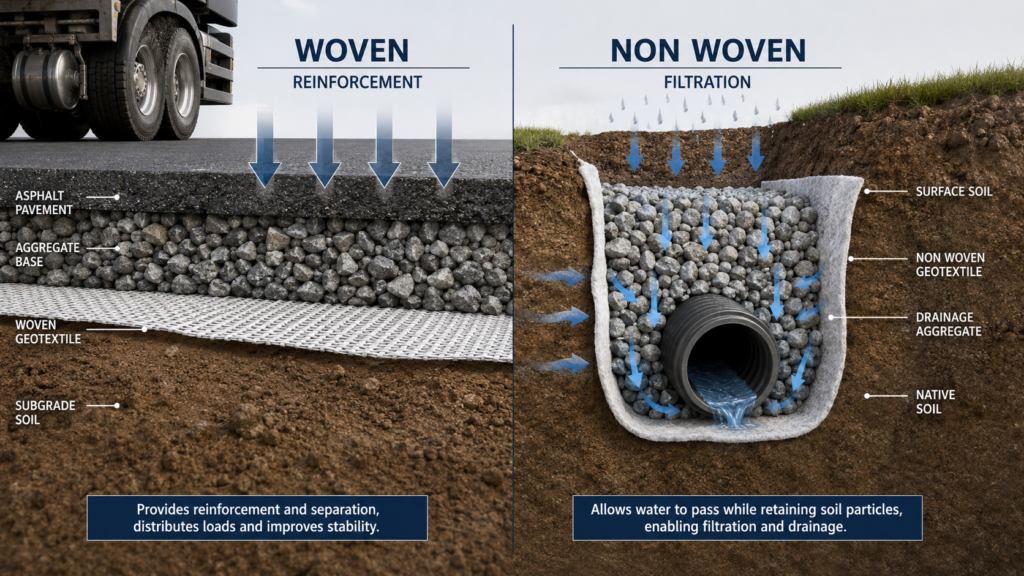
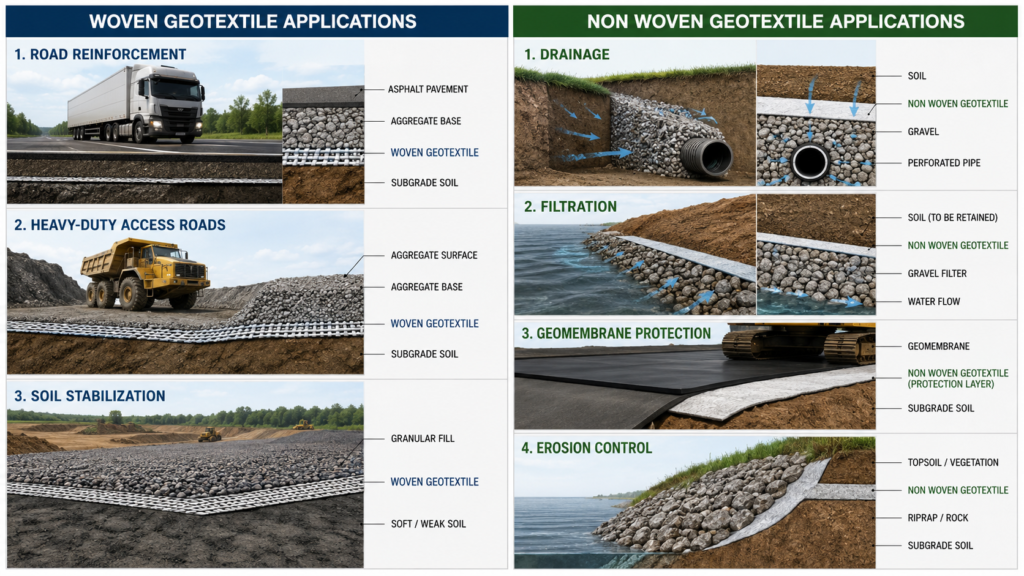
A woven geotextile is usually selected when tensile strength, load distribution, and separation are important. A non woven geotextile is usually selected when water flow, soil retention, cushioning, and protection matter more.
So Woven vs Non woven should be judged by engineering function, not by appearance alone.
What Is Woven Geotextile Used For?
Woven geotextile is made by interlacing yarns, tapes, or filaments into a stable fabric structure. This structure usually provides higher tensile strength and lower elongation than many non woven fabrics.
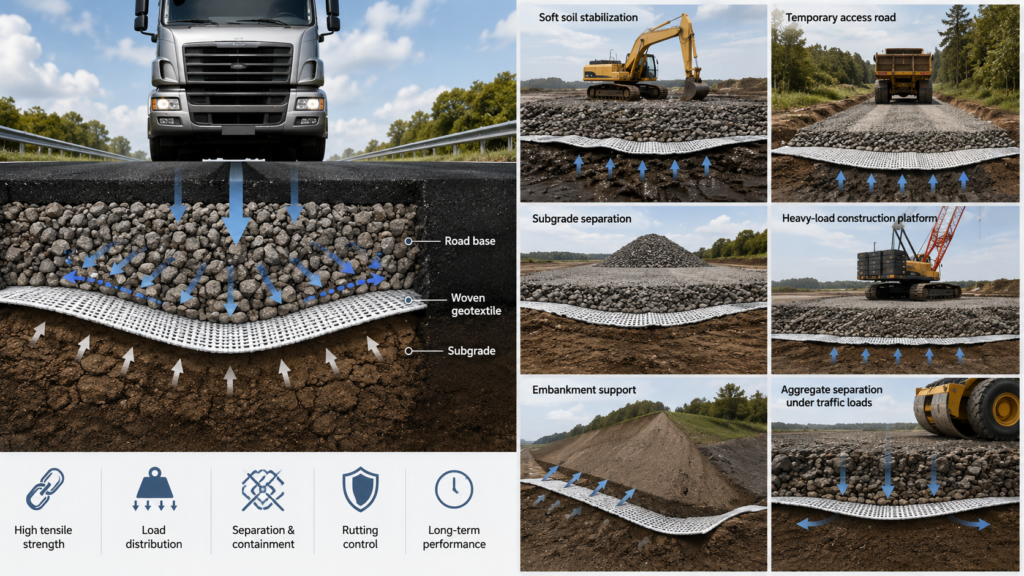
That is why woven geotextile is commonly used for:
- road base reinforcement;
- soft soil stabilization;
- temporary access roads;
- subgrade separation;
- heavy-load construction platforms;
- embankment support;
- aggregate separation under traffic loads.
For road construction and soil stabilization projects where reinforcement and separation are the main goals, a woven geotextile can be considered when the design requires tensile support and load distribution.
In Woven vs Non woven selection, woven fabric is often the stronger option when rutting, settlement, and base instability are the major concerns.
What Is Non woven Geotextile Used For?
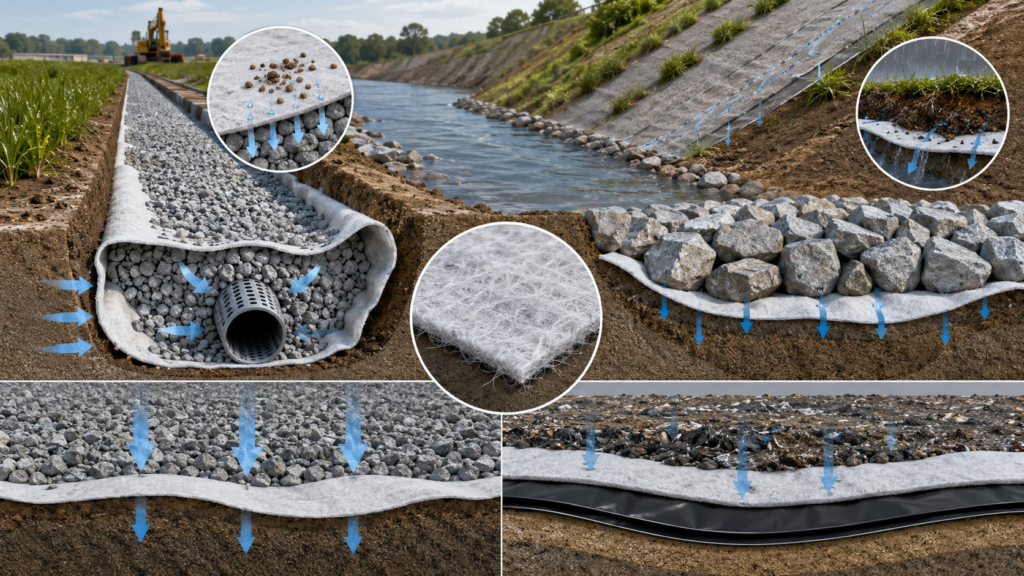
Non woven geotextile is made from fibers bonded together through needle punching, thermal bonding, or similar processes. A staple fiber needle-punched non woven geotextile has a more random fiber network, which helps create pathways for water movement while retaining soil particles.
Non woven geotextile is commonly used for:
- drainage trenches;
- French drains;
- erosion control;
- riprap underlayers;
- geomembrane protection
- landfill or pond liner cushioning;
- filtration around aggregate;
- slope and bank protection.
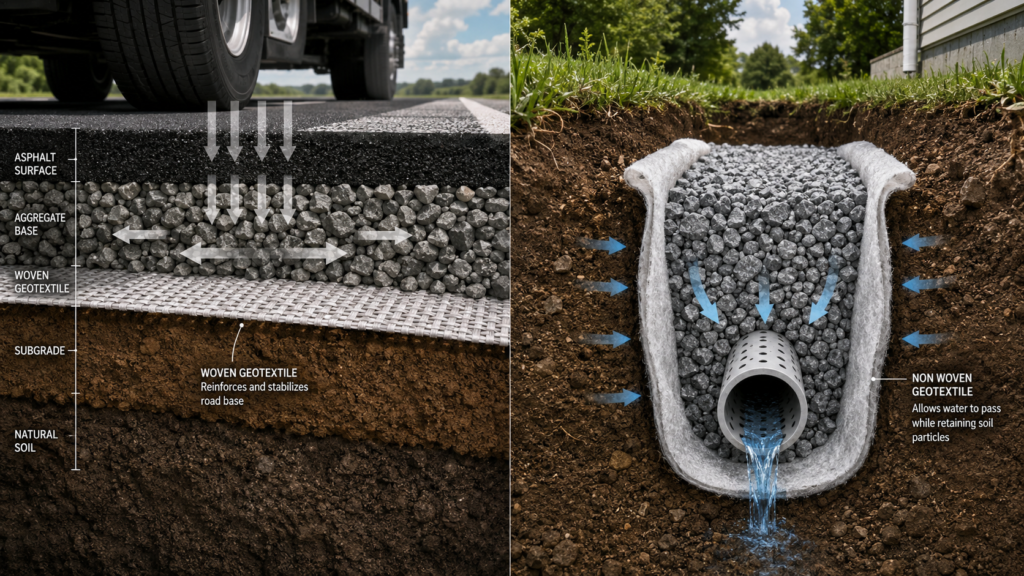
For drainage, filtration, and protection layers, a staple fiber geotextile can help retain soil particles while allowing water to pass through.
Geosynthetics Magazine notes in its article on woven and nonwoven geotextile differences that wovens generally have higher strength values, while nonwovens generally have higher flow rates and permittivity. That distinction explains why Woven vs Non woven is often reinforcement versus filtration in practice.
Reinforcement vs Filtration: The Difference Buyers Often Miss
Reinforcement and filtration are not the same job.
Reinforcement is about tensile strength, soil restraint, and load distribution. A geotextile in this role helps stabilize weak soil and reduce deformation under traffic or structural loading.
Filtration is about allowing water to pass while retaining soil particles. A good filter must balance permeability and soil retention. If the opening is too large, soil may migrate. If it is too tight, clogging or poor drainage may occur.
ASTM’s D4751 standard explains that apparent opening size indicates the approximate largest opening available for soil to pass through, and that geotextile compatibility with adjacent soil is important when the fabric is used to retain soil particles.
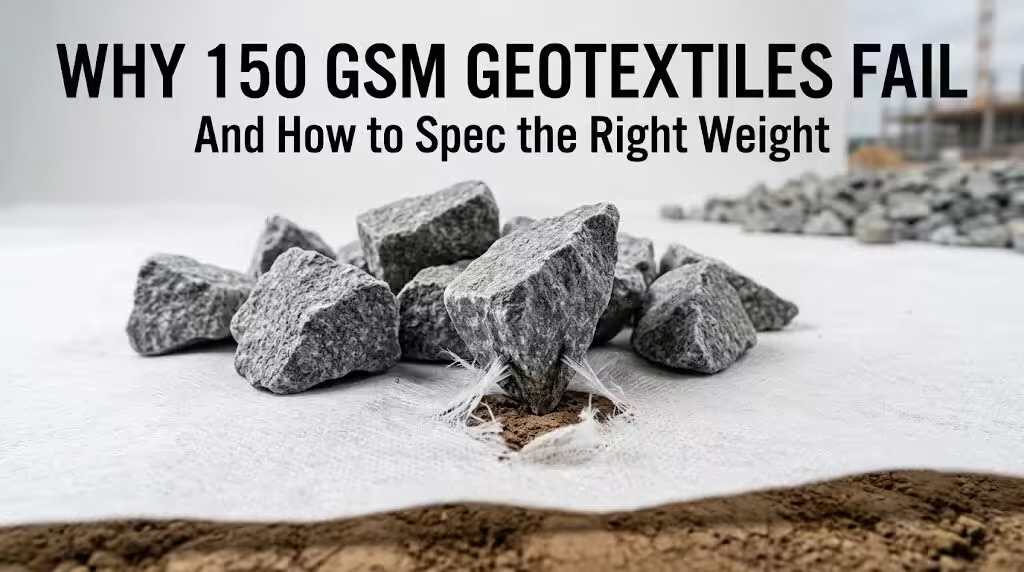
That is why Woven vs Non woven decisions should not be made only by GSM. A heavier fabric is not automatically better if the key property is filtration opening size, permeability, tensile strength, or puncture resistance.
When to Use Woven or Non woven Geotextile
Use woven geotextile when the project needs:
- reinforcement under load;
- subgrade stabilization;
- road base separation;
- low elongation;
- high tensile strength;
- rutting control;
- improved aggregate support.
Use non woven geotextile when the project needs:
- filtration;
- drainage;
- soil retention;
- geomembrane protection;
- cushioning;
- erosion control;
- water flow around aggregate.
The U.S. Forest Service document on Use of Geosynthetics lists reinforcement, separation, drainage, and filtration as basic geosynthetic functions in road applications. This supports a practical Woven vs Non woven rule: choose the fabric by function first, then compare specifications.
Woven vs Non woven Geotextile Comparison Table
| Factor | Woven Geotextile | Non woven Geotextile |
|---|---|---|
| Main function | Reinforcement / separation | Filtration / drainage / protection |
| Structure | Interlaced yarns or tapes | Random fiber network |
| Tensile strength | Usually higher | Usually moderate |
| Elongation | Lower | Higher |
| Water flow | Lower than non woven | Better drainage performance |
| Filtration | Limited depending on opening size | Stronger for soil retention |
| Cushioning | Moderate | Better |
| Typical use | Road base, subgrade, access roads | Drainage, erosion control, liner protection |
In short, Woven vs Non woven is a choice between structural support and hydraulic performance. Some projects require both, but one function is usually more important than the other.
Project Scenarios: Which Type Fits Better?
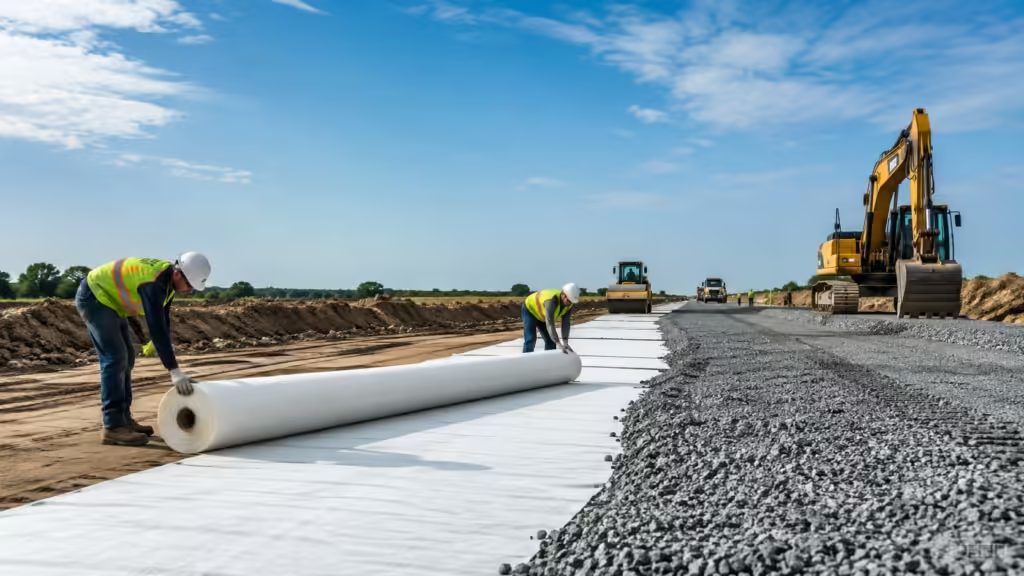
For road construction, woven geotextile is often preferred when the purpose is reinforcement, subgrade separation, and load distribution. It helps stabilize aggregate over weak soil and can reduce rutting in access roads or working platforms.
For drainage trenches and French drains, non woven geotextile is usually the better choice because water flow and soil retention matter most. The fabric wraps gravel or drainage media and helps stop fine soil from migrating into the drainage layer.
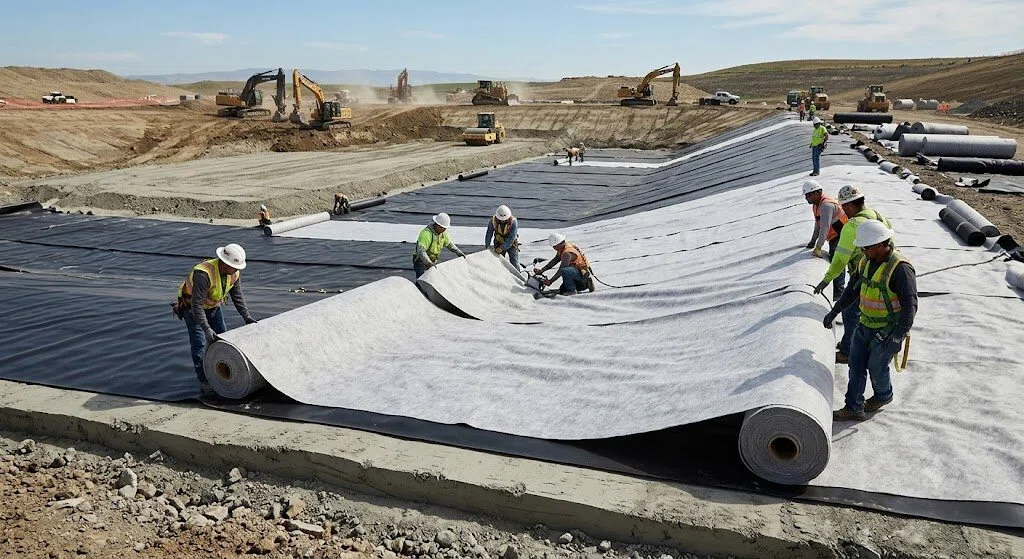
For geomembrane protection, non woven geotextile is commonly used as a cushioning layer. It helps protect liners from puncture, abrasion, and installation damage.
For erosion control under riprap, non woven geotextile is often useful because it allows water movement while helping retain soil beneath the armor layer.
For aggregate separation under lighter loads, either woven or non woven may work depending on water flow and load requirements. This is where Woven vs Non woven should be checked against site conditions, not guessed.
Common Mistakes When Choosing Geotextile
The most common mistake is choosing by price only. A cheaper fabric may cost more later if the road base fails or the drainage layer clogs.
Another mistake is choosing by GSM alone. GSM tells weight, not full performance. ASTM’s D4595 test method covers tensile strength and elongation of geotextiles using the wide-width strip method, showing why strength-related properties need their own testing, not just fabric weight.
Other mistakes include:
- using filtration fabric where reinforcement is needed;
- using reinforcement fabric where drainage is the main goal;
- ignoring soil particle size;
- ignoring water flow direction;
- ignoring installation damage;
- buying without a technical data sheet;
- failing to match the fabric to project specifications.
A professional Woven vs Non woven comparison should always include function, soil, water, load, and installation conditions.
How to Choose the Right Geotextile for Your Project
Use this checklist before ordering:
1.Define the main function: reinforcement, separation, filtration, drainage, or protection.
2.Check soil type and particle size.
3.Confirm traffic load or structural load.
4.Identify water flow direction.
5.Review tensile strength and elongation.
6.Review apparent opening size.
7.Check permeability or permittivity.
8.Consider puncture resistance.
9.Review installation damage risk.
10.sk for a technical data sheet and project recommendation.
A helpful way to remember Woven vs Non woven is simple: if the project mainly needs strength, start with woven. If the project mainly needs water flow and soil retention, start with non woven.
Conclusion
Woven vs Non woven is not a question of which fabric is generally better. It is a question of whether your project needs reinforcement or filtration.
Use woven geotextile when the site needs strength, separation, road base support, and load distribution. Use non woven geotextile when the site needs filtration, drainage, cushioning, erosion control, or geomembrane protection.
Before choosing, check the real site function, soil condition, water flow, load requirement, and project specification. When Woven vs Non woven is evaluated this way, the right geotextile becomes much easier to select.
FAQ
Is woven or non woven geotextile better?
Neither is always better. Woven geotextile is usually better for reinforcement and separation. Non woven geotextile is usually better for filtration, drainage, and protection.
Which geotextile is better for drainage?
Non woven geotextile is usually better for drainage because its fiber structure allows better water flow while helping retain soil particles.
Is woven geotextile good for road construction?
Yes. Woven geotextile is often used for road base reinforcement, subgrade stabilization, access roads, and soil separation under aggregate.
Can non woven geotextile be used under gravel?
Yes. Non woven geotextile is commonly used under gravel when the project needs filtration, drainage, and soil separation.
Should I choose geotextile by GSM?
No. GSM is only fabric weight. Also check tensile strength, elongation, apparent opening size, permeability, puncture resistance, and project function.
Can woven geotextile be used for filtration?
Some woven geotextiles can provide limited filtration depending on opening size, but if filtration and drainage are the main goals, non woven geotextile is usually more suitable.