
Geomembrane Welding Guide: Field Seaming, Factory Seams & QA

In the containment industry, the sheet of HDPE or LLDPE material is only as strong as its weakest point: the seam. Achieving a high-quality geomembrane welding result requires a combination of specialized machinery, controlled environmental conditions, and rigorous testing protocols. Whether you are working on a small decorative pond or a massive industrial tailings facility, the seaming process determines the project’s long-term success.
Table of Contents
Factory Seams vs. Field Seaming: Why It Matters
When designing a liner system, engineers must decide between maximizing factory-welded panels or relying on on-site assembly. Factory seams are created in controlled environments where temperature, humidity, and dust are strictly managed. This leads to extremely consistent results and allows for larger panels to be shipped to the site.
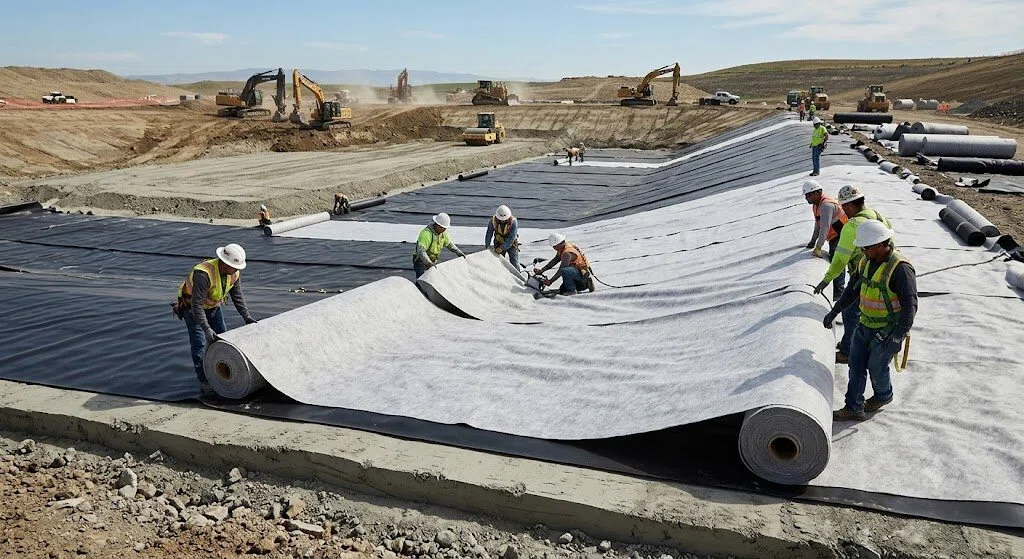
However, field seaming geomembrane is an unavoidable reality for large-scale projects. On-site welding requires technicians to battle wind, fluctuating ambient temperatures, and subgrade moisture. While factory seams are preferred for speed and precision, the skill involved in field seaming geomembrane determines whether the final containment cell will pass a leak location survey.
Primary Geomembrane Welding Techniques
There is no “one-size-fits-all” approach to joining synthetic liners. Different scenarios require different geomembrane welding techniques to ensure a molecular bond between the sheets.
Hot Wedge Welding (Dual Track)
This is the primary method used for long, straight runs of liner. A heated wedge passes between two overlapped sheets, melting the surfaces, which are then pressed together by rollers. The “dual track” creates an air channel between two parallel welds, which is critical for non-destructive pressure testing.
Extrusion Welding
This technique is utilized for repairs, detail work (like pipe boots), and T-joints where a wedge welder cannot reach. In extrusion welding, a bead of molten polymer (the same resin as the liner) is extruded onto the edge of the overlap. The heat from the extrudate and the pre-heated liner surface creates the bond. While slower than wedge welding, it is the “gold standard” for complex geometries.
Comparison: Hot Wedge vs. Extrusion Welding
| Feature | Hot Wedge Welding | Extrusion Welding |
| Primary Use | Long production seams | Repairs, patches, and pipe penetrations |
| Speed | High (up to 15-20 ft/min) | Low (manual pace) |
| Testing Method | Air Pressure (Dual Track) | Vacuum Box / Spark Test |
| Weld Geometry | Continuous flat seam | Overlapping bead |
| Ease of Use | Automated / Machine-driven | Manual / Operator-dependent |
Addressing Common Defects in Geomembrane Seams
Even with the best equipment, errors occur. Recognizing common defects in geomembrane seams early can prevent environmental disasters and costly re-lining projects.
- Fishmouths: These are ripples or wrinkles at the end of a seam caused by uneven tension during the welding process. If not cut and patched via extrusion welding, they create a direct leak path.
- Overheating (Burn-through): If the welder moves too slowly or the temperature is too high, the polymer structure can degrade, leading to a brittle seam that fails under stress.
- Contamination: Dust, moisture, or organic matter trapped in the seam is the leading cause of “cold welds,” where the sheets appear joined but separate easily under load.
- Inadequate Overlap: Most standards, such as those from the Geosynthetic Institute (GSI), require a minimum 4 to 6-inch overlap to ensure sufficient contact area for the welding equipment.

QA/QC: Essential Tests for Geomembrane Welding
Quality Assurance (QA) and Quality Control (QC) are the pillars of liner installation. You cannot manage what you do not measure. Therefore, implementing standardized QA tests for geomembrane welding is a contractual requirement on most civil engineering projects.
Non-Destructive Testing
These tests check 100% of the seam without damaging the material.
1.Air Pressure Test: Used for dual-track wedge welds. The air channel is pressurized, and the pressure must hold for a set duration (usually 5 minutes).
2.Vacuum Box Testing: Used for extrusion welds. A soapy solution is applied to the seam, and a transparent vacuum box creates a pressure differential. Bubbles indicate a leak.
Destructive Testing
This involves removing a physical sample of the seam and testing it to failure in a tensiometer.
- Peel Test: Checks the bond between the two sheets. The weld should stay intact while the parent material tears (Film Tear Bond – FTB).
- Shear Test: Measures the force required to pull the seam apart laterally.
According to the ASTM D6392 standard, these tests ensure the geomembrane welding strength meets or exceeds the calculated requirements for the specific project depth and load.
Environmental Factors and Field Preparation
Success in geomembrane welding starts before the machine is even turned on. The subgrade must be smooth and free of sharp rocks or “pumping” (soft spots).
Technicians must also perform “trial welds” (also known as “coupon samples”) at the start of each shift and after any significant change in weather. This ensures the geomembrane welding parameters (speed and temperature) are adjusted for the current ambient conditions. If the temperature drops significantly, the wedge heat must be increased to compensate for the “heat sink” effect of the cold HDPE sheet.
The Specialized Role of Extrusion Welding in Repairs
While wedge welding handles 95% of the footage, extrusion welding handles the 5% that matters most—the corners and penetrations. When a defect is found during a vacuum box test, the technician must grind the surface to remove the oxidation layer before applying a new bead. This step is critical; skipping the grinding process is one of the most frequent causes of common defects in geomembrane seams.
Compliance and Global Standards
Adhering to international standards ensures that your geomembrane welding practices are defensible in a court of law and effective in the field. The International Association of Geosynthetic Installers (IAGI) provides certification for technicians, which is often a prerequisite for high-stakes projects like hazardous waste landfills.
In these environments, the QA tests for geomembrane welding are meticulously logged, including the GPS coordinates of every destructive sample and the machine ID of every wedge welder used. This level of traceability is the hallmark of professional field seaming geomembrane operations.
Managing Thermal Expansion and Contraction
Geomembranes, particularly HDPE, have high thermal expansion coefficients. A liner that is tight in the cool morning will expand and create “waves” in the afternoon sun. If geomembrane welding is performed when the material is at its maximum expansion, the seams will be under extreme tension when the temperature drops at night, leading to stress cracking. Experienced crews use “slack” and “finger-waving” techniques to ensure the geomembrane welding remains durable through seasonal cycles.
Conclusion
Mastering geomembrane welding is a career-long pursuit for installers and a critical oversight area for engineers. By understanding the differences in geomembrane welding techniques, identifying the root causes of common defects in geomembrane seams, and strictly enforcing QA tests for geomembrane welding, you protect both the environment and your project’s budget.
The goal is simple: a monolithic containment system that performs as a single, unified barrier. Achieving that goal requires precision in every inch of geomembrane welding performed on the site.
FAQ
Can you weld geomembranes in the rain?
No. Moisture is the enemy of a good weld. Surfaces must be bone-dry. Even slight humidity can cause steam pockets inside the seam, leading to failure.
What is the most common reason for a failed air pressure test?
Usually, it’s a poor seal at the ends of the air channel or “burn-through” where the wedge was too hot, creating a pinhole leak.
Why is grinding necessary before extrusion welding?
Polyethylene develops an oxidation layer within hours of exposure to the sun. You must grind this layer off to allow the molten extrudate to fuse at a molecular level with the sheet.
How often should I perform destructive QA tests for geomembrane welding?
Most project specifications require one destructive sample every 500 feet of seam length, though this can vary based on the criticality of the containment.